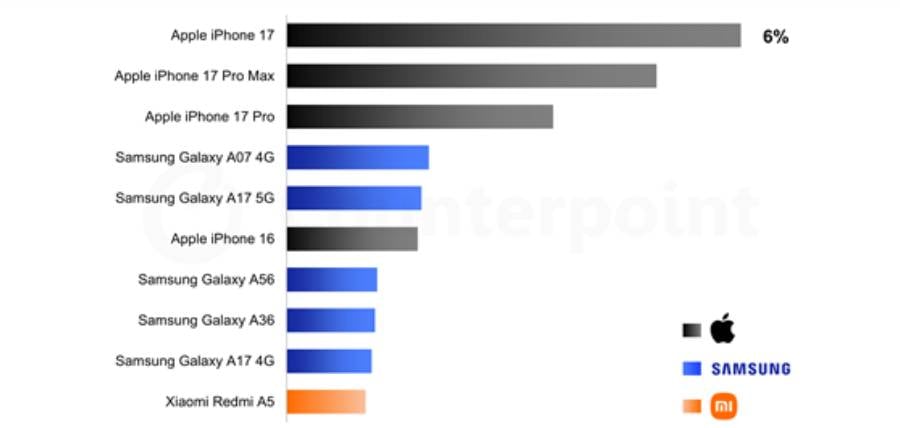

The global smartphone market in early 2026 showed a clear trend of concentration at the top end. According to research from Counterpoint Research, the iPhone 17 was the best-selling smartphone globally in Q1 2026, capturing 6% of all global smartphone sales. This marked a significant achievement for Apple, as the iPhone 17 Pro Max and iPhone 17 Pro followed closely behind, securing second and third places respectively. This meant that Apple completely dominated the top three spots on the list.
Senior analyst Harshit Rastogi highlighted that the iPhone 17 outperformed its predecessor by a considerable margin. The base model received several meaningful upgrades, including more storage capacity, a higher-resolution camera, and a faster screen refresh rate. These improvements helped narrow the gap between the standard and Pro models, which in turn encouraged more consumers to opt for the more affordable option.
Sales in key markets such as China and the United States saw double-digit growth year-over-year. South Korea experienced even stronger performance, with sales tripling compared to the previous generation of iPhones.
On the Android side, Samsung remained a dominant force, securing five positions in the top ten with devices from its Galaxy A budget lineup. The Galaxy A07 4G emerged as the top-selling Android phone of the quarter, driven by strong demand in regions such as the Middle East, Africa, and Latin America. Samsung has also made a commitment to provide six years of software updates on these devices, a move that could enhance their long-term appeal.
Despite this, the Galaxy S26 Ultra did not make it into the top ten. However, Samsung reported that it had a stronger launch than the S25 Ultra.
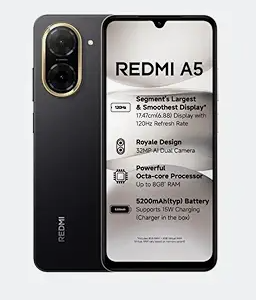
The only Chinese brand to feature in the top ten was Xiaomi, with the Redmi A5 securing the tenth position. It is also the most affordable device on the list and has maintained steady demand in emerging markets since its release.
Overall, the top ten phones accounted for 25% of all global smartphone sales, the highest share ever recorded for a first quarter. This can be attributed to two main factors: the continued strong demand for the iPhone 17 and a memory chip shortage that increased component costs. This situation put pressure on Android manufacturers, especially those competing at lower price points.
Counterpoint’s Karn Chauhan noted that the overall phone market is expected to shrink in 2026, with the budget segment facing the hardest impact. In response, many manufacturers are shifting their focus towards higher-end products rather than trying to boost volume sales.
For the latest updates and insights, consider joining our Telegram community or subscribing to our free daily newsletter. You can also explore our News Section for more daily updates.