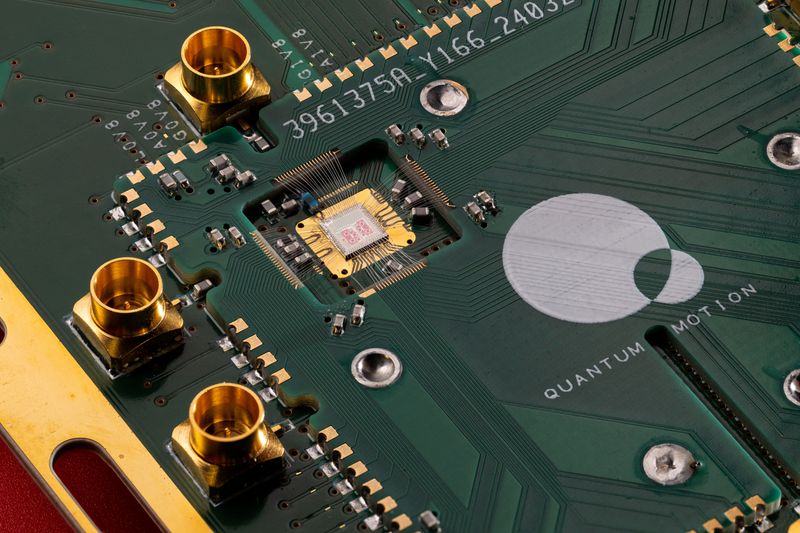
Quantum Motion Raises $160 Million to Revolutionize Quantum Computing
A UK-based startup named Quantum Motion has announced a significant funding round, securing $160 million to advance its mission of creating quantum computers that are more compact, cost-effective, and energy-efficient compared to traditional silicon-based methods.
Quantum computers are designed to tackle complex problems that conventional computers cannot solve. At the core of their power lies the qubit, a fundamental unit of quantum information. Unlike classical bits, which can only represent either a 0 or a 1, a qubit can exist in multiple states simultaneously. This unique property allows quantum computers to perform calculations at an unprecedented speed.
There are several approaches to creating qubits. For instance, companies like IBM and Alphabet’s Google use superconducting circuits, while others employ lasers to manipulate neutral atoms. However, scaling up these technologies to create functional quantum computers with thousands or millions of qubits remains a major challenge.
Quantum Motion has taken a different approach by leveraging existing technology. Instead of starting from scratch, the company is using transistors—common components found in phones and laptops—to develop qubits. This strategy aims to simplify the manufacturing process and reduce costs.
“We just kind of started the company in reverse,” said James Palles-Dimmock, CEO of Quantum Motion. “What are the minimum adaptations that we can make to transistors to turn them into high-quality qubits?”
In a traditional computer chip, a transistor operates as either on or off, allowing electrons to flow across a gap when it is activated. Quantum Motion modifies this design by suspending a single electron in the gap and manipulating it using a magnetic field. This method, known as “electron spin,” is not entirely new. Several other startups and even Intel have explored similar concepts.
However, Quantum Motion claims to have made significant progress in making this technology viable. The company is collaborating with manufacturing partner GlobalFoundries to produce chips that can support this approach. According to Palles-Dimmock, this innovation could enable the creation of practical quantum computers at a cost ranging from $10 million to $20 million.
“We’ve got a very clear path to delivering the world’s most powerful computer at a reasonable cost,” he stated.
The funding round was led by DCVC and Kembara, with additional support from the British Business Bank and Firgun. Existing investors such as Oxford Science Enterprises, Inkef, Bosch Ventures, Porsche Automobil Holding, and Parkwalk Advisors also participated in the round.
This development marks a significant step forward in the quest for affordable and scalable quantum computing solutions. With its innovative approach and strong financial backing, Quantum Motion is well-positioned to play a key role in shaping the future of quantum technology.