The Controversy Surrounding Mark Hamill’s Social Media Post
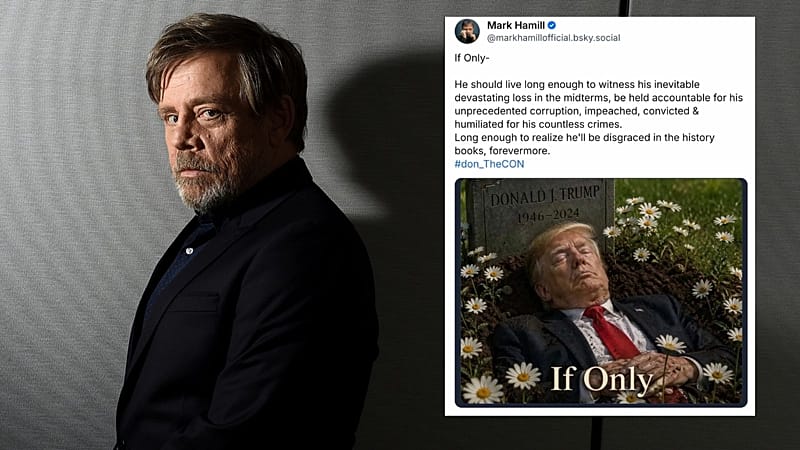
Mark Hamill, best known for his role as Luke Skywalker in the Star Wars franchise, recently found himself at the center of a public controversy after sharing an image on social media that depicted former US President Donald Trump in a grave. The post sparked a strong reaction from the Trump administration, which accused Hamill of inciting security threats.
The White House took to the platform X (formerly Twitter) to express its disapproval, calling Hamill “a sick individual” and accusing the actor of being part of a group of “Radical Left lunatics.” According to the administration, such rhetoric has led to three assassination attempts against the president within two years. The image shared by Hamill showed Trump in an open grave, with a headstone indicating his death date as 2024. The caption read “If Only,” suggesting a wish for Trump to live long enough to face consequences for his actions.
Hamill later deleted the image and issued a clarification, stating that he was not wishing for Trump’s death but rather for him to be held accountable for his alleged crimes. He added, “Actually, I was wishing him the opposite of dead, but apologize if you found the image inappropriate.”
A History of Controversial Imagery
This incident is not the first time Trump has been associated with controversial or provocative imagery. Earlier this year, a man was charged with attempting to assassinate Trump during a speech at the White House Correspondents’ Association dinner. This event highlighted the growing tensions surrounding political figures and their public image.
In the aftermath of the shooting, Melania Trump called for the firing of talk show host Jimmy Kimmel after he made a joke about her appearance. Kimmel defended his comment, stating it was a reference to the age difference between him and his wife. However, Melania’s remarks were met with backlash online, with many accusing her of hypocrisy, especially considering Trump’s own history of using violent rhetoric against his opponents.
AI Images and Cultural Missteps
Trump has also been involved in several instances where AI-generated images have drawn criticism. For example, he posted an AI-generated video showing himself bombing protestors and another image inspired by the war film Apocalypse Now. These posts sparked discussions about the ethical implications of using AI in political messaging.
In addition, Trump has used Star Wars references in his public appearances, often without fully understanding the cultural significance. During Star Wars Day (May 4), the White House shared an image of Trump dressed as the Mandalorian, holding an American flag with only 11 stripes instead of the correct 13. The image also showed Trump without his helmet, which is considered a violation of the Mandalorian code.
The caption for the post read, “In a galaxy that demands strength – America stands ready.” The post received negative reactions from Star Wars fans, with some calling it a “major disturbance in the force” and others joking about the possibility of legal action.
The Red Lightsaber Incident
This is not the first time the Trump administration has used Star Wars imagery in a way that drew criticism. Last year, the White House shared an image of a muscular Trump holding a red lightsaber. The caption included a reference to the “Radical Left Lunatics” and compared them to the Empire in the Star Wars universe.
However, the use of a red lightsaber was problematic, as it is traditionally associated with the villainous Sith Lords. Star Wars creator George Lucas once stated that “good guys are green and blue, bad guys are red.” This oversight was pointed out by critics on social media, who noted the irony of the administration using a symbol of evil to represent itself.
As one user on X commented: “The lack of self-awareness and hypocrisy by calling the left ‘the empire’ while showing Trump with a Sith lightsaber.”
Conclusion
The use of imagery and cultural references in political messaging continues to be a contentious issue. Whether through AI-generated content or Star Wars-inspired posts, the line between creative expression and political provocation remains blurred. As public figures navigate these challenges, the importance of cultural awareness and responsible communication becomes increasingly evident.