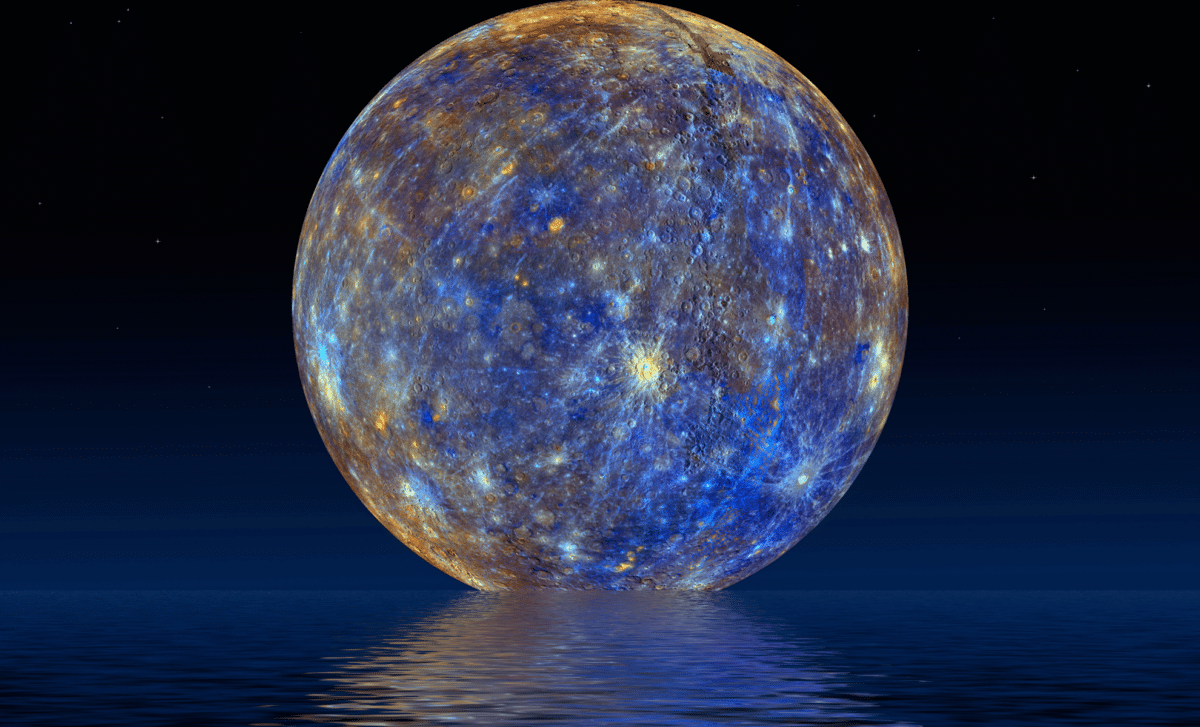
Mercury, the smallest and least explored planet in our solar system, has long been shrouded in mystery. Despite its scorched surface and barren landscape, new research suggests that beneath its unassuming exterior, Mercury might be hiding one of the solar system’s most unexpected treasures: a thick layer of diamonds.
The Mystery of Mercury’s Dark Surface
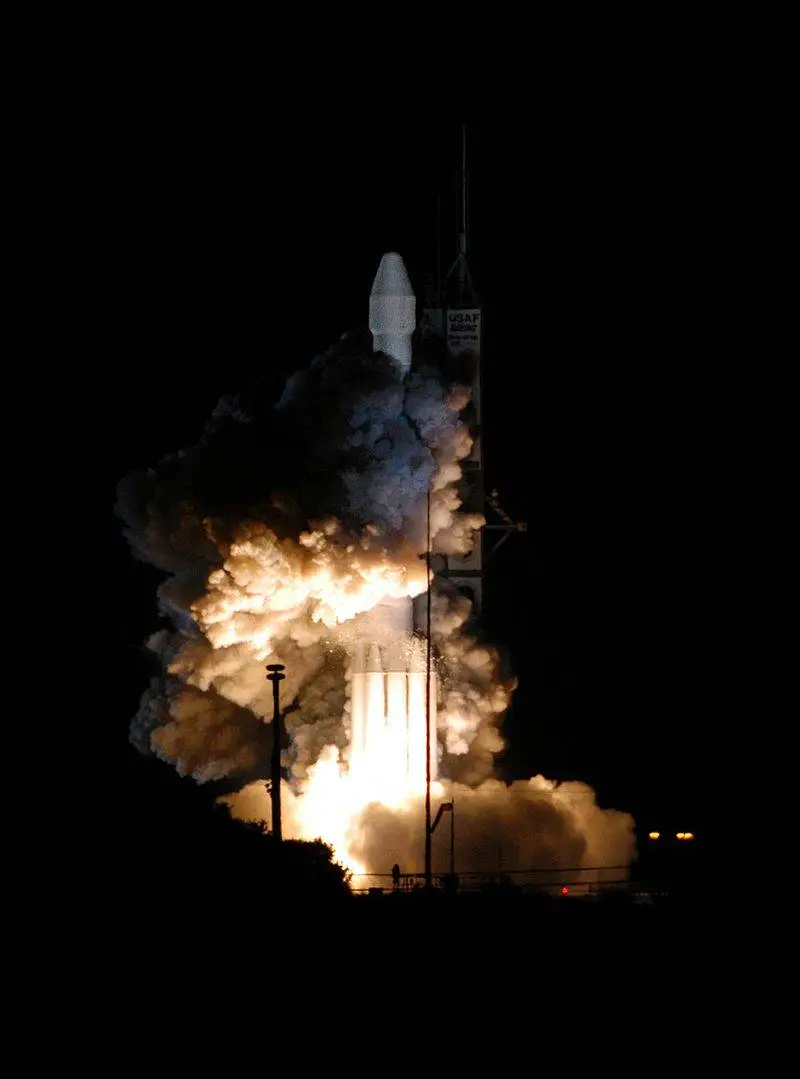
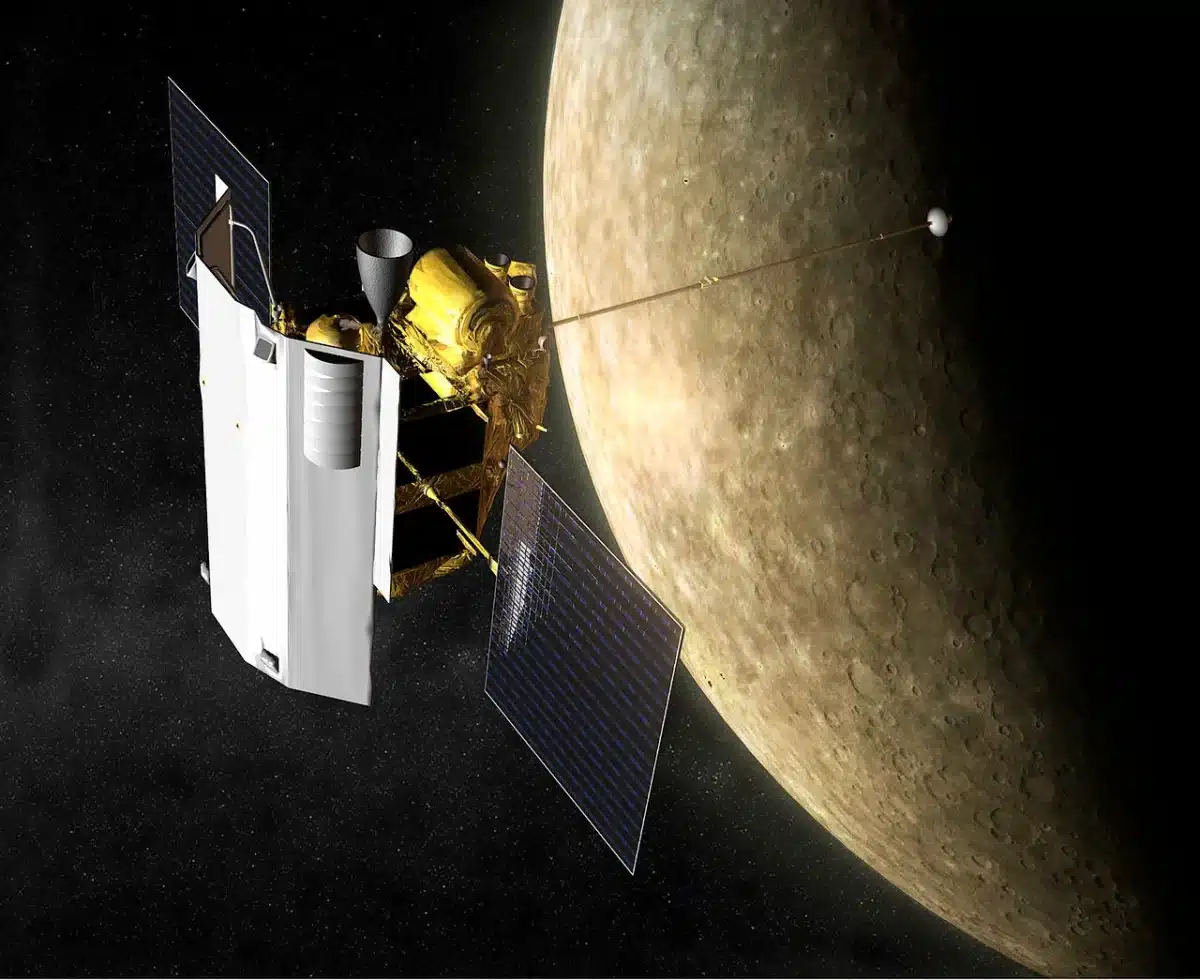
Mercury’s surface has long puzzled scientists. Its dark crust, once thought to be solely composed of graphite, has been linked to carbon-rich minerals deep within the planet. Spectral data from NASA’s MESSENGER mission suggested the presence of graphite, with carbon making up about 2 to 4 weight percent of Mercury’s crust. However, a more recent reanalysis indicated this percentage may be under 1 percent. This disparity raised the question of whether Mercury’s carbon came from external sources or if it formed deep within the planet itself.
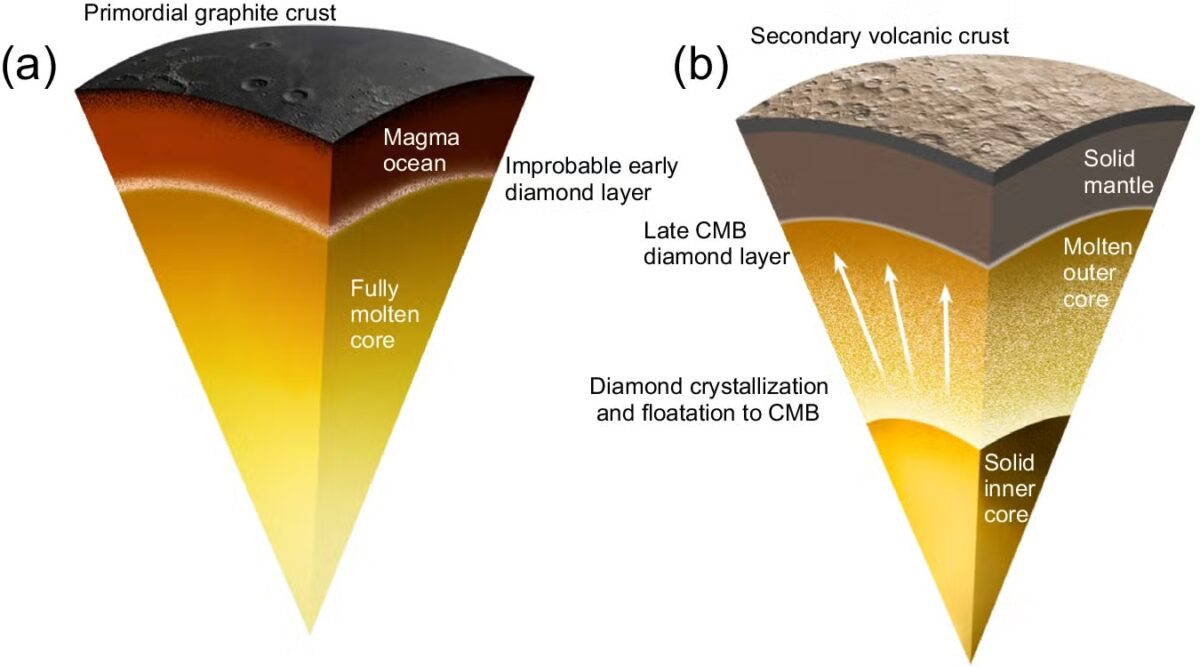
For years, scientists believed the planet’s low reflectivity and dark surface were the result of widespread graphite deposits. This theory suggested that Mercury’s early history involved a carbon-saturated magma ocean, with graphite rising to form the planet’s crust. However, new calculations of Mercury’s internal structure have led to an exciting and unexpected hypothesis: a diamond layer buried beneath the surface.
A Diamond Layer at the Core-Mantle Boundary
The breakthrough analysis of Mercury’s internal structure, based on gravity-based models and new data from the MESSENGER mission, shows that the pressure at the boundary between Mercury’s core and mantle is much higher than previously thought. This higher pressure is a game changer for carbon chemistry.
“We calculate that, given the new estimate of the pressure at the mantle-core boundary, and knowing that Mercury is a carbon-rich planet, the carbon-bearing mineral that would form at the interface between mantle and core is diamond and not graphite,” said Olivier Namur, an associate professor at KU Leuven and lead researcher on the study.
The new models show that the pressure at this boundary is sufficient to stabilize diamond rather than graphite. Namur and his team estimate that this layer could be between 9 and 11 miles thick, or approximately 14.9 to 18.3 kilometers. Though the exact thickness remains uncertain due to the complexity of internal models, the implications are profound: Mercury could be home to a diamond-rich zone, something no one had ever imagined for this small, sun-scorched planet.
The Role of Sulfur in Mercury’s Diamond Formation
To better understand this possibility, the researchers conducted high-pressure experiments that mimicked Mercury’s conditions. Using a large-volume press, they exposed Mercury-like materials to extreme pressures and temperatures to see how carbon would behave. These experiments confirmed that sulfur, an abundant element on Mercury, could lower the temperature at which the magma ocean begins to crystallize, nudging the conditions into the diamond stability field.
Namur explained,
“We believe that diamond could have been formed by two processes. First is the crystallization of the magma ocean, but this process likely contributed to forming only a very thin diamond layer at the core/mantle interface. Secondly, and most importantly, the crystallization of the metal core of Mercury.”
This second process, the crystallization of Mercury’s metal core, is central to the theory. As Mercury cooled over billions of years, its core began to solidify. The remaining liquid outer core, now enriched with carbon, could have led to the formation of diamonds, which would then float upwards towards the core-mantle boundary.
Implications for Mercury’s Magnetic Field
This discovery doesn’t only have implications for our understanding of Mercury’s internal structure. It also could impact the planet’s magnetic field. A diamond layer at the core-mantle boundary might influence how heat escapes from Mercury’s outer core. Unlike the insulating properties of an iron sulfide (FeS) layer, a diamond layer could allow heat transfer in ways that affect the planet’s magnetic field generation. This possibility opens up new avenues for studying the dynamics of Mercury’s magnetic field and how it may differ from Earth’s.
Mercury’s Unique Chemistry and Formation
Mercury’s chemistry sets it apart from Earth and its neighboring planets, Venus and Mars. Namur suggests that Mercury likely formed from a carbon-rich dust cloud much closer to the Sun, leaving it poorer in oxygen and richer in carbon compared to its rocky counterparts. This unique composition influenced how carbon moved throughout the planet during its early formation stages, including the magma ocean and core crystallization processes.
While Earth’s core may also contain carbon and could potentially produce diamonds, the extreme conditions of Mercury, combined with its sulfur-rich and silicon-rich core, make it a prime candidate for the formation of a deep diamond layer.
The Broader Implications: Diamonds in Space
The discovery of a potential diamond layer on Mercury adds to the growing body of evidence that extreme environments in space can lead to diamond formation. Planets like Neptune and Uranus are thought to have similar conditions in their interiors, where methane is converted into diamonds under immense pressure. On Jupiter and Saturn, lightning storms may create diamonds in their atmospheres. Even meteorites found on Earth have been shown to contain microscopic diamonds formed under high-pressure conditions.
The theory of diamonds on Mercury also invites speculation about other exoplanets. For example, 55 Cancri e, a rocky exoplanet, is thought to potentially have a diamond-rich interior due to its high carbon content and extreme pressure conditions. These discoveries further expand our understanding of the vast diversity of environments in the universe.
The Need for Future Exploration
Despite the compelling evidence supporting the idea of a diamond layer beneath Mercury’s surface, the theory is not yet proven. The researchers acknowledge that current interior models are not precise enough to confirm the existence of such a layer. Future missions and more detailed exploration of Mercury will be needed to test these hypotheses and provide further insight into the planet’s mysterious interior.
The researchers’ findings, published in Nature Communications, open up exciting new possibilities for planetary science. Understanding Mercury’s unique carbon-rich chemistry could lead to discoveries not only about this small planet but also about the formation of other rocky planets and their potential for hosting unusual materials like diamonds.