A Legacy of Leadership and Resilience
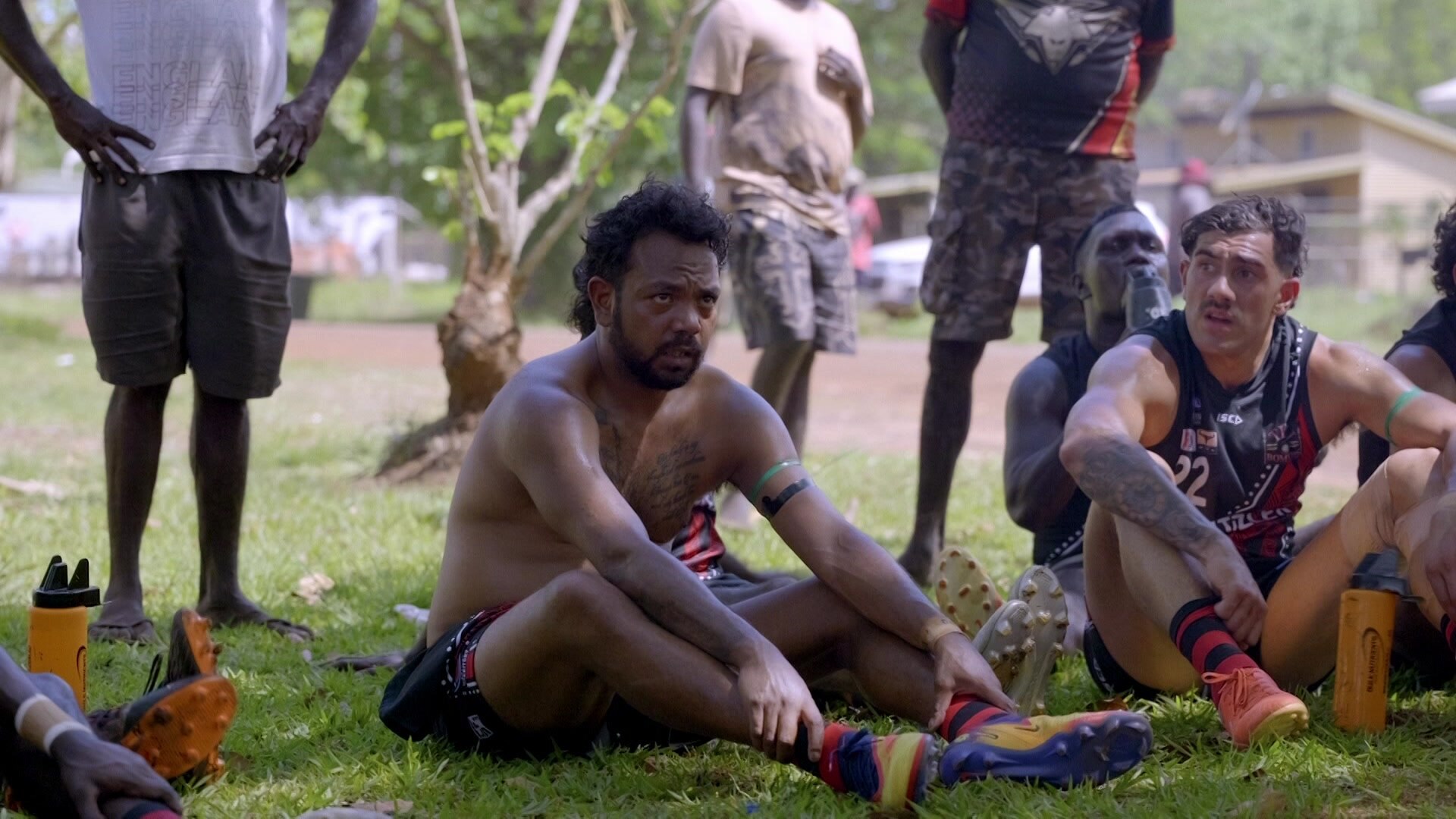
Willie Rioli Jr — a gemstone in the treasure chest of Australian football history, a prince of the Australian Football League’s most majestic family — is sitting under a billowing tree in Wurrumiyanga, sweating, exhausted, content.
It is half-time during his first football game on the Tiwi Islands since he was a boy. Teammates nibble icy poles. Coach Patrick Bowden paces and studies his whiteboard with brother Rhett. A white-haired spectator rests against the tree, almost fainting, astounded that anyone could actually play in this heat. At a rare home game, in a pre-monsoonal atmosphere, locals desire victory and rain.
Rioli Jr is shirtless, a small 2018 West Coast Eagles premiership tattoo on his ribs, thinking of his late father, Willie Sr, who died in 2022 at age 50. Up here, Willie Sr was a player, coach, mentor, role model, friend, legend. Today, his son has a strip of brown tape on his wrist, where he has written “DAD”. Still only 30, Willie Jr is considered by some as the best kick in the family, the highest praise given the Riolis’ mastery of the Sherrin. He kicked 151 goals in his 109 games with the Eagles and Port Adelaide, each one of them seemingly inevitable, executed with superior evasion and splendid timing. He was also a defensive weapon.
Giving Back After Footy Took Away
Anyone can see the value of his presence in a replay of the last two minutes of the 2018 grand final: centre square repeat effort, tackling Jeremy Howe in the goal square, a first-year player slamming the door shut on Collingwood and its army.
He could still be playing in the AFL, earning good money. Instead, he came home. “For me, it’s just timing,” Rioli Jr tells the ABC. “Mum’s been a bit crook lately and she sacrificed a good 15 years for me to live out my dream of playing AFL footy — and I’ve seen the last few years with dad not being around she’s been struggling, so it’s my time to give back to these kids and spend quality time with my mum and my kids as well.”
Giving back to family is a Tiwi trait, a Rioli tradition. Family supported him in his rise to fame, and family stood by him in crisis, including a plea of guilty for a cannabis possession charge in 2021, and his father’s fatal heart attack a year later. He considered quitting. Even in this “dark time” he was conscious of his role model status. “I do hold a bit of blame myself a little bit for some of the stuff I have been through, in terms of clubs not trusting Indigenous players,” Rioli Jr said in 2025. “I felt that was my driver to come back to footy … be the light in terms of ‘we can go through this’. I look at the drop in terms of Indigenous players in the competition; that gives me the motivation to stick around longer, to help the next generation do better than what we are doing or what I am doing. It’s more just trying to show the real person I am. I want the next [Indigenous] generation to be better than what we are right now. And I want them to have their confidence to make mistakes and not be judged by their mistakes.”
The Final Year of Professional Football
His final year of professional football was angst-ridden. He was racially abused online for expressing his dislike of Hawthorn Football Club, due to “deep-seated pain and sadness from past family experiences”, and he was criticised for sending a confrontational private message to an opponent, Western Bulldogs defender Bailey Dale. But it was his mother Georgina’s health, his father’s legacy, and his sense of passing time that decided his future. “I’ve got no bad blood with the AFL,” he tells the ABC at Wurrumiyanga. “I love what they do with our people. I left the AFL with good terms. For me now, it’s just giving back to these kids, hopefully giving them guidance that we never had when we were young. Football’s a journey. The people you learnt off along the way that helped shape you into a better person, a better player … because where I come from, as you can see, we’re raw out here, raw talent. I feel like our next generation will be better.”
Under the tree at half-time, his mind turns to winning a game for the Bombers, a one-of-a-kind footy club founded almost 20 years ago to combat world-worst rates of youth suicide. He begins to deliver an address to teammates, a lesson in top-level strategy, and they stop moving to listen. “We’re working hard to slide and support,” he says. “The more we slide and support, the more our backs are gonna intercept it and we’re gonna go, go back at the game.” Coach Bowden, of Alice Springs origin, who played 75 AFL games, watches with pride. He first coached Willie Jr as a teenager in Perth — their relationship has spanned a generation and continent. “See a blue jumper … just go there,” Willie Jr instructs. “Go to the corridor. If we protect the corridor, they’ve got nowhere else to go. Go out there, tackle, chase, that’s all we need.”
Life is Football but Tiwi Footy is in Trouble
Witnesses are in awe of this precious football moment — as a returning hero shares the wisdom from his there-and-back-again journey. “This is an experience like no other, really,” Bowden confides as his players follow Rioli back onto the field. “I say my bit, but when Willie talks, it’s really special and the boys listen. He’s got control of them now.” Rioli-inspired, the Bombers surge, finding a state of dynamic balance in which the beautiful chaos of Tiwi football is somehow synchronised. A nine-goal victory is celebrated by locals, and the sky promises big rain tonight. Asked by this over-heated spectator if he is “a born coach”, Rioli Jr says he wants to be. “My dad taught me to lead and sometimes I don’t lead by talking as much, but football is my strength, I know a lot of these kids — when I talk they listen,” he says. “I feel like it’s time for me to give back and no better space to come back home and be here in front of my people.”
The Struggles of the Tiwi Bombers
Rioli Jr’s homecoming to the Tiwi Bombers came as the club approached its 20-year anniversary. There is no other footy club like it in what is a footy-mad nation. Patrick Bowden’s brother Sean is AFLNT chairman. He says the Bombers “are integral to the Northern Territory Football League”. “On the Tiwi Islands, life is football.” But the Bombers face significant logistical and financial challenges. There are three separate training venues (Darwin, Bathurst Island, Melville Island), and getting men’s and women’s teams to Darwin for most of their games can be arduous in extreme weather. Many players are Darwin-based, so even the Bombers’ few home games take careful planning. If the ferry is cancelled due to rough seas, flights have to be organised. The cost of those can be high and finance is a major problem for the Bombers. Sponsorship is not what it used to be and a search is underway for more financial help beyond “short-term deals and the kindness of donors”.
“The hurdles we face are unlike those of any other club in the country,” club secretary Karl Mayne says. “We are operating one of the most unique and complex sporting models in Australia, and we simply cannot do it on passion alone anymore. We’ve seen many of our foundation funding avenues fall away over the years. For the Tiwi Bombers to see another 20 years, the magic on the oval must be matched by stability off it.” The club has lodged a $300,000-a-year grant application with Aboriginal InvestmeNT. “We are currently navigating a storm of rising logistical costs and a shifting funding landscape,” Mayne explains. “The reality is that the current model, relying so heavily on a volunteer base to manage such a high-expenditure operation, is unsustainable. We need philanthropic leaders and corporate Australia to step up and ensure this pathway for Tiwi talent doesn’t disappear.”
Fighting Suicide and Building Futures
Despite their financial woes, Sean Bowden is confident the Tiwi Bombers have a strong future. “We’re committed to continuing the journey,” he says. “And continue to help individual young men and women further their football careers and better their lives.” Funding for two AFLNT-employed football development officers to live and work on the Tiwi Islands comes from government and AFL headquarters.
20 years fighting suicide
While some fight the financial battle, other volunteers are trying to serve the club’s original purpose of creating incentive and hope for disadvantaged youth. Club champion and current assistant coach Simon Munkara remembers how the club began in the mid-2000s. “The old people were putting this together and made the Tiwi Bombers team for not only us to play but for the young ones coming through and for our future,” he says. Tiwi Bombers men’s captain Kim Kantilla watched those first few seasons as a boy. “All I can remember is that there was a lot of suicide,” he says. Kantilla is the great grandson of David Kantilla, first Tiwi Islander to play in the big time (SANFL) in 1961. “The elders came together and said we need to do something about it and stop the suicide rate. It’s very important because you have someone, a coach or another player that you trust.”
Dreaming of Dreamtime
The earliest days of the Tiwi Bombers were successful; by 2008 the islands’ suicide rate had dropped; a first premiership was celebrated in 2012. But the underlying social challenges remain. Last year, three Tiwi Bombers players (two males and one female) died by suicide. Another young player attempted suicide, but his life was saved. Despite that outgoing club president Lindsay Whiting has been a resilient leader. “I was a firm believer and I still am a firm believer that that the football will come,” he says. “As long as at a management level we can do what we need to be able to do to move these kids and support these kids as best as we could. I believe in what we’re doing with values and morals and things we’re trying to instil in our kids. To be able to able to motivate these kids in every direction, whether its social, behavioural, healthier choices all of those sorts of things. Sport plays a massive role.”
The Bombers were named after the Essendon Football Club, which has a strong affiliation with the Tiwis through former players Dean Rioli and Michael Long. And Essendon says they remain committed. “The partnership between Essendon and Tiwi Islands is built on a genuine investment in people, in culture and in the long-term future of football on Tiwi,” Essendon said in a statement. In 2015, Willie Rioli Sr, as coach of the Tiwi Bombers, was a special guest at the MCG for ‘Dreamtime at the ‘G’. “There’s a lot of things to take in but it has been very enjoyable,” Rioli Sr said then. “It means a lot. Being a Tiwi person and an Indigenous person of Australia — it’s a great thing that the AFL recognises us. It’s amazing how big this week has become.” The AFL club still regularly arranges visits and programs for development of players and coaches.
On the day of Rioli Jr’s homecoming game, two Essendon’s young guns, Issac Kako and Jayden Nguyen, were in Wurrumiyanga playing kick-to-kick with the local kids — trying to knock mangoes from the trees. There’s even more opportunity for those kids now. A post-COVID initiative was the creation of a women’s team, unearthing AFLW prospects and empowering many young mothers. Current co-coach Lilly Carpenter says: “When I first started helping we didn’t have much that was happening for the women because a lot of us used to play in Darwin with other sports so it was good finally that the women over here could do something. We’ve come far, we wanted to set a foundation for our younger generations coming through.”
A New Generation Rising
And after a lean patch during the pandemic, when it was sometimes hard to field a side, the men’s team has returned to prominence. In the 2024-25, season the Bombers came within 10 points of a preliminary final, losing to St Mary’s in a semi-final to remember — Anthony Munkara (Simon’s nephew and former Essendon rookie) and Billy Munkara (Simon’s son) kicking half the Tiwi goals. But player pathways have somewhat dried up with less Indigenous players now in the AFL than in previous years. “It’s something that we want to work on,” Indigenous St Kilda star Brad Hill says. “We want to get more Indigenous players at AFL level. There’s obviously something going on – I don’t know if it’s at grassroots or wherever it is – but we definitely need to put some things in place to get the numbers.”
One place to look is the Tiwi Islands, where the talent is bright as ever. Earlier this month the Northern Territory Under 16 girls team was announced for the National Championships. Representing the Tiwi Bombers were Taniesha John-Forrest and Maria Tipuamantamerri. Last weekend another Tiwi Bomber teenager, Frances Tipungwuti, kicked two goals for the Northern Territory Academy against the Western Jets in the AFL’s premier Under 18 competition. “Frances is a real talent,” Patrick Bowden told the NT News over summer. “He’ll go as far as he wants to go.” And there is another Rioli on the horizon. Kailanie Rioli, who boards at school in Adelaide, is a member of the Northern Territory Academy Under 18 team. She is the niece of Willie Rioli Jr, who is committed to helping the next generation rise. “I think it’s just time to give back to these kids,” he says. “Nothing is given, so I just want to hopefully rub it into these kids that if you want to play AFL, you wanna have a good job, you’ve got to work hard.”
Watch 7.30, Mondays to Thursdays 7:30pm on ABC iview and ABC TV.