Exciting Gold Discovery at Clifton East
Augustus Minerals has made a significant breakthrough with its first drilling campaign at the Clifton East prospect, located north of Leonora in Western Australia. The results from this initial effort have revealed several promising gold intersections, highlighting the potential for a broader mineralised system.
The maiden reverse circulation (RC) program at Clifton East involved 11 holes drilled over 1,100 meters. This program uncovered several notable gold hits, including a 16-meter intercept grading 1.46 grams per tonne (g/t) gold from 28 meters and a thicker 32-meter hit running 0.9g/t gold from just 40 meters downhole. This latter intercept also featured a higher-grade 4-meter core at 2.72g/t gold. These findings are part of the company’s broader Music Well gold project.
Geological Insights and Future Plans
The results from the 4-meter composites will now be analyzed to provide more accurate 1-meter breakdowns from the best hits. This process could help refine the grades within the broader intercepts, offering a clearer understanding of the mineralisation.
Andrew Ford, the general manager of Augustus Minerals, noted, “Early indications suggest the potential for a broader mineralised system, both at Clifton East and across the wider Music Well project.”
Geologically, the drilling has confirmed that the area is dominated by granites of the Bundarra Batholith, which exhibit sanukitoid signatures. Management believes this offers a new regional exploration perspective in the Yilgarn Craton, where many of the largest gold camps are found adjacent to these high-magnesium sanukitoid granites.
Similarities to Golden Cities Deposits
Augustus Minerals has identified similarities between the geological setting and geochemistry at Clifton East and the Golden Cities group of deposits. This 1.4-million-ounce gold system is located 50km north of Kalgoorlie and is hosted within a sanukitoid-type mafic granitoid.
The drill bit also intersected lamprophyre dykes, which the company describes as important indicators of gold-fertile tectonic and mantle conditions. These dykes suggest that the geological plumbing of the area has deep gold-carrying roots.
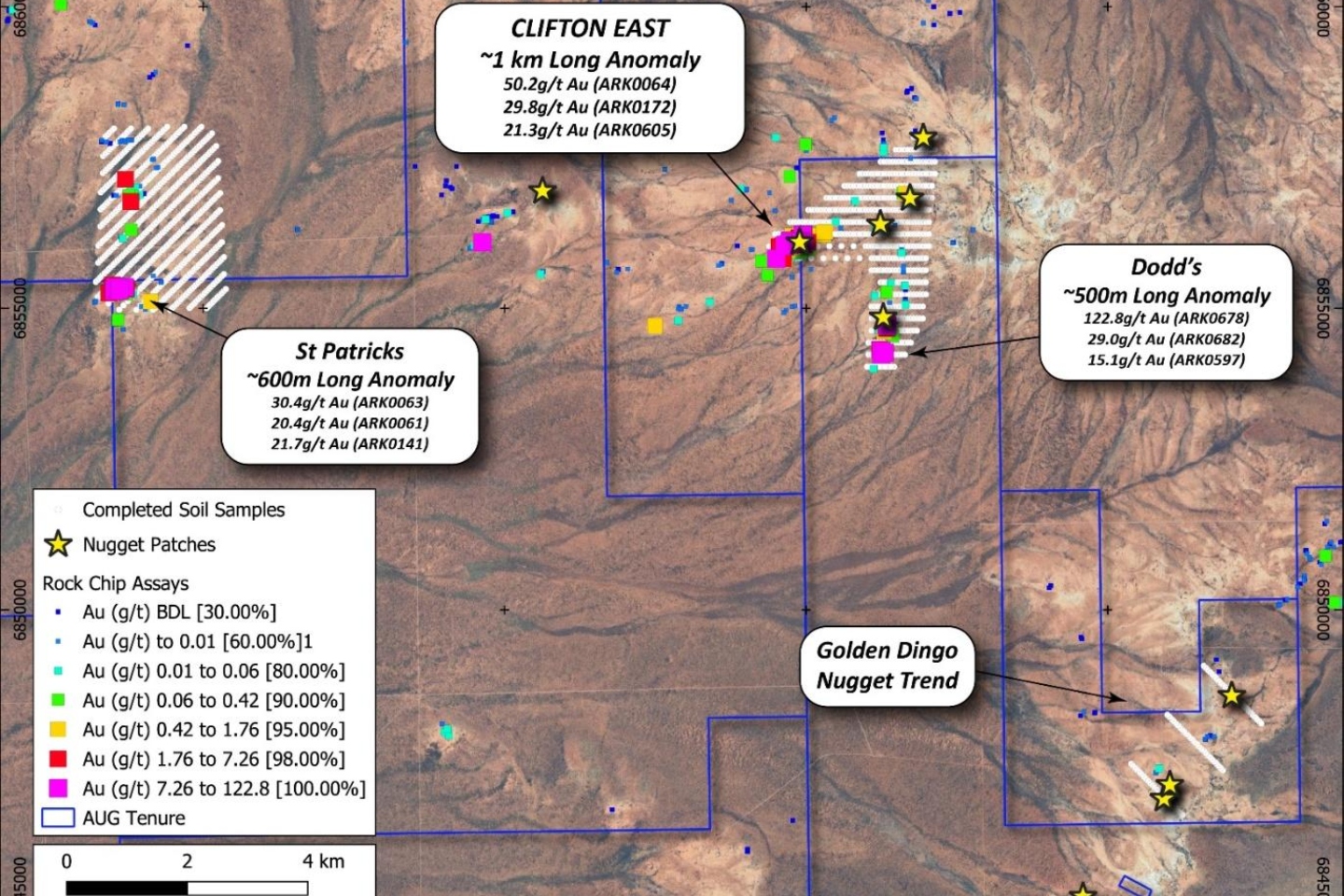
Notably, the drilling program only tested a 350m section of a 1.2km-long gold-in-soil and high-grade rock chip anomaly, leaving much of the trend untouched.
Strategic Location and Exploration Potential
The Music Well project is situated 35km north of Leonora in WA’s gold-rich Leonora-Laverton Greenstone Belt. This region hosts a total gold endowment of more than 28 million ounces. The project is surrounded by major operations, including Vault Minerals’ Darlot and King of the Hills mines and Northern Star’s Thunderbox operation.
Despite the region’s popularity, Augustus has secured more than 1,240 square kilometres of tenure in the district. Regional fault systems are interpreted to channel mineralising fluids from neighbouring gold camps into its ground.
Beyond Clifton East, the target pipeline at Music Well includes soil anomaly extensions at the company’s Dodds and St Patricks prospects, as well as nugget trends at its Golden Dingo target that warrant closer inspection.
Looking Ahead
For a first pass at a new prospect, the unearthing of wide zones of gold mineralisation is a solid result. Although the drilling may have only just scratched the surface of a 1.2km-long anomaly, the company’s geological theory and approach are starting to look more and more prospective.
If they can define some higher-grade cores within the broad envelopes already identified, it will give the company a much clearer picture for planning its next round of deeper drilling.
If your ASX-listed company is doing something interesting, feel free to reach out.