The Cereals That Americans Can’t Get Enough Of
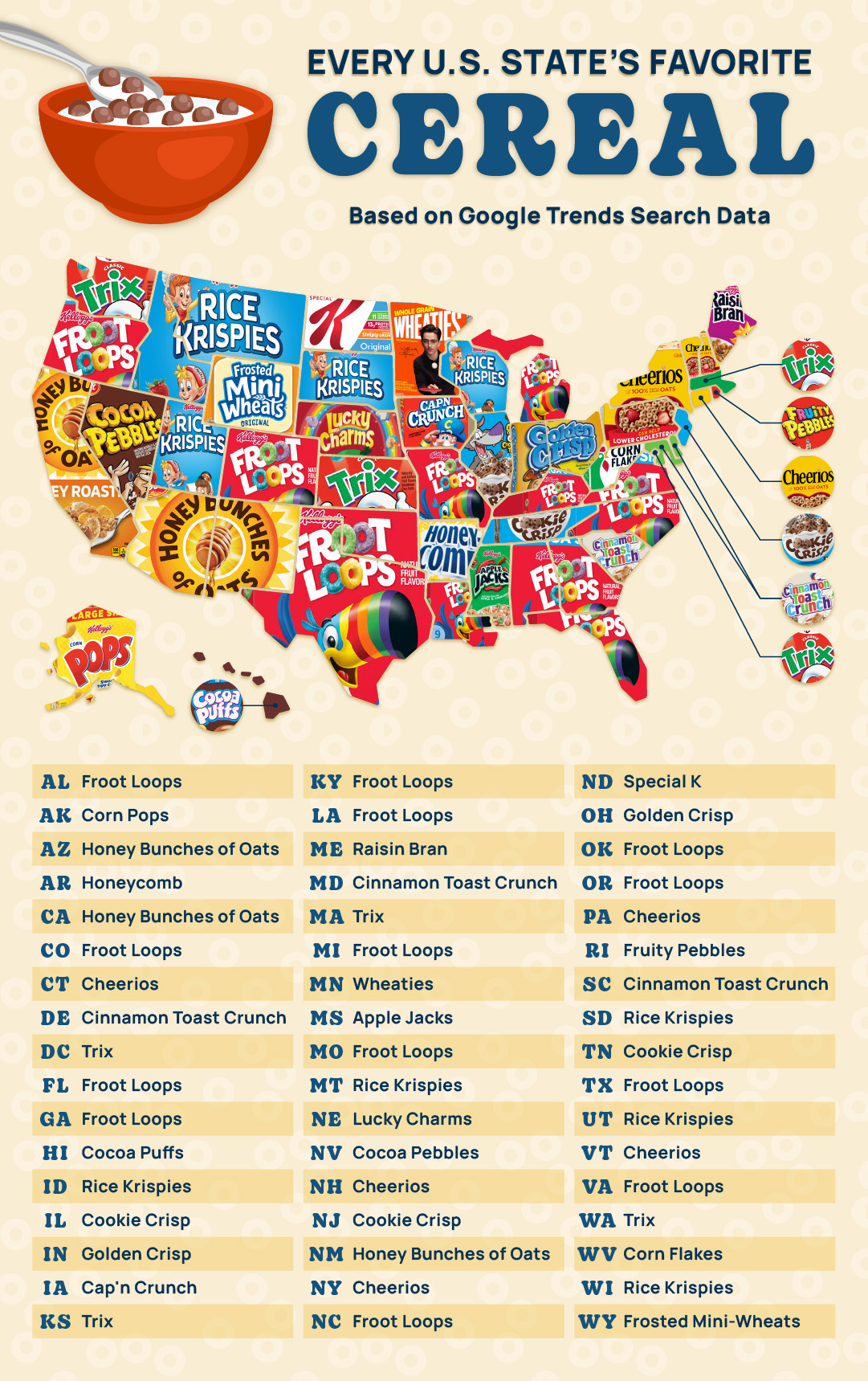
A recent study has uncovered the most popular cereals across the United States, revealing a surprising favorite that has captured the hearts of many. The research, conducted by a team at Concordia University, St. Paul in Minnesota, aimed to determine which cereal type is most loved in each state.
The findings show that Froot Loops, known for its colorful, ring-shaped design, is the top choice in 13 states. These include Alabama, Colorado, Florida, Georgia, Kentucky, Louisiana, Michigan, Missouri, North Carolina, Oklahoma, Oregon, Texas, and Virginia. This sugary treat has clearly won over a significant number of American consumers.
Kellogg’s Rice Krispies came in second place, being the most popular in five states: Idaho, Montana, South Dakota, Utah, and Wisconsin. Interestingly, General Mills’ Cheerios also shared this position, as it was the favorite in another five states — Connecticut, New Hampshire, New York, Pennsylvania, and Vermont.
The results were based on an analysis of Google Trends data, which identified the most-searched cereal in each U.S. state and Washington, DC, between January 2025 and January 2026.
Other cereals also made an appearance on the list. For instance, General Mills’ Trix, with its fruit-shaped design, was the most popular in Washington, DC, Kansas, Massachusetts, and Washington. Meanwhile, Cocoa Puffs, a chocolate-flavored cereal, was the fan-favorite in Hawaii and Nevada. Cinnamon Toast Crunch topped the charts in Delaware, Maryland, and South Carolina.
Despite the popularity of these cereals, sales have been on a downward trend for several years. According to market research company Nielsen IQ, in the 52 weeks ending July 3, 2021, Americans purchased nearly 2.5 billion boxes of cereal. However, by July 2025, this number had dropped to 2.1 billion, a decrease of more than 13 percent.
This decline can be attributed to various factors, including concerns about food processing and sugar content. For example, one cup of Lucky Charms contains 24 percent of a consumer’s daily recommended intake of sugar.
Experts suggest that the cereal industry faces challenges in overcoming its image as an artificial product. Tom Rees, global insight manager for staple foods at Euromonitor, stated in a statement from July 2025, “Cereal finds it really hard to get out from underneath that. It can’t escape the fact that it doesn’t look like a natural food. You have to create it and form it.”
Artificial dyes, such as the petroleum-based colors used in Froot Loops, have also come under scrutiny. In 2024, dozens of people protested outside the headquarters of WK Kellogg’s in Battle Creek, Michigan, calling for the removal of artificial dyes from cereals.
In response to these concerns, companies have started to make changes. Both Kellogg and General Mills have pledged to eliminate artificial dyes from all their products by the end of 2027.
Independent readers are known for their independent-minded approach, often guided by their attitudes rather than traditional demographics. In a world that is becoming increasingly fragmented, communities value real facts and honest opinions delivered by trusted news sources. Armed with information and inspiration, these readers are empowered to take a stand for their beliefs.