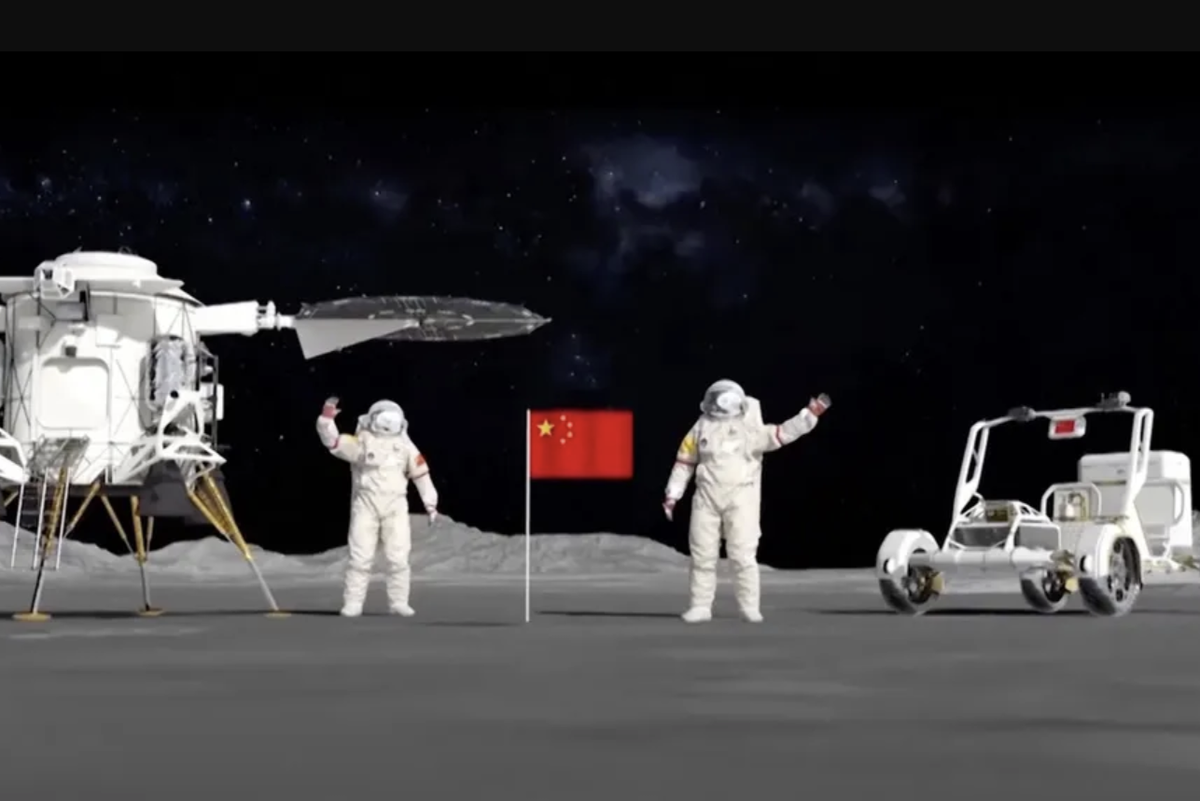
China has made a significant leap in its space exploration ambitions by unveiling an AI-powered humanoid robot that it plans to send to the Moon as part of its 2029 Chang’e-8 mission. This development marks a key step in China’s long-term strategy to establish a presence on the lunar surface and eventually send humans there.
The robot, designed by the Hong Kong University of Science and Technology (HKUST), weighs approximately 100 kilograms (220 pounds) and is intended to serve as a porter during the mission. Its primary role will be to transport and install scientific instruments at various locations on the Moon ahead of a potential crewed landing. The design features a humanoid upper body with two arms mounted on a four-wheeled module equipped with solar panels, allowing it to navigate the lunar terrain effectively.
Professor Gao Yang from HKUST shared insights about the project, stating that while the Chang’e-7 mission might see the first humanoid robot landing on the Moon’s south pole, their robot will explore a different region of the same area. “It is a very large area, and we are curious about all of it,” she said, highlighting the significance of this mission as a novel demonstration of humanoid robotics on the Moon.
The AI capabilities of the robot are also noteworthy. It is equipped with advanced artificial intelligence that enables it to identify and trace objects, allowing it to formulate strategies before executing tasks. This level of autonomy is crucial for operating in the challenging lunar environment, where communication delays with Earth can hinder real-time control.
China’s space program has been steadily advancing over the past few decades, with the goal of sending humans to the lunar surface by 2030. This ambition places China in direct competition with other global space agencies, particularly NASA, which aims to return astronauts to the Moon by 2028 as part of the Artemis IV mission.
However, the timeline for NASA’s Artemis missions has faced several delays due to technical challenges and development setbacks. One of the major hurdles is the development of SpaceX’s Starship Human Landing System (HLS). The massive size of the spacecraft requires orbital refueling to land and return safely, a process that has never been attempted at this scale.
At a recent Senate Committee hearing, former NASA administrator Jim Bridenstine expressed concerns about the complexities of the HLS. He pointed out that the system relies on advanced technologies such as cryogenic in-space refueling, which have yet to be fully developed. “Unless something changes, it is highly unlikely the United States will beat China’s projected timeline to the Moon’s surface,” he stated.
SpaceX’s Starship has only conducted two test flights since Bridenstine’s comments, with the next one scheduled to take place later this month. Despite these developments, the path to a successful lunar landing remains uncertain, with many experts questioning whether the US can catch up with China’s ambitious space program.
As both nations push forward with their lunar exploration goals, the race to the Moon continues to capture global attention. The technological advancements being made by China and the United States highlight the growing importance of space exploration in shaping the future of human civilization.