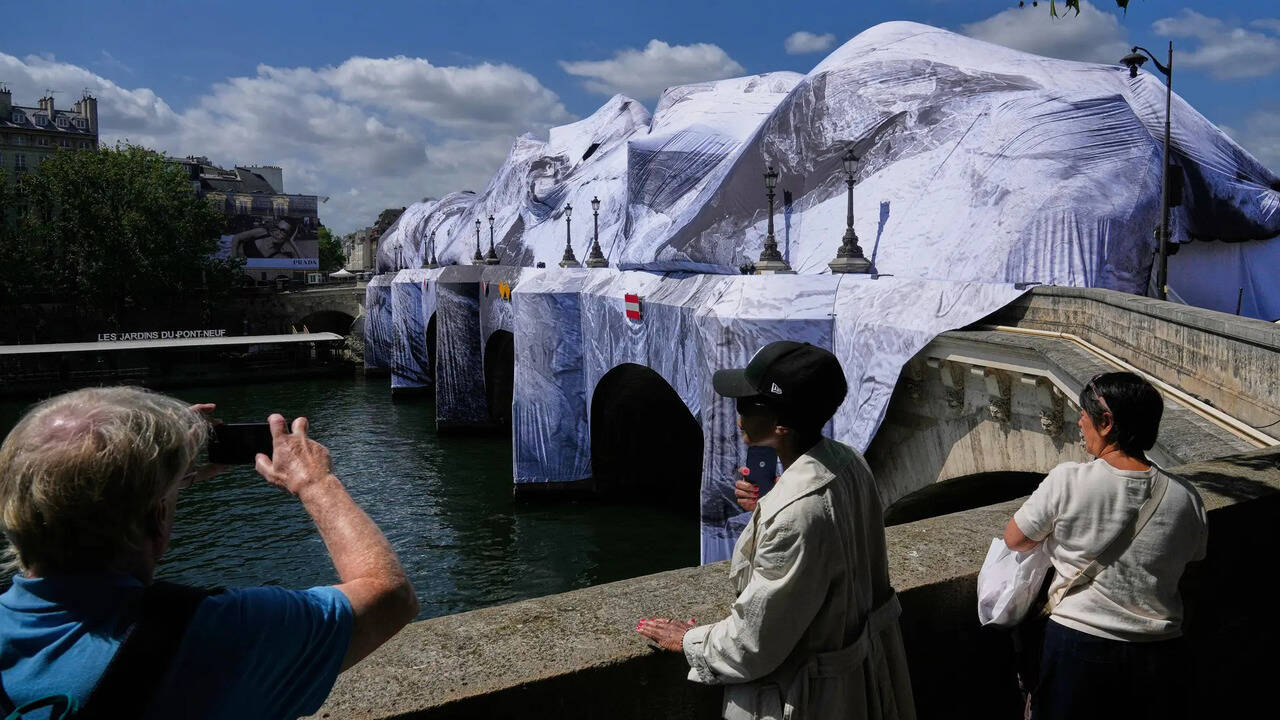
A New Vision for the Oldest Bridge in Paris
Paris, a city steeped in history and art, has once again become the canvas for a bold artistic experiment. The oldest bridge in the city, the Pont Neuf, has undergone a dramatic transformation that has captivated both locals and visitors alike. This unique artwork, titled La Caverne du Pont Neuf (The Cave of the Pont Neuf), is the creation of JR, a renowned street artist often referred to as the “French Banksy.”
The Artistic Concept
JR’s project aims to bring “mineral and nature” back to the heart of the city. Rather than covering the bridge, he has created an illusion that reveals the stone from which Paris itself was built. The result is a jagged mass of gray rock that appears to rise over the 17th-century bridge, transforming its arches into dark cave mouths above the Seine.
Marie Leclerc, a local resident, described her first encounter with the installation: “I thought, ‘Where has the bridge gone?’ It’s strange because you know it’s fabric and air, but from here it really looks like stone. Paris feels suddenly ancient again.”
The Construction Process
The inflation of the artificial cave took place overnight after being delayed by bad weather. This marks the most dramatic stage of a project that has been in the works for over a year. JR described the structure as “a gigantic puzzle that has just been finished.” His team worked tirelessly to pump air into the 80 fabric arches, creating a towering formation that reaches nearly 18 meters high.
The installation is one of the most ambitious public artworks seen in Paris in decades. Funded by the sale of JR’s work and corporate partners, it will open to the public on June 6. The transformation has been documented since March using time-lapse cameras, including one fixed on a rooftop terrace overlooking the river.
The Experience
From the outside, the installation looks like a rocky mass that “literally” breaks the landscape. JR, known for pasting enormous photographs on buildings, walls, and rooftops around the world, said that the goal is to make people stop and reflect. “Usually everyone crosses here without looking,” said Julien Moreau, who was taking photos near the Seine. “This morning everyone was standing still. That’s already the artwork.”
The structure is 120 meters long and 18 meters tall — as high as a six-story building. Despite its size, it is built almost entirely from air, weighing only about five tons. JR’s engineers spent weeks testing the structure in a hangar at Orly airport, ensuring it could withstand various conditions.
A Tribute to Artistic Legacy
The cave is also a tribute to a Parisian artistic legend. In 1985, artists Christo and Jeanne-Claude wrapped the same bridge in pale golden fabric, an act that helped redefine monumental art in modern cities. A square beside the bridge now carries their names, and it is from there that visitors will step into the dark tunnel of JR’s installation.
A Warning and a Reflection
In addition to its aesthetic appeal, the cave serves as a warning. JR built it as a nod to Plato’s allegory, where prisoners mistake shadows on a wall for reality. He draws a parallel to today’s society, where people believe their algorithm on social media is the reality. Yet, to enter his cave about screens, visitors must raise their phones, highlighting the contradiction.
A tech company, Snap, has added an augmented-reality layer that shows what the eye cannot see. The sound of the cave is a low, mineral hum from Thomas Bangalter, formerly of Daft Punk.
A Temporary Masterpiece
The cave will be open around the clock from June 6 to June 28, closing the bridge to traffic and visible from the quays, passing boats, and even from the top of the Eiffel Tower. It will coincide with Paris Fashion Week, World Music Day, and the all-night Nuit Blanche arts festival.
When it comes down, the fabric will be reused or recycled. Like the golden wrapping over 40 years before, the cave will be gone — and the Pont Neuf, older than the republic and the revolution, will reappear exactly as it was.