The Evolution of Battlefield Medicine
During World War II, the battlefield was a place of extreme danger. A soldier could survive an initial injury from a bullet or shell fragment only to face a far more insidious threat: shock. This condition, caused by severe blood loss, led to falling blood pressure, poor circulation, organ failure, confusion, and ultimately death. Before surgeons could repair the damage, the wounded had to remain alive long enough to reach medical care.
This challenge gave rise to a groundbreaking solution: dried plasma. The U.S. Army Medical Department’s history highlights that the use of plasma for shock and hemorrhage was a major development during the war. While plasma couldn’t fully replace whole blood, it played a crucial role in restoring blood volume and stabilizing casualties until further treatment could be administered.
The Limitations of Whole Blood
Whole blood was undeniably lifesaving, but its use on the front lines was fraught with difficulties. It required careful collection, typing, storage, and transport under controlled conditions. These challenges made it impractical in the chaotic environments of beaches, jungle aid stations, hedgerows, or roads under fire.
Modern warfare, with its amphibious landings, airborne drops, and mass casualty events, made these limitations even more urgent. Dried plasma offered a logistical breakthrough. Medics could reconstitute it by adding water, making it usable in settings where whole blood would have been nearly impossible to handle.
Plasma as a Portable Bridge
Plasma is the liquid component of blood, responsible for maintaining circulation and containing proteins involved in clotting and other vital functions. However, it doesn’t carry oxygen like red blood cells do. This meant that severely wounded soldiers might still need whole blood later, but in the critical minutes after massive blood loss, restoring volume was essential to keep the heart pumping and organs alive.
This made plasma a crucial bridge between injury and surgery. Historical records from 2019 note that dried plasma kits included a bottle of dried plasma and a bottle of sterile water for reconstitution. Millions of units were produced during the war by organizations like the American Red Cross and used by Allied forces.
The Role of Dr. Charles Drew
The success of plasma as a medical tool wasn’t just about science—it was also about organization. Dr. Charles R. Drew played a pivotal role in transforming plasma collection and preservation into a practical wartime supply network. His work was instrumental in standardizing methods for preserving and storing plasma, and he helped create the Blood for Britain program during World War II.
This initiative collected donations in the U.S., separated plasma, preserved it, and shipped it across the Atlantic to support Britain. Drew’s contributions extended beyond medical brilliance; they involved large-scale organization, including collection, processing, preservation, testing, storage, and transport.
A Moral Contradiction Exposed
Drew’s story also revealed a troubling contradiction. While the U.S. fought against regimes built on racial hierarchy, it maintained racially discriminatory blood policies at home. Drew opposed the segregation of blood donations, as the science did not support the idea that plasma differed by race.
This issue highlighted how medical systems are shaped by the societies that build them. Even life-saving technology can reflect prejudice. The irony was clear: plasma was valuable because it could be widely processed, stored, and distributed, yet wartime policies still imposed racial categories without scientific basis.
The Simplicity of the Kit
The dried plasma kit was designed for conditions that were anything but ideal. It had to be compact, durable, and easy to use under pressure. It needed to function without a laboratory, refrigeration, or a quiet hospital ward.
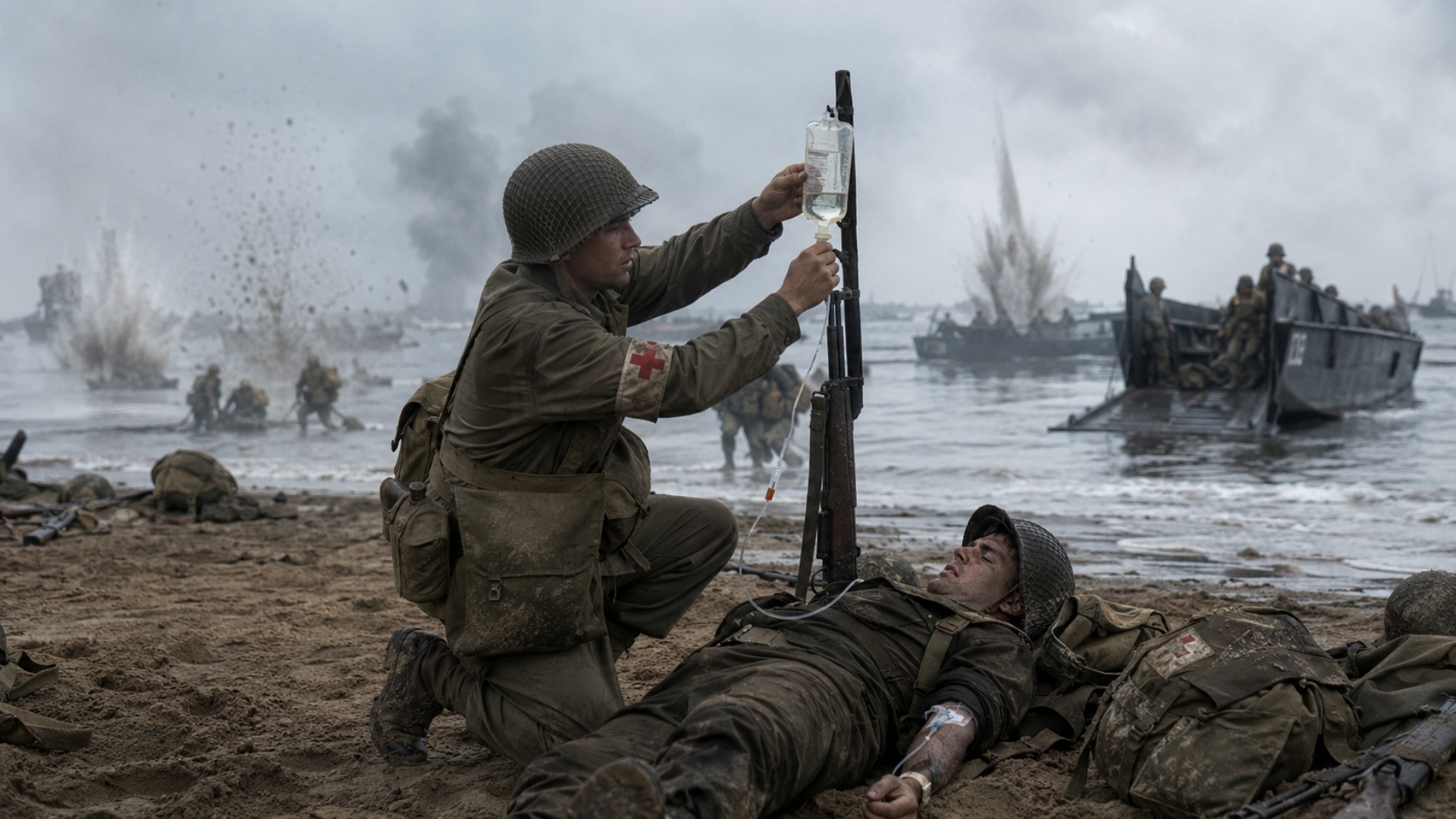
A typical kit contained dried plasma, sterile water, tubing, and a needle. In the field, the powder was reconstituted and hung wherever gravity could assist: from a rifle, a tree branch, a vehicle, or a stretcher pole. This simplicity was not just aesthetic—it was essential. A fragile treatment that only works in perfect conditions is almost useless at the point of injury.
The Powder That Bought Minutes
Dried plasma may have looked unassuming—a bottle, powder, water, tubing, and a needle—but its impact was profound. On a beach, in a jungle, or beside a road under fire, it represented a new kind of battlefield medicine. It allowed medics to fight shock before the wounded reached a hospital, turning blood banking into a mobile system and making survival possible for those who once would have died while waiting for evacuation.
Dried plasma didn’t win battles, but it helped more men live through them. In a war where death often came not from the wound itself but from the minutes after, that small bottle of powder became one of the quietest lifesaving tools of World War II.