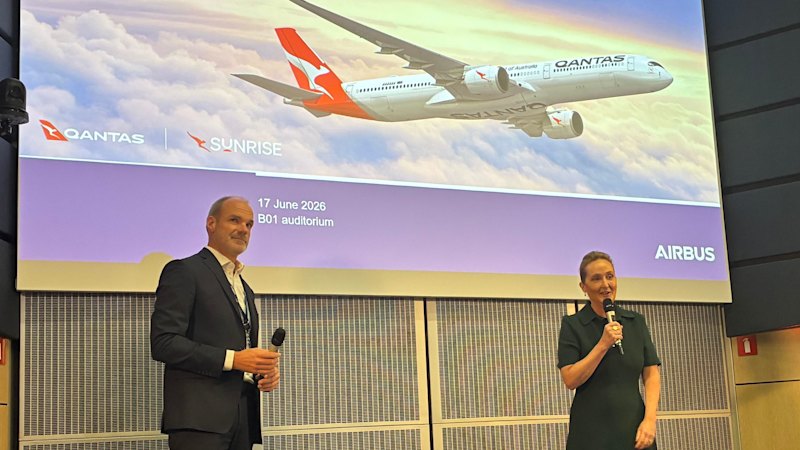
Qantas Launches Project Sunrise: Direct Flights from Sydney to London by 2027
Qantas has made a groundbreaking announcement that Australians will soon be able to travel from Sydney to London without any stopovers. This development, part of the company’s Project Sunrise, is set to revolutionize long-haul travel and significantly reduce the time required for such journeys.
The inaugural flights will operate on a specially modified Airbus A350-1000ULR (Ultra Long Range), which will enable non-stop flights lasting up to 22 hours. This will make them the longest commercial flights in the world. The project aims to eliminate the need for multiple layovers, offering passengers a more convenient and efficient travel experience.
“The tyranny of distance for Australians will finally be conquered,” said Qantas Chief Executive Vanessa Hudson. She emphasized that these direct flights will save customers up to four hours compared to the fastest one-stop service currently available. “It will give our customers something that no other airline in the world can give them—the choice to fly Sydney to London without swapping anywhere along the way on an aircraft.”
Flight Schedule and Expansion Plans
The first Project Sunrise flights are scheduled to begin in October 2027, with tickets going on sale in February 2027. Once the Sydney-to-London service is established, Qantas plans to expand its network by introducing direct flights from Sydney to New York, also expected to take around 22 hours.
Hudson highlighted that the A350-1000ULR will allow Qantas to connect East Coast Australia to both London and New York. She pointed to the airline’s historical role in keeping Australia connected to Europe during World War II, noting that the new route is a natural progression for the carrier.
Flights from Sydney are expected to depart in the early afternoon and arrive in London in the early morning. However, flights from Melbourne will depend on future demand, and no firm commitments have been made at this stage. Hudson stated that Qantas will announce routes progressively as new aircraft become available over the next two-and-a-half years.
Challenges and Delays
Despite the excitement surrounding Project Sunrise, the project has faced some delays. Airbus initially planned to deliver the first A350-1000ULR to Qantas in 2026, but this has now been pushed back to 2027. These delays have raised concerns about the timeline, particularly regarding the production of cabin interiors and safety certifications.
The delay has also impacted the overall production of Airbus planes, as the industry continues to recover from supply chain disruptions caused by the COVID-19 pandemic. Hudson acknowledged these challenges, stating that the stakes are high for Qantas as it works to meet its 2027 deadline.
Aircraft and Symbolism
One of the aircraft involved in the project, named Vega, was displayed at the Airbus production facility in Toulouse, France. It was named in honor of one of the World War II-era Double Sunrise Catalina planes that inspired the term “Project Sunrise.” However, the plane did not yet have engines attached, which raised questions about its readiness.
Qantas denied that the lack of engines was due to production issues, instead stating that the aircraft had been pulled out of manufacturing to be present at the event. A separate Project Sunrise plane undergoing test flights already has engines installed.
Strategic Importance and Market Position
Hudson emphasized that Project Sunrise is not just about convenience—it also serves a strategic purpose. “It is also going to enable us, as Qantas, the national carrier, in times of need, whether it be war, whether it be weather, whether it be some kind of crisis, to be able to do what we know is a fundamental part of our purpose, which is to fly to any point of the globe to repatriate Australians in need.”
The A350-1000ULR can fly more than 16,000 km, carrying 238 passengers across four cabins. This capacity ensures that the aircraft can accommodate a wide range of travelers while maintaining comfort and efficiency.
Addressing Market Concerns
Chief Financial Officer Rob Marcolina addressed concerns about potential competition from Middle Eastern airlines, which are expected to re-open traditional routes and potentially trigger a price war. However, he argued that Qantas targets a different market segment.
Over two-thirds of Qantas’ international passengers are premium leisure travelers, who are willing to pay a premium for direct flights and the quality of service associated with the Qantas brand. “That’s not necessarily the people who would be attracted to fly through the Mideast,” Marcolina said.
Industry Perspective
Linus Benjamin Bauer, founder of Singapore-based BAA & Partners, noted that one-stop routing exposes travelers to multiple segments and potential risks. He explained that reducing the number of points where a trip can break down—especially in contested airspace—increases the willingness of premium travelers to pay for fewer dependencies.