NASA scientists have found that some fungi may possess the extraordinary resilience needed to survive the grueling journey to Mars. Published in Applied and Environmental Microbiology, the study highlights how fungal spores, particularly those from the Aspergillus calidoustus species, endured the harsh conditions of space travel and the Martian environment. This finding not only challenges our understanding of life’s limits but also aids in refining NASA’s planetary protection strategies, which aim to prevent Earth’s microbes from contaminating other planets.
The Unexpected Resilience of Fungi
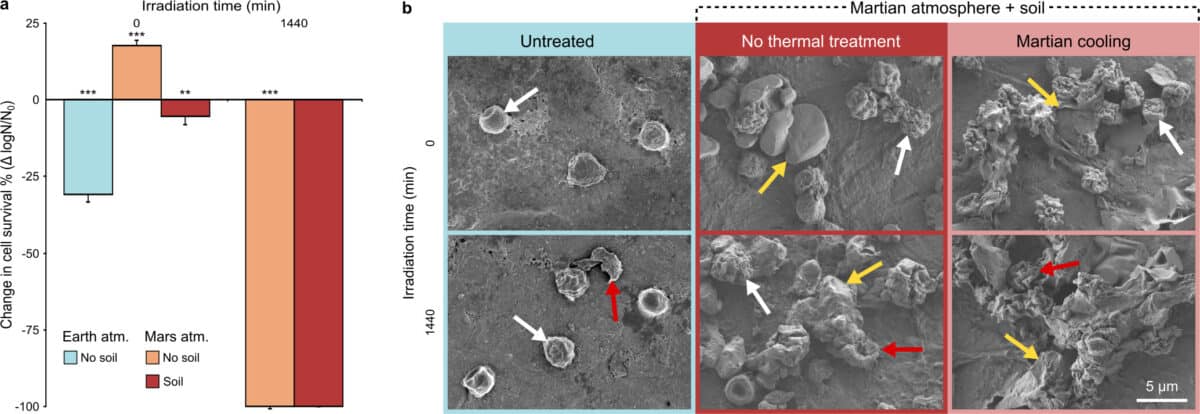
Fungi have long been known for their impressive resilience in Earth’s extreme environments, but this new study takes their endurance to a whole new level. In an effort to understand the potential for microbial survival in outer space, researchers isolated fungal spores from NASA’s cleanroom environments, highly controlled spaces where spacecraft components are assembled to prevent contamination. These spores were then subjected to rigorous simulations of space travel, including extreme low temperatures, radiation exposure, and low atmospheric pressure, conditions that mimic those found on Mars.
Incredibly, the spores from Aspergillus calidoustus withstood these stressors, showing a remarkable level of resilience. While not all environmental stresses could be survived, the fungus showed that combinations of tolerance mechanisms might enable its survival, even in the most hostile conditions. This discovery opens new doors in our understanding of microbial life’s potential to endure off-planet conditions.
“This does not mean contamination of Mars is likely, but it helps us better quantify potential microbial survival risks,” said Dr. Kasthuri Venkateswaran, the study’s leader and a former Senior Scientist in NASA’s Biotechnology and Planetary Protection Group.
The Science Behind the Survival
The study, published in Applied and Environmental Microbiology, involved testing fungal spores under conditions designed to mimic the intense environment encountered by spacecraft as they travel to Mars. These spores were exposed to ionizing radiation, ultraviolet rays, and low atmospheric pressure, three of the most challenging factors that space-bound organisms would face. What makes Aspergillus calidoustus particularly interesting is its ability to survive the combination of these stresses, offering new insights into microbial resilience.
NASA’s Planetary Protection Group, tasked with safeguarding against potential contamination of other planets, has long focused on studying bacteria’s survival in space. However, this study marks a shift toward understanding fungal survival as well.
Fungi, as eukaryotic organisms, are structurally more complex than bacteria, and their survival mechanisms are not fully understood. This study is the first to demonstrate that eukaryotic microbes, organisms with a nucleus, can survive the extreme conditions of space travel and Mars.
Implications for Mars Missions and Space Exploration
The findings are not just a fascinating look at microbial survival, they have real implications for the future of space exploration. With missions like NASA’s Perseverance rover landing on Mars, the risk of contaminating the Martian surface with Earth microbes becomes a significant concern. While this study doesn’t suggest that contamination of Mars is likely, it does provide valuable data that can help refine NASA’s planetary protection strategies and microbial risk assessments.
“Microbial survival is not determined by a single environmental stress but rather by combinations of stress tolerance mechanisms,” Venkateswaran explained.
This insight could influence how spacecraft are decontaminated and how future missions approach the challenge of preventing interplanetary contamination.
By understanding which microbes are capable of surviving the harsh journey, scientists can better prepare for the possibility of life, even microbial life, surviving on Mars, or potentially being introduced from Earth.