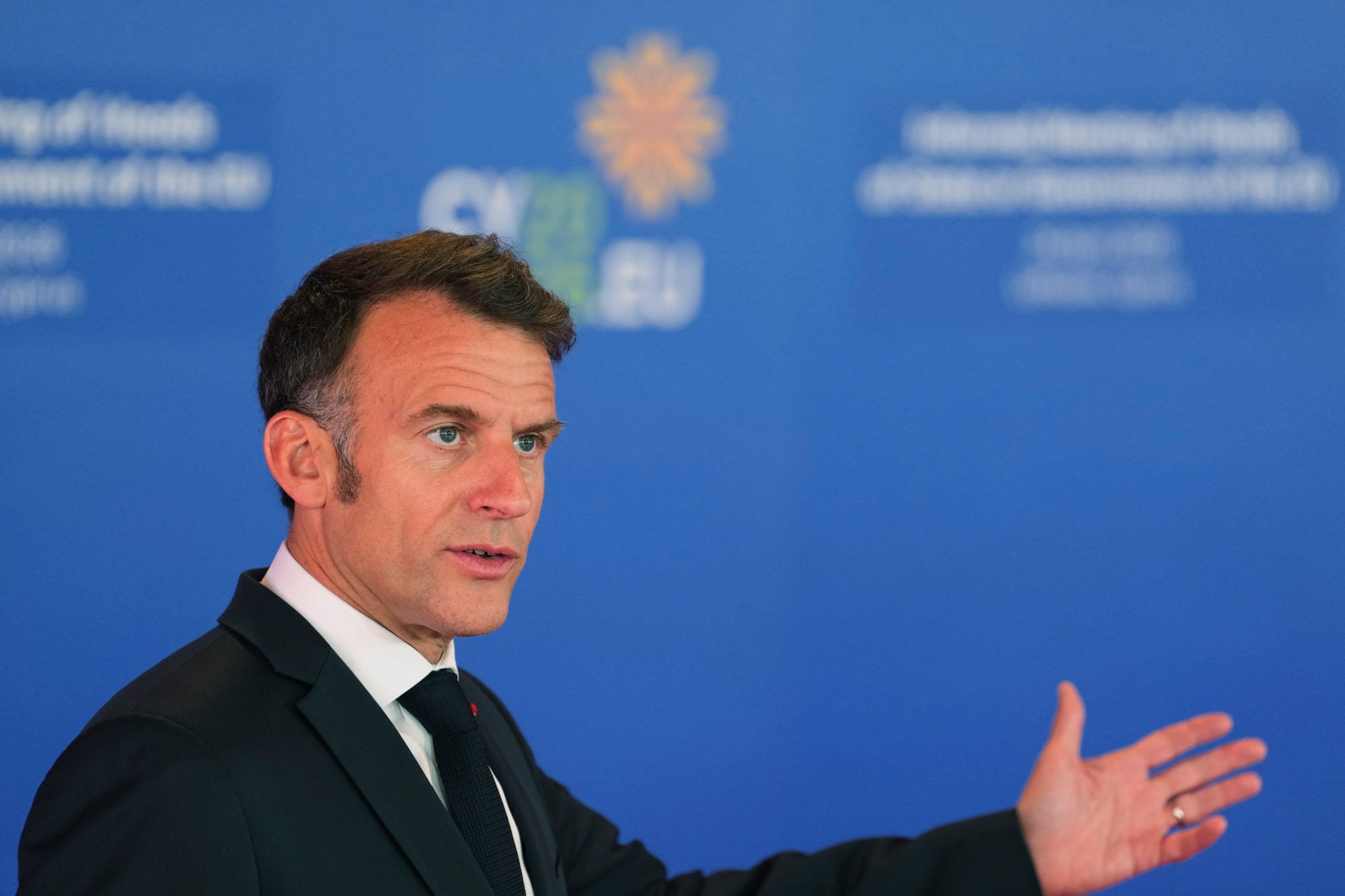
French president is trying to shore up his legacy of strategic autonomy before leaving office next year, analysts say
From Taiwan to Tibet, French President Emmanuel Macron has touched Beijing’s nerves on a range of sensitive issues over the past few weeks.
On a trip to Japan earlier this month, he and Japanese Prime Minister Sanae Takaichi “emphasised the importance of peace and stability in the Taiwan Strait and urged a peaceful resolution of cross-strait issues through constructive dialogue”.
The irritation for Beijing was less about the language and more about the timing, with the joint statement coming less than six months after Takaichi’s controversial comments in November about possible Japanese military intervention in a Taiwan contingency.
Do you have questions about the biggest topics and trends from around the world? Get the answers with SCMP Knowledge, our new platform of curated content with explainers, FAQs, analyses and infographics brought to you by our award-winning team.
In an interview with Japanese public broadcaster NHK on April 1, Macron also said that “we do not want to be under the hegemony of China or the United States of America”, though he added that Paris should “create a mutually beneficial situation” with Beijing.
At Yonsei University in Seoul two days later, Macron referred to Beijing and Washington, saying: “Our objective is not to be the vassals of two hegemonic powers.”
Macron also briefly spoke with the Dalai Lama’s representative to the EU, Genkhang Rigzin Choedon, at a cultural event in Paris in late March, expressing his “high esteem” for the exiled Tibetan spiritual leader, Genkhang wrote on social media.
Beijing views the Dalai Lama as a separatist and accuses him of inciting unrest in Tibet – particularly in the 1980s and during protests in 2008 – allegations that exiled Tibetan spiritual leader denies.
Observers see these gestures by Macron as an attempt to cement his image as a standard-bearer of European strategic autonomy before he leaves office next year.
However, they say the actions are unlikely to fundamentally shake the relationship between China and France, which could potentially move in a more positive direction if the far-right wins power in 2027.
“This series of moves from Macron … objectively speaking, are not positive [for bilateral ties],” said Song Luzheng, a research fellow with Fudan University’s China Institute.
“But it remains tolerable within the framework of the China-France strategic relationship and will not fundamentally alter relations between the two countries.”
He noted that Macron’s contact with the Dalai Lama’s envoy was unlikely to be a chance encounter but might only amount to a symbolic move to assure the Tibetan exile community, which had some influence in France.
Song also said that Macron’s remarks in South Korea were consistent with his long-held position that Europe should engage in benign competition with both China and the US, while the joint statement on Taiwan did not cross Beijing’s red lines.
Beijing sees Taiwan as part of China to be reunited by force if necessary. Most countries, including the US and France, do not recognise Taiwan as an independent state, but Washington is opposed to any attempt to take the self-governed island by force and is committed to supplying it with weapons.
Macron’s provocative moves are not out of character.
Soon after a high-profile state visit to China in December – his fourth to the country – Macron also warned Beijing that Europe would impose tariffs on Chinese products if trade imbalances were not addressed.
China had developed ample “mental preparation” for French “two-sidedness”, said Wang Yiwei, director of Renmin University’s Centre for European Studies in Beijing, though he added that the growing trade deficit with China was a widely held concern in Europe.
Wang agreed that the French president’s moves could be read as a manifestation of the “strategic autonomy” agenda he has long pushed for.
“[Macron’s] Asia tour came against this backdrop – US allies are strengthening ties among themselves and huddling together for warmth to hedge against the risks posed by … a China-US bipolarity, the so-called G2,” he said.
Song said that since Macron’s governing coalition lost ground in the 2024 legislative elections, he had put more energy into foreign affairs to shore up his domestic popularity and secure a political legacy.
According to the latest poll published on April 11 by market research firm Ipsos BVA in partnership with the French engineering school CESI, Macron’s approval rating in France rose by 1 percentage point this month from March to 23 per cent.
Even though Macron had become something of a “lame duck” president, China was likely to want to stay on good terms with him, Wang said.
“Macron is still young,” Wang said, suggesting that Macron could seek to lead the European Commission in the future.
But while Macron might be looking ahead to a change in role, analysts pointed out that the future of the countries’ ties was in the hands of the French electorate.
“The outcome of next year’s presidential election will really affect China-France relations, more so than Macron’s recent actions,” Song said.
Far-right leaders Jordan Bardella and Marine Le Pen are still the most popular potential candidates, according to the Ipsos BVA-CESI poll.
“If figures like [Marine] Le Pen come to power, they could free up thinking and genuinely cooperate strategically with China. There is little hope for that from the establishment,” Wang said.
A court in Paris found Le Pen and several members of her party guilty of embezzling European Union funds last year, ruling her out of the 2027 election. She is awaiting the final verdict of her appeal, due in July.
If the far-right were to win, China-France ties could reach a “third peak” following the establishment of diplomatic relations in 1964 and the elevation to a comprehensive strategic partnership in 2004, Song said.
He added that France’s far-right tended to deal with China pragmatically, through the lens of economic interest and cooperation, rather than focusing on conflicts over differing values.
More Articles from SCMP
Malaysia gets new anti-corruption chief as protests mount against outgoing head
‘Stressed’ Hongkonger Ceci Lee finishes outside medals on World Cup opening day
Pathway of Hong Kong pupils’ well-being runs through relationships
US crackdown threat could shake out China’s ‘distillation’ AI copycats: analysts
This article originally appeared on the South China Morning Post (www.scmp.com), the leading news media reporting on China and Asia.
Copyright (c) 2026. South China Morning Post Publishers Ltd. All rights reserved.