The Possibility of Time Travel Through Quantum Physics
Time machines are often thought to belong in the realm of science fiction, but recent research suggests that this futuristic technology might be more than just a fantasy. Scientists have proposed a method for time travel based on the principles of quantum physics, which could allow messages to be sent into the past.
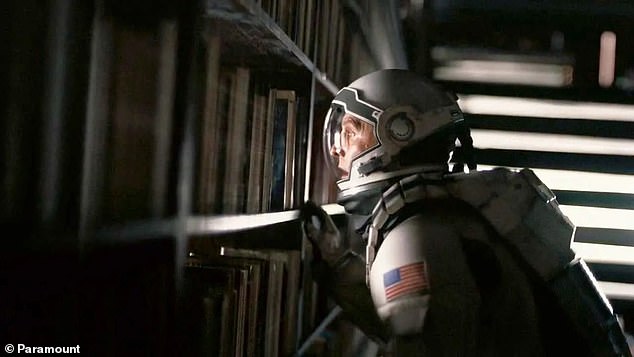
While this concept may not enable us to travel back to the time of the dinosaurs, it opens up intriguing possibilities. The researchers suggest that this technique could resemble the way time travel is depicted in Christopher Nolan’s film Interstellar. In the movie, an astronaut played by Matthew McConaughey sends a message to his daughter in the past by moving the hands on her watch.
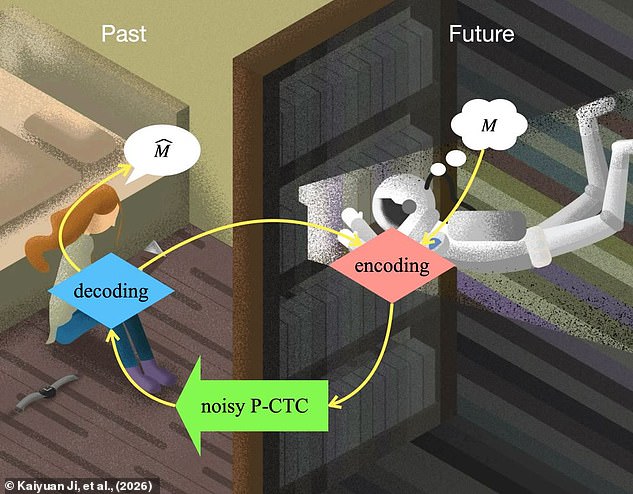
Although the real-world application would not be as dramatic as in the film, the researchers argue that this “causal loop” mirrors how actual time travel might function. Dr Kaiyuan Ji, a researcher at Cornell University, explained: ‘The father remembers how the daughter decodes his future message. So he can instruct himself on what is the best way to encode the message.’
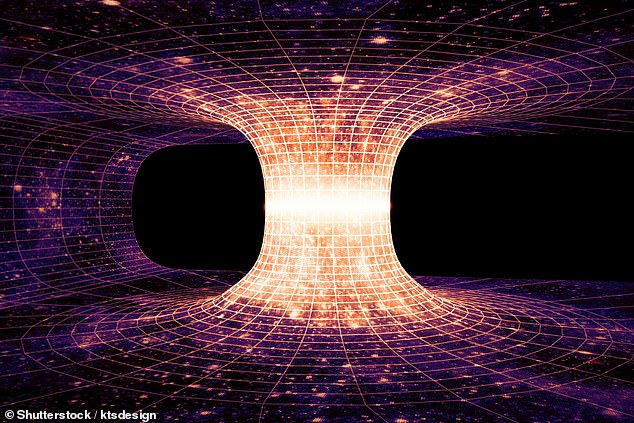
It might seem surprising, but there is nothing in the current laws of physics that makes time travel impossible. According to general relativity, which is our best understanding of the universe, everything moves through space and time along a set path. One such path is known as a closed time-like curve (CTC). A particle following a CTC would move into the future before looping back on itself via the past to return to its starting point.
The laws of physics allow these loops to form, but creating them on a large scale requires an enormous amount of energy. However, on the quantum level, structures like CTCs might naturally occur due to the laws of quantum physics.
On the quantum level, two particles can become ‘entangled’, meaning that what happens to one particle affects the other, even if they are light-years apart. This phenomenon, which Einstein called “spooky action at a distance,” can be explained by suggesting that one particle sends messages backwards in time to the other.
How to Send a Message Back in Time
To send a message back in time, scientists propose using a quantum system with two entangled particles. These particles form a closed time-like curve. Altering one particle creates a change in the other, effectively sending information backward through time.
If you remember how the message was decoded in the past, you can use this knowledge to change how you encode the message in the future. This allows for legible messages, regardless of how noisy the connection is.
Rather than assuming the particles are part of a single massive system or sending information faster than light speed, their sensitivity is explained by receiving messages in the past that tell them how to react later.
This idea might sound far-fetched, but in 2010, scientists came up with a way to mimic closed time-like curves using entangled particles. Professor Seth Lloyd, a quantum physicist from MIT, described it as “the equivalent of sending a photon a few nanoseconds backwards in time, and having it try to kill its former self.”
This creates a situation similar to a telephone with a direct connection to another device a few moments earlier. In theory, this could be used to pass messages back to oneself in the past. Just like a real phone line, the connection on a CTC isn’t always perfect, and noise or disruption can make it difficult to pass information with 100% accuracy.
Professor Lloyd noted: ‘Nobody’s built an actual physical, closed time-like curve, and there are reasons to think it’s very hard to make one. But all channels are noisy.’
This is where an insight from Interstellar becomes useful. In their new paper accepted for publication in Physical Review Letters, Professor Lloyd and his co-authors wrote: ‘The father, who is in the future, may retrieve his memory of past events he has witnessed, even including the daughter’s decoding of the message which he is about to send! It would thus not be surprising that he will consult his memory of the daughter’s decoding when encoding his message, so as to maximize the efficiency of the communication.’
Essentially, if you’ve already seen someone struggle to understand your message, you should know how to send it so that it’s easier for them to decode. Even with a noisy connection, a backwards time-traveling message would still be legible.
The slightly strange conclusion is that sending messages backwards in time might be clearer than sending a message in normal time. Although no one has built a real closed time-like curve, Professor Lloyd believes it should be relatively easy to turn this idea into an experiment on the quantum level. This could allow scientists to study how information is transmitted through ‘noisy channels’ and potentially improve real-life communication methods.