With so much going on in the world, we wouldn’t blame you for feeling a bit worn out.
Things are so stressful, apparently, that even the faults that slice through California are under record-breaking burden, a study has found.
The Los Angeles region sits in the tension-wracked meeting point of the North American and Pacific tectonic plates, making earthquakes common.
New models found that tectonic stress in the region is higher today than at any point over the last millennium, suggesting a ‘Big One’ is overdue.
But when this massive quake could happen all depends on a single location: a busy highway intersection not far from LA.
California primed for a ‘large future rupture’
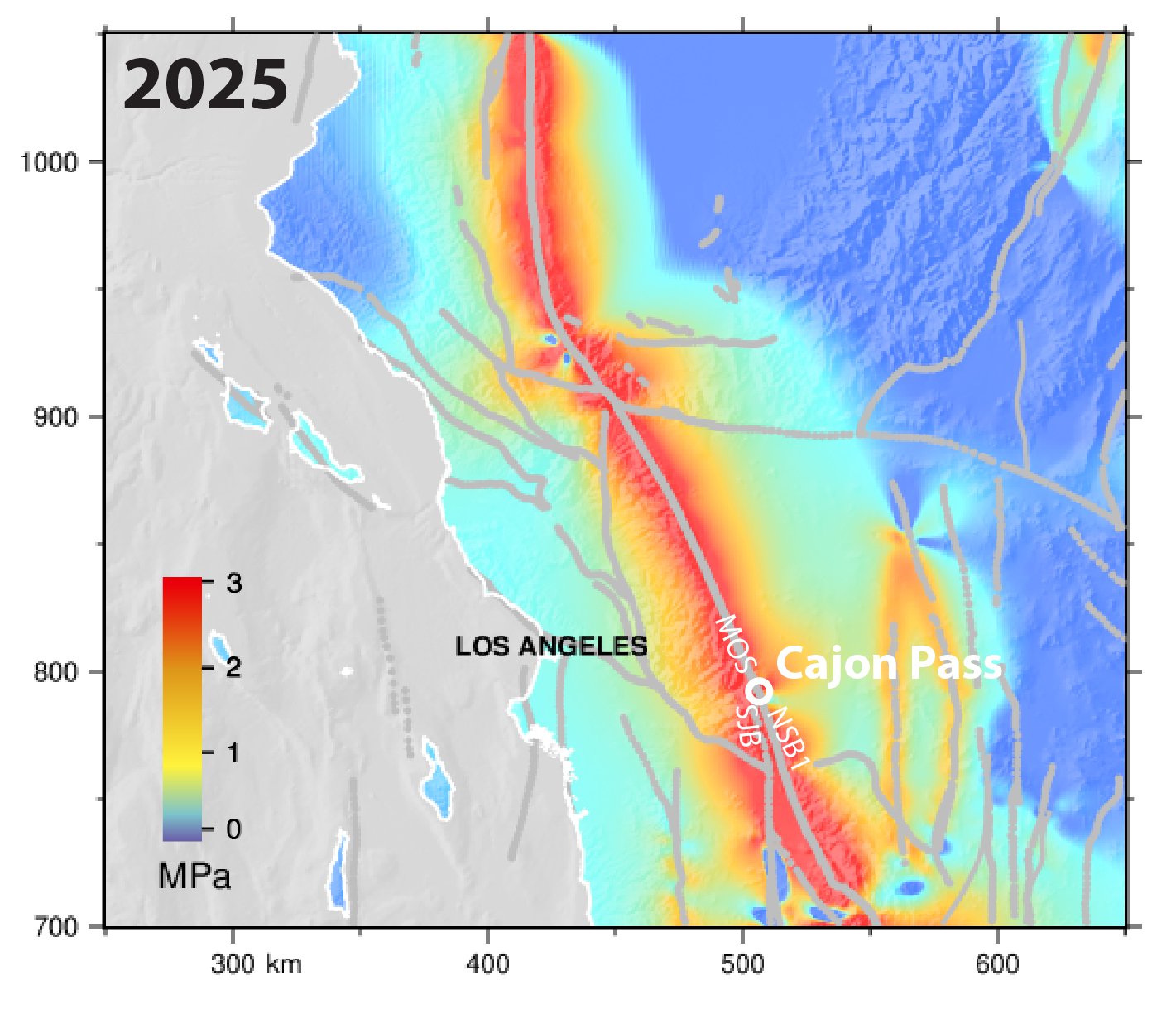
According to a paper published in the Journal of Geophysical Research, 36 quakes of magnitude 6.4 or larger have occurred in the Los Angeles region in the last 1,000 years.
The last major earthquake that shook LA was the Fort Tejon quake of 1857, with a magnitude of 7.9.
Tectonic stress has been building up ever since, an unnerving ‘quiet period’ that hints at a ‘large future rupture’, lead author Dr Liliane Burkhard of the University of Bern in Germany said.
Tectonic plates sit on spongy magma and are always moving around. When they pull in opposite directions, they sometimes get stuck.
Yet these slabs of Earth still try their best to move, creating a lot of push-and-pull tension that has nowhere to go.
Eventually, this reaches a breaking point and releases huge amounts of pent-up energy, which shakes the Earth’s surface – an earthquake.
The roads, railway tracks and energy lines lacing Cajon Pass feed into the Los Angeles area, San Bernardino, Riverside, and the Coachella Valley.
Burkhard said: ;So not only is it concerning that the stresses are reaching historic highs but also that the relative stress conditions between the two fault systems are approaching the range we associate with major ruptures crossing both faults simultaneously – and that is a scenario with much larger consequences for the region.;
She stressed that her findings aren’t a prediction of when a quake will happen.
‘What we can say is that the system is critically stressed and that physics-based models like ours give a clearer picture of the range of scenarios we should be prepared for,’ Burkhard added.
‘This information is important for hazard assessment, infrastructure planning and emergency preparedness.’
There is a 31% chance that an earthquake measuring magnitude 7.5 or higher will upend the Los Angeles area in the next 30 years, according to the US Geological Survey.
Get in touch with our news team by emailing us at [email protected].
For more stories like this, check our news page.