Cosmic Beacons: Astronomers Uncover Universe’s Most Potent Natural ‘Space Laser’
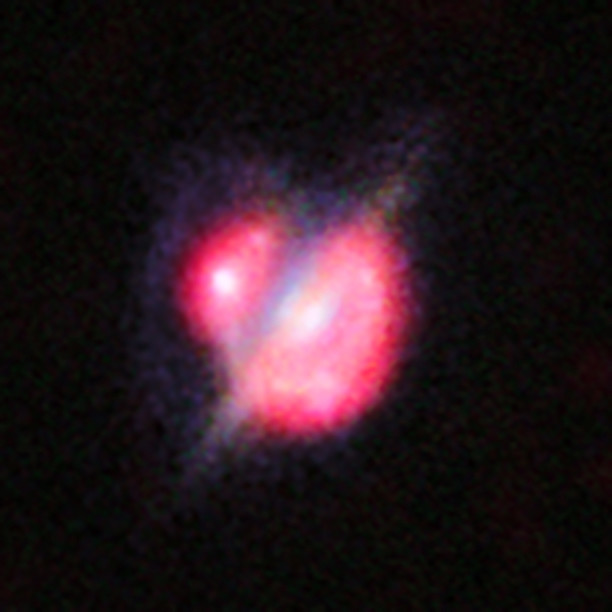
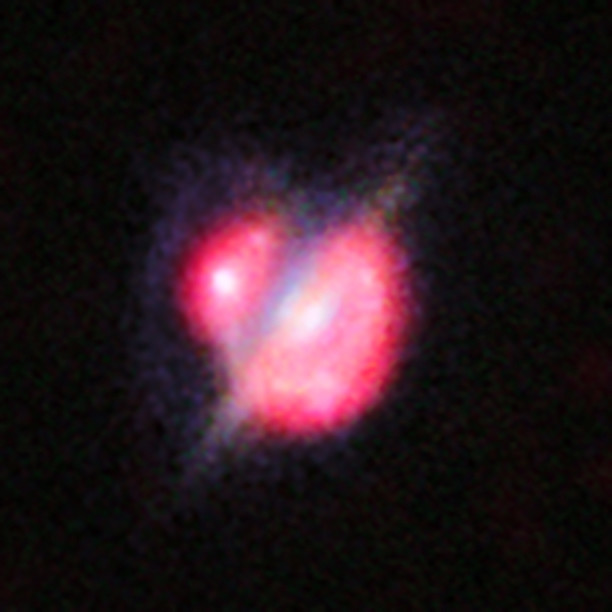
Astronomers have unveiled the detection of the most luminous and most distant natural ‘space laser’ ever observed, a colossal emission originating from the violent collision of two galaxies billions of light-years away. This extraordinary phenomenon, known as a gigamaser, was identified using the cutting-edge MeerKAT radio telescope array in South Africa.
The powerful signal, a testament to the universe’s spectacular and often violent processes, emanates from a galactic merger occurring approximately eight billion light-years from our own Milky Way. This celestial event is a prime example of how extreme cosmic occurrences can create phenomena that push the boundaries of our understanding.
The Science Behind the Gigamaser
Gigamasers, while sounding like something out of science fiction, are very real astrophysical occurrences. They are a particularly intense form of cosmic maser, which is itself the microwave equivalent of a laser. The process begins when vast quantities of gas are compressed during a galactic collision. This compression acts as a catalyst, stimulating hydroxyl molecules – a common chemical compound in space – to emit incredibly intense microwave radiation at a very specific wavelength.
The newly identified object, catalogued as HATLAS J142935.3–002836, is so exceptionally powerful that researchers have classified it as a gigamaser. This designation places it in a rare category of cosmic lasers that can be billions of times brighter than typical masers observed in space.
A Cosmic Telescope and Lens: Amplifying the Signal
Adding to the remarkable nature of this discovery is the role of gravitational lensing. This cosmic phenomenon occurs when the immense gravity of a foreground galaxy acts like a natural magnifying glass, bending and amplifying the light from objects situated behind it. In this instance, the signal from the gigamaser was significantly boosted by such an alignment.
Dr. Thato Manamela, the lead author of the groundbreaking study detailing this find, expressed his astonishment. “This system is truly extraordinary,” he stated. “We are seeing the radio equivalent of a laser halfway across the universe.”
Dr. Manamela, affiliated with the University of Pretoria, further elaborated on the unique circumstances. “Not only that,” he explained, “during its journey to Earth, the radio waves are further amplified by a perfectly aligned, yet unrelated foreground galaxy. This galaxy acts as a lens, the way a water droplet on a window pane would, because its mass curves the local space-time. So we have a radio laser passing through a cosmic telescope before being detected by the powerful MeerKAT radio telescope – all together enabling a wonderfully serendipitous discovery.”
From Masers to Gigamasers: A Spectrum of Cosmic Emissions
Natural masers are not uncommon in the cosmos and can form in a variety of environments. These include:
- Star-forming regions: Areas where new stars are being born, often rich in gas and dust.
- Cometary atmospheres: The tenuous envelopes of gas and dust surrounding comets.
- Remnants of exploding stars: The aftermath of supernovae, which can contain energetic outflows.
More powerful emissions, known as megamasers, are typically associated with more extreme astrophysical events. These often involve:
- Galaxy mergers: The dramatic process of two galaxies colliding and combining.
- Activity around supermassive black holes: The intense radiation and outflows generated by matter falling into the colossal black holes at the centres of galaxies.
The gigamaser now under scrutiny is believed to have originated from the merger of two galaxies. This cataclysmic event would have compressed vast clouds of gas, triggering intense bursts of star formation. The radiation emitted by these newly formed stars would then energise the surrounding hydroxyl molecules, leading to the amplification of their microwave emissions and the creation of the gigamaser.
The light detected by the MeerKAT telescope has travelled an incredible 7.8 billion light-years to reach Earth. This distance shatters the previous record of approximately five billion light-years for a similar cosmic object, highlighting the immense scale of the universe and the power of new observational technologies to probe its furthest reaches. This discovery opens new avenues for understanding the early universe and the extreme conditions that can forge such spectacular cosmic phenomena.