Canine Courage: Seven Dogs’ Epic 10-Mile Dash to Freedom from Chinese Meat Factory
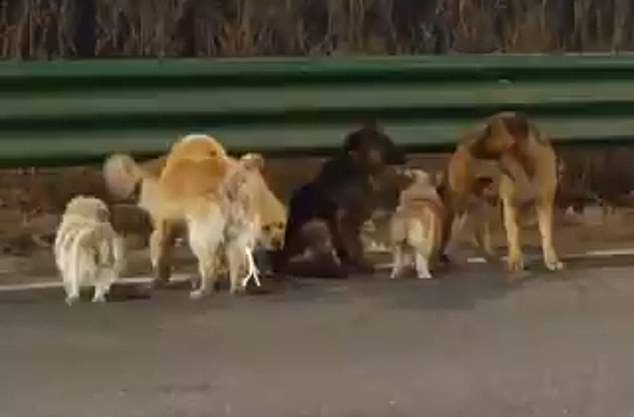
In a tale that echoes the heartwarming narratives of beloved animal films, seven dogs have captured the world’s attention with their daring escape from a meat factory in China. Their remarkable journey, spanning an impressive 10 miles, saw them band together, forming an unlikely pack of heroes as they navigated the perils of a busy highway in Changchun, Jilin province, in a desperate bid for freedom and a return to safety.
The footage captured during their escape is nothing short of extraordinary. It depicts a united front, a “band of brothers” as it were, with a wounded German Shepherd at the heart of their formation. A plucky Corgi, fearlessly leading the charge, repeatedly glances back, ensuring no member of their courageous crew is left behind. This diverse group of escapees included the loyal Golden Retrievers, the ever-popular Labradors, and a spirited Pekingese, showcasing a remarkable cross-section of canine companionship united by a common goal.
The Incredible Navigation of the Escape Artists
But how exactly did this motley crew, driven by instinct and an unknown determination, manage to find their way home? Scientists and animal behaviourists point to a fascinating interplay of innate homing instincts and highly developed sensory abilities that dogs possess. Their journey is a testament to these remarkable natural gifts.
The Power of the Canine Nose
One of the most significant factors in their successful escape is undoubtedly their unparalleled sense of smell. Dogs experience the world primarily through scent, a sense that far surpasses our own.
- Exceptional Scent Receptors: Studies have revealed that dogs possess an astonishing number of scent receptors in their noses – over 10 million, compared to humans’ mere 6 million. This biological advantage makes a dog’s nose exponentially more sensitive than ours, with some estimates suggesting it’s over 10,000 times better at detecting scents.
- Detecting the Faintest Traces: This heightened olfactory prowess means dogs can pick up on incredibly minute traces of scent. For instance, forensic detection dogs are capable of identifying as little as 0.01 microlitres of gasoline – a volume so small it’s difficult to comprehend. It’s highly probable that familiar scents from their home environment or the route taken played a crucial role in guiding them away from the factory and towards safety.
Navigating by Earth’s Magnetic Field
Beyond their incredible noses, dogs also possess a less understood, yet equally vital, navigational tool: a sensitivity to the Earth’s geomagnetic field. This ‘internal compass’ can guide them over vast distances, even when visual cues are absent.
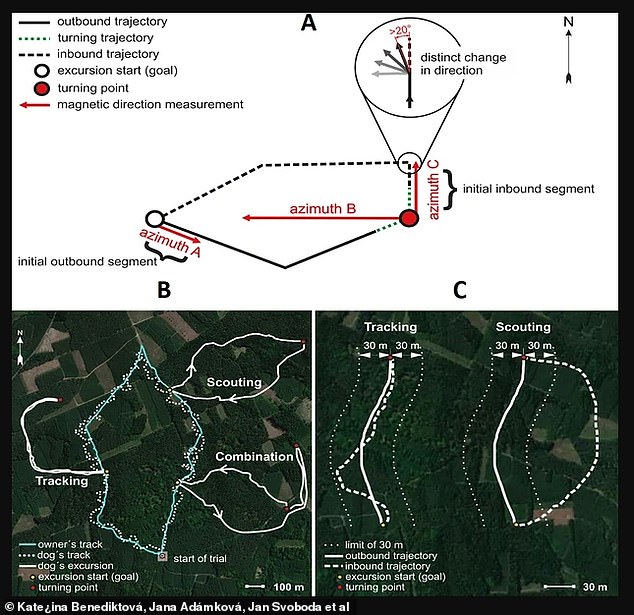
- The Compass Run Phenomenon: Research conducted by scientists at the Czech University of Life Sciences shed light on this phenomenon. Over three years, they tracked 27 dogs from 10 different breeds. During controlled releases in forests, the dogs consistently performed what researchers termed a “compass run.” This involved a short, precise dash of approximately 65 feet, aligning perfectly with the Earth’s north-south geomagnetic axis.
- Orientation for Return: The researchers concluded that this highly stereotyped alignment strongly suggests the dogs were using the Earth’s magnetic field to orient themselves for their return journey. Visual, olfactory, or celestial cues were deemed unlikely explanations, especially given the dense forestation that would have obscured many visual landmarks.
A Combination of Navigation Techniques
Once this initial magnetic orientation was established, the dogs likely employed a combination of navigation strategies to complete their trek. The research indicates that the dogs switched between two primary methods:
- Scent-Based Navigation (Tracking): Approximately 59% of the dogs in the study relied on scent trails to find their way back. This is the familiar method of “tracking,” where dogs follow a specific odour.
- Visual Navigation (Scouting): A further 32% of the dogs utilised physical landmarks and other visual information, a behaviour known as “scouting.” This involves recognising and remembering features of the landscape to guide them.
- Integrated Approach: A small but significant portion, around 8% of the dogs, demonstrated a mix of both tracking and scouting behaviours, showcasing their adaptability and resourcefulness in finding their way home.
The incredible journey of these seven dogs is a powerful reminder of the deep bonds, intelligence, and remarkable natural abilities that our canine companions possess. Their escape from the meat factory and subsequent 10-mile trek is a testament to their courage, resilience, and the enduring instinct to return to the safety and familiarity of home.