Tariffs, Tech, and Trade: How Global Commerce Navigated a Turbulent Year
It’s been nearly a year since the era of “reciprocal tariffs” was declared by US President Donald Trump, a move that aimed to fundamentally alter the landscape of global trade. Many predicted a significant downturn, a crippling blow to international commerce. However, the reality, according to a comprehensive report by the McKinsey Global Institute, paints a far more complex and surprisingly resilient picture. The “Geopolitics and the Geometry of Global Trade” report reveals that despite the highest US tariff rates seen since World War II, global trade not only survived but actually grew at a faster pace than the world economy. In a counterintuitive twist, both US imports and Chinese exports reached unprecedented highs, suggesting a significant reshaping of trade dynamics rather than a collapse.
Shifting Sands: The US-China Trade Reconfiguration
One of the most significant shifts observed was the evolving direct trade relationship between the United States and China. While flows between the two nations did indeed drop considerably, this trend predated the introduction of tariffs. Tiago Devesa, a co-author of the McKinsey report, highlighted this observation, noting that the decline in direct trade was a pre-existing trend.
The figures underscore this point: US-China trade saw a reduction of approximately 30%, with around $130 billion (approximately €112.3 billion) in Chinese exports to the US disappearing from the ledger. As the US sought alternative sourcing, Southeast Asia emerged as a major beneficiary. Countries like Vietnam, Thailand, and Malaysia absorbed a substantial portion of the displaced supply chains. Their exports to the US saw a near 14% surge, as they rerouted finished goods, particularly consumer electronics, to American consumers.
India also played a crucial, albeit more specialised, role in this recalibration. For instance, while US smartphone imports from China plunged by about 40%, equating to an $18 billion (approximately €15.5 billion) decrease, India stepped in to fill the void, increasing its smartphone exports to the US by an impressive $15 billion (approximately €13 billion).
Despite these shifts, China’s overall trade surplus managed to reach a record high. This was achieved by Chinese firms pivoting their focus to what McKinsey terms a “factory to the factories” model, significantly ramping up the production of industrial components and capital goods destined for emerging economies. To maintain competitiveness and market share globally, Chinese exporters also implemented an average price cut of 8% on their consumer goods.
The Tariffs vs. Reality: US Trade Deficit Stubbornly Persists
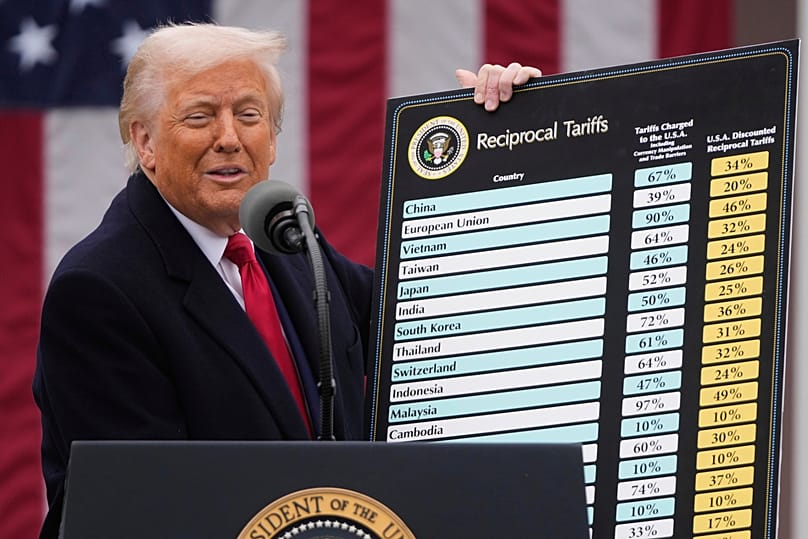
The impact of the tariffs on the US presents a stark contrast between political rhetoric and economic outcomes. President Trump’s “Liberation Day” speech in the Rose Garden articulated a strong stance against chronic trade deficits, framing them as a national security and existential threat. However, the Bureau of Economic Analysis reported a full-year goods and services deficit of $901.5 billion (approximately €779 billion) for the preceding year, a mere 0.2% reduction from $903.5 billion (approximately €780.5 billion) in the year prior.
While the trade deficit with China did narrow to $202.1 billion (approximately €174.6 billion), its smallest in over two decades, data from the US Department of Commerce revealed that this gap simply migrated. The primary beneficiaries of this shift were Vietnam and Taiwan, both of which experienced record widening of their bilateral deficits with the US.
AI: The Unforeseen Engine of Global Trade Growth
In a significant development, the United States demonstrated remarkable strength in the realm of artificial intelligence. In 2025, the US accounted for roughly half of the world’s new data-centre capacity and was the primary driver of AI-related goods demand.
The burgeoning AI sector provided a substantial boost to global trade, with AI-related shipments emerging as the single most significant contributor to growth. McKinsey’s findings indicate that exports of AI-related goods represented approximately one-third of overall trade growth. Specifically, semiconductors and data-centre equipment experienced an expansion, collectively making up over 35% of global trade.
The demand for essential hardware components, including chips, servers, and networking gear, surged as major technology firms invested heavily in building out AI infrastructure at an unprecedented pace and scale.
Asian manufacturing hubs, particularly Taiwan, South Korea, and various parts of Southeast Asia, were instrumental in supplying these critical goods to markets worldwide, with notably strong flows directed towards the US. Much of this AI-driven commerce occurred between geopolitically aligned economies, underscoring how the rapid advancement of technology has begun to reshape global trade routes, even amidst the disruptions caused by tariffs elsewhere. The report emphasizes that the robust investment in AI has left a lasting mark on trade patterns, sustaining momentum at a time when traditional trade pathways between major global powers were experiencing contraction. Devesa aptly described this phenomenon: “Every year, trade is shaped by both long-term waves and short-term splashes. The AI boom is a long-term wave that will continue to redefine trade for years to come, while the tariffs were last year’s disruptive splash.”
The EU’s “Double Squeeze”: Navigating a Complex Trade Landscape
The European Union, among the major economic blocs, provides a particularly instructive case study of the challenges posed by the current global trade environment. The report identifies the bloc as facing a “double squeeze.” On one front, the EU’s trade deficit with China has widened, with imports increasing and exports declining. Concurrently, its trade surplus with the United States has narrowed over the past year.
Furthermore, as exports to China decrease and imports rise, the EU finds itself in direct competition with the world’s second-largest economy for key markets that are traditionally significant destinations for EU exports. This intensified competition is a growing concern.
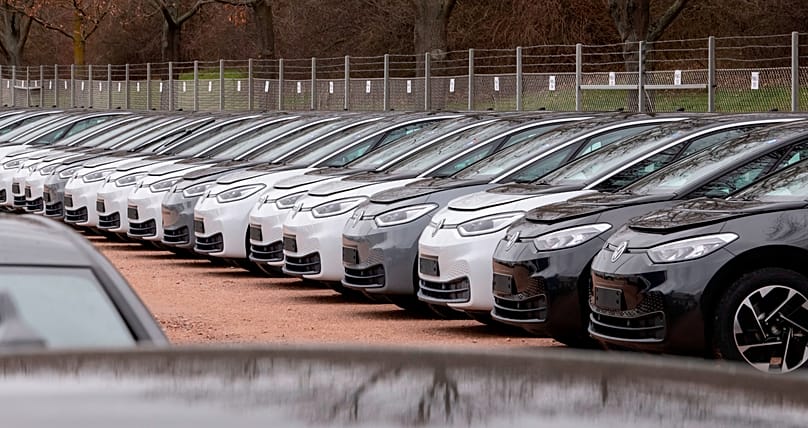
The automotive sector has been particularly hard hit. EU car exports to the US saw a 17% decline, while shipments to China dropped by over 30% in 2025. Simultaneously, Chinese electric vehicles have flooded the European market, with imports rising by approximately 50% to exceed 800,000 vehicles. In a striking reversal, Germany, the heartland of Europe’s automotive industry, imported more cars from China than it exported there for the first time in its industrial history.
When temporary pharmaceutical frontloading purchases are excluded, the EU’s manufacturing trade surplus has shrunk by an estimated $40 billion (approximately €34.5 billion). In response to this mounting pressure, Brussels is actively seeking to mitigate its vulnerabilities. In January, the European Commission forged landmark trade agreements with India and Mercosur. The pact with India, for example, includes a reduction in car tariffs from as high as 110% to 10% over five years. The agreement with Mercosur also aims to slash barriers on autos and pharmaceuticals, among other products. More recently, the EU announced a new free trade agreement with Australia. This deal aims to liberalise the flow of goods while maintaining quotas on sensitive EU agricultural products.
These strategic agreements represent a deliberate effort by the EU to diversify its trade relationships away from Washington and Beijing, which together account for approximately one-third of the bloc’s external commerce. Devesa noted that while the current scale of trade with Mercosur and India is limited, these are rapidly growing markets that offer complementary opportunities for EU products and services. For instance, India’s ambition to expand its advanced manufacturing sector creates a demand for the components that Europe can supply. The report, however, cautions that India and Mercosur combined currently represent less than 8% of EU trade, and it will take time for this share to grow significantly. These initiatives are viewed as long-term insurance policies rather than immediate solutions to current trade challenges.