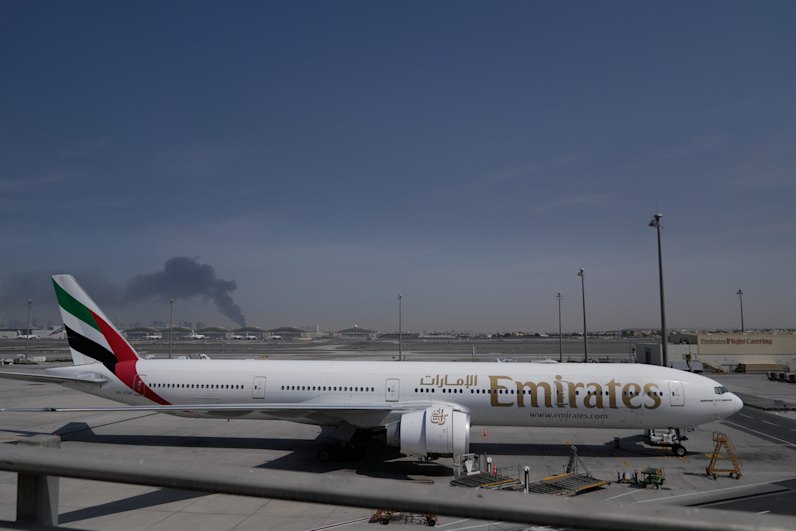
Australians caught in the escalating conflict in the Middle East are facing a labyrinth of complex and costly travel arrangements to return home. With crucial airspace closures in the region impacting a vital air travel corridor between Australasia and Europe, travellers are being forced to seek out extraordinary alternative routes, often via destinations as far-flung as South Africa and through various Asian hubs.
The current situation, triggered by military strikes against Iran, has led to a significant disruption of air travel. According to flight analytics company Cirium, approximately 40 per cent of scheduled flights in and out of the Middle East – totalling over 12,900 services – have been cancelled since Saturday evening (AEDT). This has left an estimated 11,000 Australians, who are typically transiting through the region at any given time, stranded. The Middle East serves as a major hub for airlines like Emirates, Qatar Airways (a partner of Virgin Australia), and Etihad, making the airspace closures particularly impactful.
Navigating the Disruption: Alternative Routes Emerge
For those unable or unwilling to wait for the resumption of normal air travel, the search for alternative routes is on. Travel industry professionals are reporting a surge in demand for flights through less conventional pathways.
Mark Trim, founder of Adelaide-based Complex Travel Group, highlighted the trend of travellers rebooking long-haul flights that were originally routed through the Middle East. These passengers are now opting for routes via Asia, which come with significantly inflated prices and rapidly diminishing seat availability.
“Some are flying out through Johannesburg, and home on Qantas from there,” Trim explained. “We just re-booked some clients in Cairo on that routing.” His company has been actively assisting travellers in nations within the region where airspace remains open, such as Saudi Arabia and Oman, but whose flights on major carriers like Emirates or Qatar Airways have been affected.
The Oman and Saudi Arabia Corridors: A Land and Air Solution
The closure of airspace over Qatar, Bahrain, Kuwait, Syria, Israel, Iran, and Iraq has created a strategic necessity for detours. Cirium’s Asia editor, Ellis Taylor, identified two primary corridors around the conflict zone: one to the south, encompassing Oman and southwestern Saudi Arabia, and another to the north, utilising routes over the subcontinent and Turkey.
The Southern Corridor:
- Travellers are exploring the possibility of crossing land borders into countries like Saudi Arabia and Oman, located on the Arabian Peninsula.
- Muscat, the capital of Oman, is being eyed as a potential transit point. Oman Air offers services to destinations such as Bangkok, Kuala Lumpur, and Jakarta, which could serve as gateways back to Australia.
- Flights from Oman to Phuket and Manila are also available, though direct services to Singapore are not.
- Anthony Goldman, a joint managing director of Melbourne-based Goldman Travel Group, acknowledged Muscat as a viable option, albeit one that requires a willingness to travel overland through a potentially volatile area.
The Northern Corridor:
- This route involves flights travelling over the Indian subcontinent towards Afghanistan, Turkmenistan, and ultimately Turkey, effectively bypassing Iranian airspace.
- Taylor noted that this northern path appears to be facilitating the operation of flights from India and Southeast Asia to Europe with minimal deviations.
Adapting to the New Reality: Qantas and Qatar Airways
Major airlines are also adjusting their operations to accommodate the disruptions. Qantas chief executive Vanessa Hudson confirmed that the Australian carrier has customers on code-share services with Emirates who are stranded. However, Qantas’s own services, particularly those flying to Europe via Perth and Singapore, have not been significantly affected.
In response to the constraints on passenger traffic, Qantas announced that its previously non-stop Perth-to-London service would include a stop in Singapore from Wednesday. This change is expected to add capacity for up to 60 extra passengers on the route.
Qatar Airways, a key partner for Virgin Australia, has suspended its Doha services until March 5th, citing “the ongoing security situation in the Middle East and the closure of Qatari airspace.”
Expert Advice for Stranded Travellers
Travel agents are urging those stranded to seek professional assistance. Goldman of the Goldman Group strongly advised Australians to consult with travel agents who possess the expertise to navigate these complex and rapidly evolving travel arrangements.

He also pointed out that the UAE has committed to covering all hosting and accommodation costs for affected and stranded passengers in hotels, a crucial piece of information for those currently in the Emirates.
Online travel agency Webjet has observed a shift in booking patterns, with travellers increasingly redirecting through Asian hubs like Singapore, Bangkok, and Kuala Lumpur. They are also seeing a rise in bookings for the direct Perth-London service, which now includes the Singapore stopover. A Webjet spokesperson stated, “We are working closely with airline partners and, where flights are operating, helping customers explore alternative routes across different airlines – whether they are in Europe trying to return to Australia, or vice versa.”

The current situation underscores the importance of flexibility and resilience in international travel, particularly during times of geopolitical instability. While the options may be limited and the costs higher, creative solutions are emerging to help Australians find their way back home.