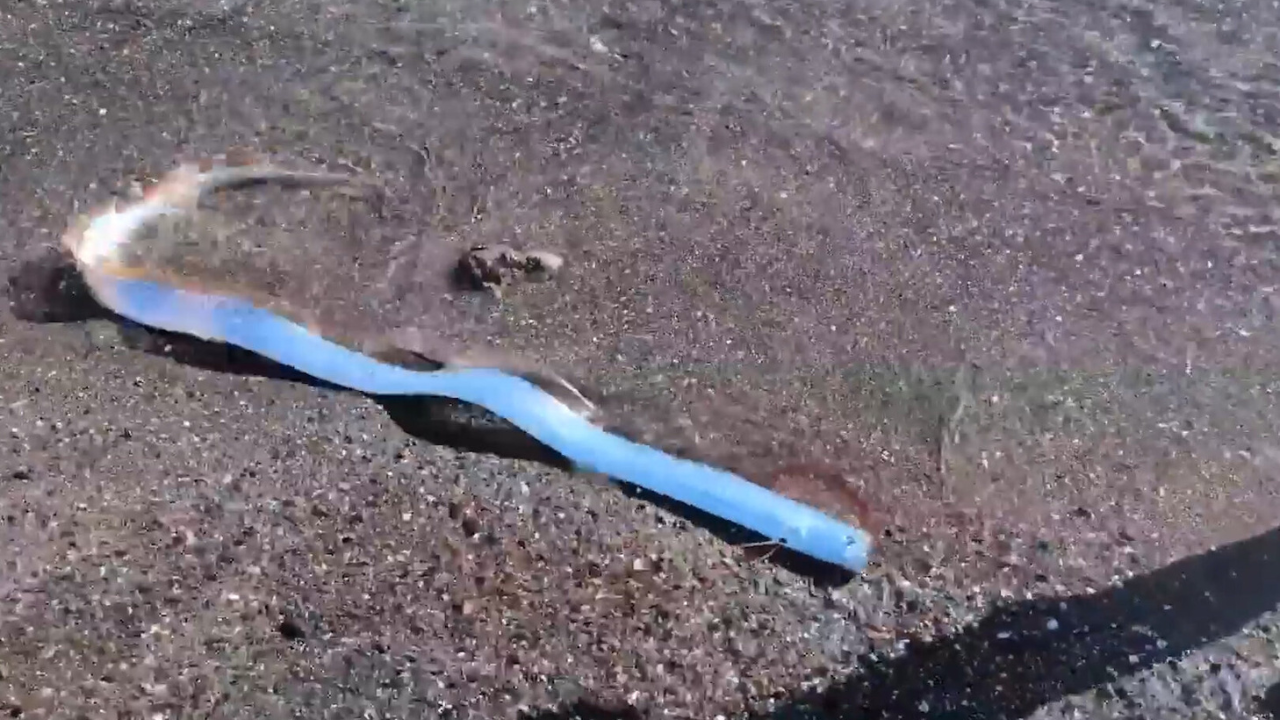
The shores of Cabo San Lucas in Mexico recently became the stage for an unusual and somewhat unsettling spectacle: not one, but two deep-sea oarfish washing ashore late last month. The sight drew a considerable crowd of onlookers, a mix of curiosity and concern palpable in the air. One of the colossal fish had beached itself firmly in the sand, while the other, tragically, was observed struggling for survival in the shallow waters.
Reports from the scene indicate that beachgoers attempted to assist the distressed oarfish in the shallows, guiding it back towards deeper waters. However, accounts regarding the fate of the oarfish that landed on the sand vary, with some suggesting it was found deceased and others claiming it managed to swim away alongside its companion. Regardless of the exact outcome for the individual fish, footage of this extraordinary event quickly went viral, reigniting ancient folklore and superstitions surrounding the oarfish, often ominously dubbed the ‘doomsday fish’.
The Ominous Oarfish: A Harbinger of Calamity?
Across various cultures, the appearance of oarfish from the ocean’s depths is steeped in a lore of ill omen. In Taiwan and Japan, these elusive creatures are commonly referred to as ‘earthquake fish’ or, with even greater dread, ‘apocalypse fish’. The oarfish’s most notorious moniker, however, remains the ‘doomsday fish’. Japanese folklore, in particular, paints a grim picture of this magnificent but rarely seen animal, with its elongated body and distinctive facial features sometimes described as resembling a human face on a fish’s form.
The sheer rarity of spotting an oarfish, let alone two in such close proximity as witnessed in Mexico, underscores its deep-sea habitat. These creatures are native to the ocean’s ‘twilight zone,’ a region that plunges to depths of around 1,000 metres (over 3,280 feet). Their infrequent surfacing is, according to popular superstition, a harbinger of impending disaster or significant calamitous events. This belief is not entirely without historical reference; a study published in the Bulletin of the Southern California Academy of Sciences in 2018, for instance, noted a mere 19 documented oarfish sightings in California over the entire preceding century.
The recent double sighting in Cabo San Lucas has, naturally, fuelled this age-old superstition. Online discussions have ranged from theories attributing the oarfish’s appearance to oceanic pollution disrupting deep-sea ecosystems and forcing these creatures to the surface, to more light-hearted, albeit nervous, jokes. Some netizens quipped that returning the struggling fish to the sea was akin to “hitting the snooze button on doomsday disaster,” a dark humour reflecting the underlying unease.
Scientific Perspectives and Superstition
While the ‘doomsday fish’ narrative is deeply ingrained in popular culture and folklore, scientists offer more grounded explanations for these rare appearances. Changes in ocean currents, seismic activity, or even illness can cause deep-sea creatures to become disoriented and ascend to shallower waters or wash ashore. The oarfish, with its immense size and unusual physiology, is particularly striking when observed out of its natural environment.
The belief in the oarfish as an omen is, at its core, a matter of faith in superstition. However, the psychological impact of such a rare and dramatic natural event, especially when coupled with existing folklore, is undeniable. The sight of these ancient, mysterious creatures, thrust from the abyss into the human world, inevitably sparks a sense of awe and, for many, a touch of apprehension about the unknown forces at play in our planet’s vast oceans. The two oarfish in Cabo San Lucas serve as a potent reminder of the mysteries that lie beneath the waves, and the enduring power of stories passed down through generations.