In the heart of New South Wales’ rural Goulburn, a group of residents, initially admitting to knowing “nothing” about solar farms, embarked on an ambitious journey 12 years ago to build a commercial-scale renewable energy project. Their motivation stemmed from a deep frustration with the perceived lack of action on climate change. The result of this collective drive is a 1.4-megawatt solar farm on the outskirts of town, a project wholly owned by the community, demonstrating Goulburn’s progressive spirit.
“What this farm shows is that Goulburn is not a backwards, conservative, country city,” explained Ed Suttle, one of the driving forces behind the initiative. “Within that country city are enough people, with enough oomph and energy to create something that is bloody close to unique.”
A Groundbreaking Community Undertaking
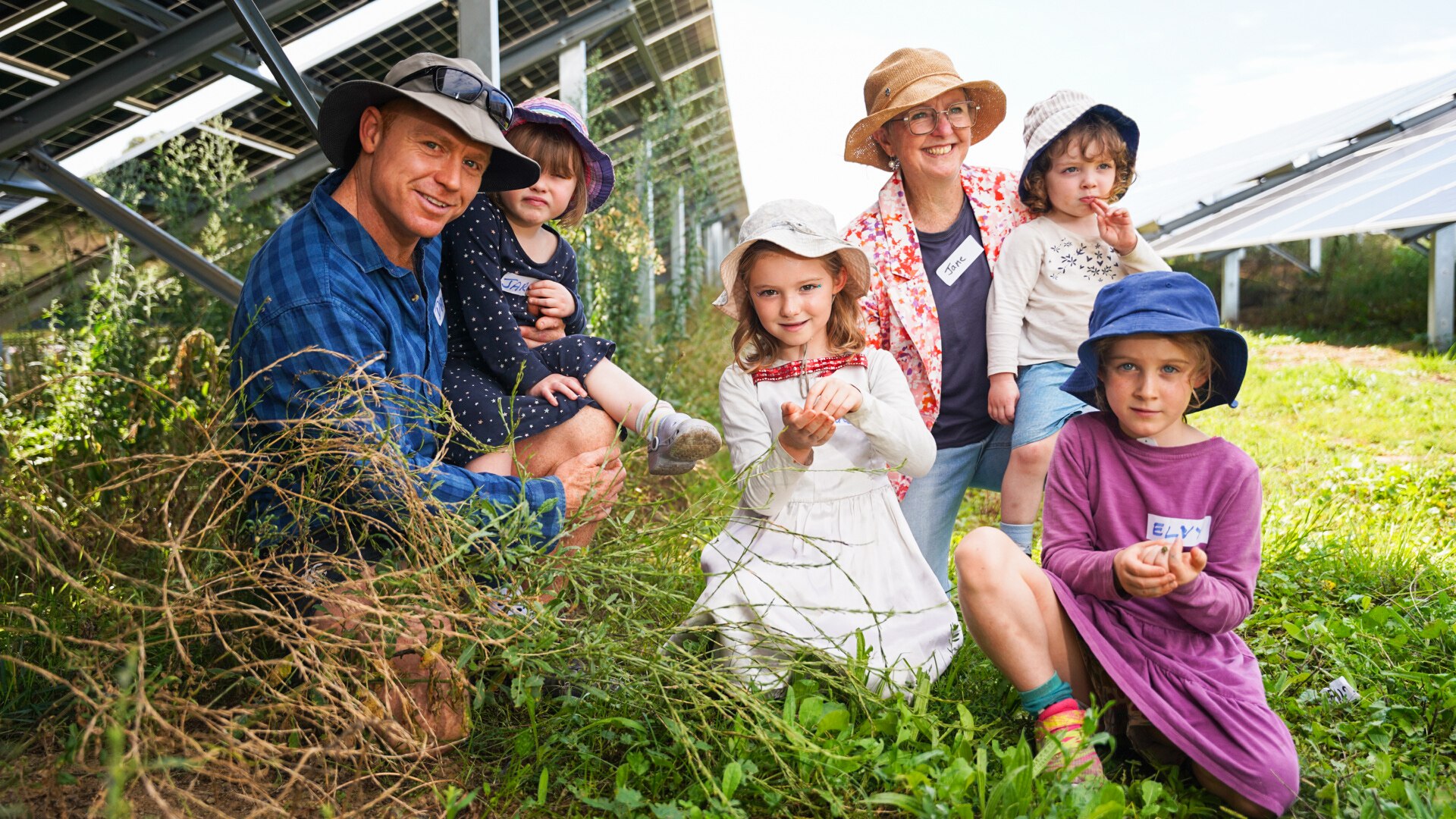
The Goulburn Community Solar Farm is a testament to what can be achieved when a community unites. It comprises 2,300 solar panels and a substantial 4-megawatt battery, collectively capable of powering approximately 500 homes. This impressive setup positions it as one of Australia’s largest community solar projects and, crucially, the first to incorporate battery storage.
The vision resonated with 288 investors, who collectively contributed $3.2 million. This was further bolstered by a $2.3-million grant from the state government. Investments varied significantly, from a modest $400 to purchase a single panel to a substantial $100,000. Among the youngest shareholders are Ed Suttle’s own grandchildren, a poignant symbol of intergenerational commitment to a sustainable future.
Dave Suttle, Ed’s son, reflected on the journey: “For a long time, it has been talk around the kitchen table. Suddenly here we are in amongst the panels, watching the sun send electrons to the people and my kids all own little parts of this with the community.” He highlighted the solar farm’s role in restoring power to the community during a period of energy uncertainty. “The sun is coming back for free; it’s going to be doing that for a very long time,” he stated. “It’s not as if there’s a Strait of Hormuz between us and the sun. It comes down for free and we should be harnessing it and, all the better, the community owns it.”
People Power and Shared Benefits
The Goulburn Community Solar Farm operates by selling energy back to the national grid. This generates a dividend for investors, estimated at around five per cent. Importantly, a portion of the profits is earmarked for a community fund, designed to assist those within the community who struggle to afford their electricity bills.
“Part of the profits will go into that fund to assist those within our community who can’t afford to buy electricity every quarter,” Mr. Suttle elaborated.
The facility is structured as a cooperative, a democratic model that grants every investor an equal say in its operation, irrespective of their financial contribution. For the majority of the investors, the project transcends mere financial returns; it represents a tangible commitment to renewable energy and community empowerment.
Heather West, a local resident and investor, expressed her enthusiasm: “Goulburn’s like that, the community gets together and makes things happen, so it’s just wonderful. We need more of these in Australia; I mean, we’ve got it, haven’t we — the sun — and we should be using it.”
Rita Warleigh echoed this sentiment, stating, “It’s definitely a show of support for renewable energy and it is the way forward and things are changing; they have to. The climate is in a crisis.”
Sheep farmer Dimity Taylor finds satisfaction in seeing the solar panels as she drives into town. “I think it’s that sense of control and feeling you’re a part of the change and a part of the solution that gets people emotionally invested, not just financially invested,” she commented.
Navigating Bureaucratic Hurdles
Despite the community’s enthusiasm and dedication, the path to energised panels was not without its challenges. Bureaucratic delays significantly extended the project’s timeline.
“Every single government body with whom we had to deal and get certificates was far, far slower in their work and determination than we could have ever anticipated,” said Ed Suttle.
The chosen location of the solar farm, adjacent to a rail line, necessitated extensive consultations with rail authorities. A regulatory approval process that was initially slated for six weeks stretched into an arduous 18 months. These delays, compounded by the onset of the COVID-19 pandemic, set the project back by several years.
“I think many organisations just weren’t used to dealing with our-sized projects and one that was run by a community organisation. We’re not professionals,” Mr. Suttle explained. “We’re not a massive international developer, and neither are we a simple company putting panels on a roof, we’re somewhere in between.”
Addressing the ‘Missing Middle’ in Renewables
Community-led renewable energy projects like Goulburn’s often fall into the category of “mid-scale” energy initiatives, bridging the gap between massive commercial ventures and individual rooftop solar installations.
Kim Mallee, director at the Community Power Agency (CPA), a non-profit organisation dedicated to supporting community renewable projects, identifies this as a critical area for development in Australia. “Something that is missing in the Australian renewable sector is what we call the missing middle, and it’s mid-scale solar and wind projects,” Ms. Mallee stated.
The CPA’s recent mentorship program, designed to assist communities in establishing their own renewable projects, saw an overwhelming response, with 26 applications for just five available places. “There are a huge amount of projects across Australia that want to be able to have agency over their own energy sovereignty where they are,” Ms. Mallee observed.
Ed Suttle expressed his hope that future community renewable projects will face a smoother process. “This has been a very hard road; it took us nearly 12 years. If we did it again, the pain would be gone because we’d know the obstacles in front of us,” he concluded. “It is not that difficult, it just requires a lot of patience, and it does require a community behind you.”