A Once-in-a-Lifetime Cosmic Spectacle
Brace yourself for a celestial event that sounds almost too extraordinary to be true: NASA has confirmed that the massive asteroid known as Apophis, often referred to as the “God of Chaos,” will make a historic close pass by Earth. This cosmic encounter will bring the asteroid closer than any object of its size in recorded history, even slipping beneath the orbit of many satellites. Remarkably, the asteroid is expected to be bright enough to be seen with the naked eye, offering a rare and potentially awe-inspiring spectacle for millions around the globe.
The God of Chaos Asteroid Set for Historic Close Pass
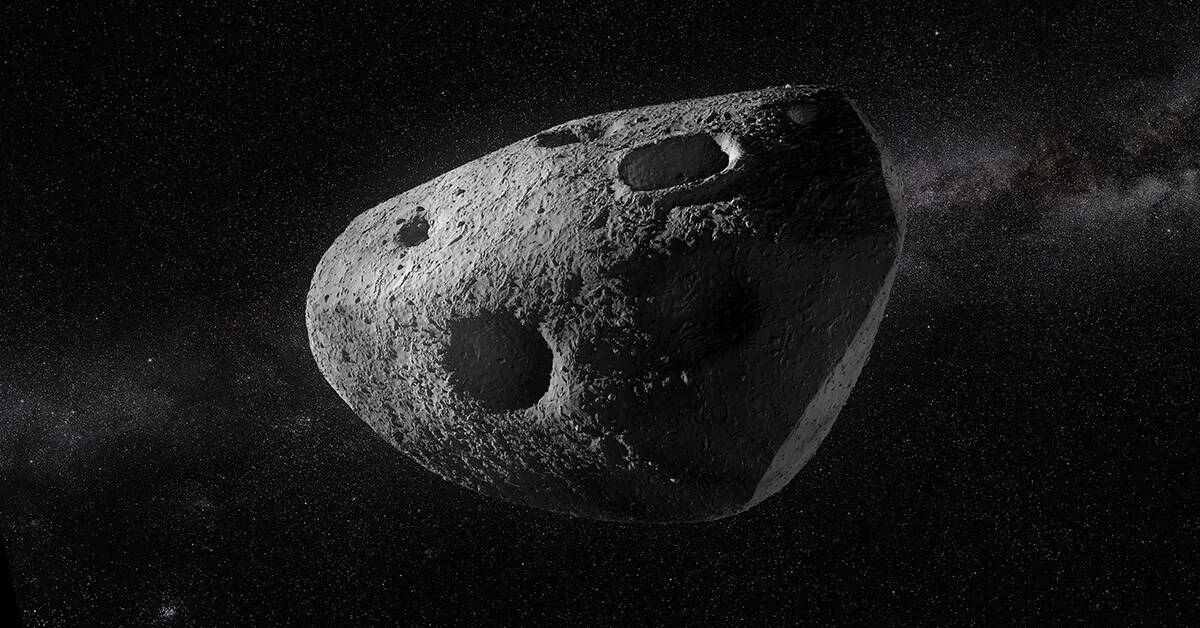
In an unprecedented celestial event, a massive asteroid is set to make a record-breaking flyby of Earth, passing closer than any other object of its magnitude in recorded history. Named Apophis, after the Egyptian deity of darkness and ruin, this 1,230-foot space rock is an absolute giant, comfortably surpassing the height of the 1,083-foot Eiffel Tower.
According to NASA, the “God of Chaos” is scheduled to arrive on Friday, April 13, 2029. While the date may sound ominous, the agency assures that the flyby will be safe, providing a rare opportunity for people across the globe to witness the asteroid’s passage. At its closest approach, Apophis will come within 20,000 miles of Earth’s surface. To put that into perspective, the asteroid will be nearly 12 times closer to us than the moon, effectively dipping inside the orbital altitude of many high-flying satellites.
The scientific community sees this as a landmark moment for planetary study. NASA noted that asteroids of this scale only encounter Earth “every few thousand years on average, so it’s likely that an event like this has not happened at any time in recorded human history.” Beyond the sheer rarity of the proximity, the timing allows for a unique level of scrutiny. As the agency pointed out, “Without a doubt, this is the first time it’s happened when humans have had the technology to observe it.” This 2029 encounter represents a singular opportunity for researchers to study a behemoth of the solar system from a front-row seat.
If skies remain clear, millions across the Eastern Hemisphere could witness the approach of Apophis with nothing more than their own eyes. According to NASA, the asteroid’s remarkable flyby will be visible from the ground without the need for telescopes or binoculars, giving both dedicated skywatchers and casual observers a rare chance to see a colossal space rock glide past Earth in real time.
Is Earth Really Safe from the God of Chaos Asteroid?
Despite the asteroid’s ominous name, NASA has officially confirmed that Earth is not in danger. The space agency has clarified that there is no threat to our planet, our orbital satellites, or the astronauts currently in space.
While the asteroid is currently labeled as “potentially hazardous” by Space.com, this designation reflects its massive size and proximity rather than an active threat level. The journey to this “all-clear” status took years of rigorous tracking. When the rock was first discovered in 2004, it briefly reached Level 4 on the Torino Impact Hazard Scale, with early calculations suggesting a 2.7% chance of a catastrophic impact in 2029, 2036, or 2068.
However, following advanced radar observations in 2021, NASA was able to definitively rule out any collision risk for at least the next century. Rather than a disaster scenario, the 2029 flyby is now being treated as a premier scientific mission. The European Space Agency (ESA) is even preparing its Rapid Apophis Mission for Space Safety (Rames) team to shadow the asteroid. Their goal is to monitor the journey in real-time and study the fascinating ways the asteroid is warped and physically altered by the pull of Earth’s gravity.
Will the God of Chaos Asteroid Return After 2029?
Yes — Apophis isn’t a one-time visitor. After its dramatic 2029 flyby, the massive space rock will return in 2036, though this time it will pass much farther from Earth, making the encounter far less remarkable than its record-breaking close approach. On March 30, 2036, Apophis will pass Earth at a much greater distance: 5.2 million miles. That’s more than 20 times the distance between the Earth and Moon.