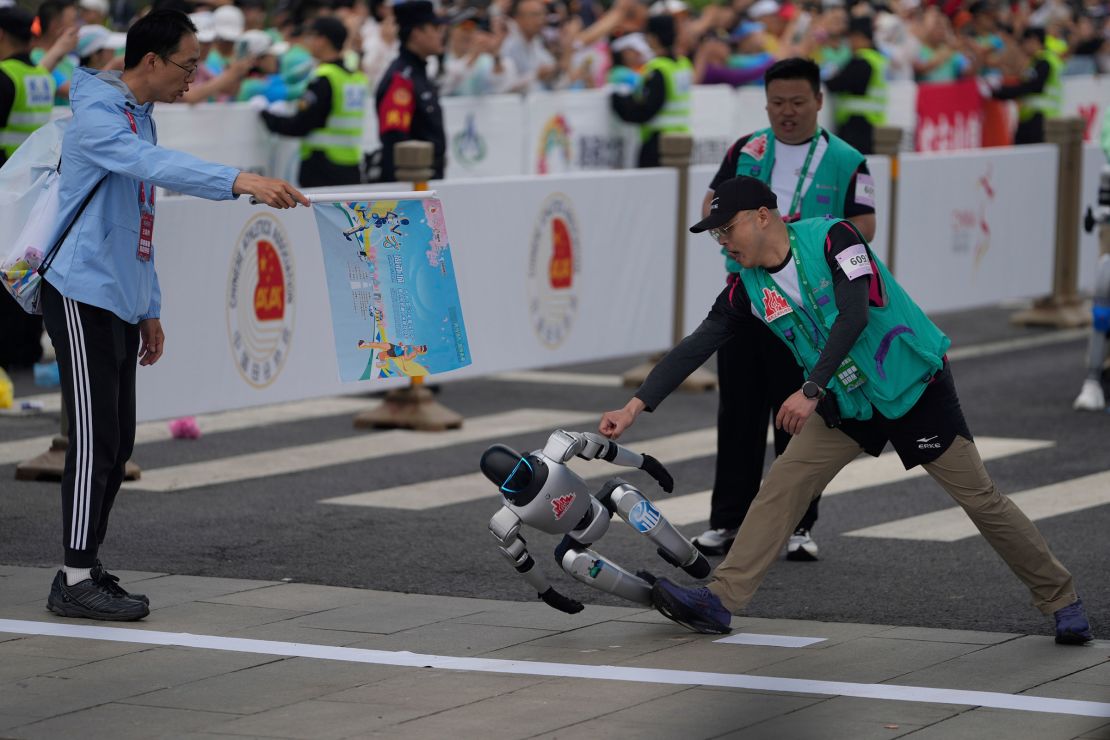
Humanoid Robot “Flash” Wins 2026 Beijing E-Town Half-Marathon
In a groundbreaking event that showcased the intersection of technology and athleticism, a humanoid robot named “Flash” from Shenzhen Honor Smart Technology Development Co. Ltd claimed victory at the 2026 Beijing E-Town half-marathon. The robot completed the 21.0975-kilometer race in 50 minutes and 26 seconds using autonomous navigation, surpassing the human world record of 57 minutes and 20 seconds set by Uganda’s Jacob Kiplimo at the Lisbon Half Marathon last month.
This achievement marks a significant milestone in the development of humanoid robots, demonstrating their growing capabilities in real-world environments. The race not only highlighted technological advancements but also emphasized the potential for robots to perform complex tasks with precision and efficiency.
Evolution of the E-Town Half-Marathon
The E-Town half-marathon, which began in 2025, has seen remarkable growth over the years. In its inaugural edition, Tiangong Ultra secured the win with a time of two hours, 40 minutes, and 42 seconds. Only six out of the 20 competing teams managed to finish the race, making it a historic event in the field of robotics.
By 2026, the competition had expanded significantly, with more than 100 teams participating. Among them were teams from Germany, France, and Brazil, showcasing the global interest in this unique event. The increased participation reflects the growing enthusiasm for integrating advanced robotics into competitive sports.
Competition Rules and Innovations
The competition rules for the 2026 E-Town half-marathon remained consistent with previous editions, ensuring safety and fairness. Both robots and human runners followed the same route but used separate lanes. The cutoff time for robots was set at three hours and 40 minutes, allowing for a balanced competition.
This year introduced a new format, offering two modes of participation: remote control and autonomous navigation. Teams opting for remote control had their finishing times multiplied by a coefficient of 1.2, encouraging the use of autonomous navigation. Approximately 40% of the teams chose this mode, aiming for better results and pushing the boundaries of robotic technology.
Technological Advancements and Future Implications
Liang Liang, deputy secretary-general of the Chinese Institute of Electronics, explained the significance of the coefficient setting. “The purpose of this coefficient is to guide and encourage research and development in autonomous navigation, which represents a technological foundation for humanoid robots to be applied in more scenarios in our daily life towards the future,” he stated.
This initiative underscores the importance of autonomous navigation in the evolution of humanoid robots. As these machines become more capable, they could find applications in various fields, from healthcare to logistics, transforming how we interact with technology in everyday life.
Human Runners Shine in the Event
While the focus was on the robots, the human athletes also delivered impressive performances. China’s Zhao Haijie won the men’s title with a time of one hour, seven minutes, and 47 seconds, while his compatriot Wang Qiaoxia took the women’s race with a time of 1 hour, 18 minutes, and 6 seconds. Their achievements highlighted the competitive spirit and dedication of human runners, even in the shadow of technological marvels.
Conclusion
The 2026 Beijing E-Town half-marathon was a testament to the rapid advancements in robotics and the evolving relationship between humans and machines. With each passing year, the event continues to push the limits of what is possible, inspiring innovation and redefining the future of both athletics and technology. As humanoid robots like “Flash” continue to improve, the line between human and machine becomes increasingly blurred, opening up exciting possibilities for the future.