The Impact of the US-Iran Conflict on Global Shipping
The ongoing tensions between the United States and Iran have led to the closure of the Strait of Hormuz, a critical maritime passage that has had far-reaching consequences for global shipping. This situation has not only affected fuel supplies but also disrupted plans for an innovative electric vessel.
The China Zorrilla: A Grounded Innovation
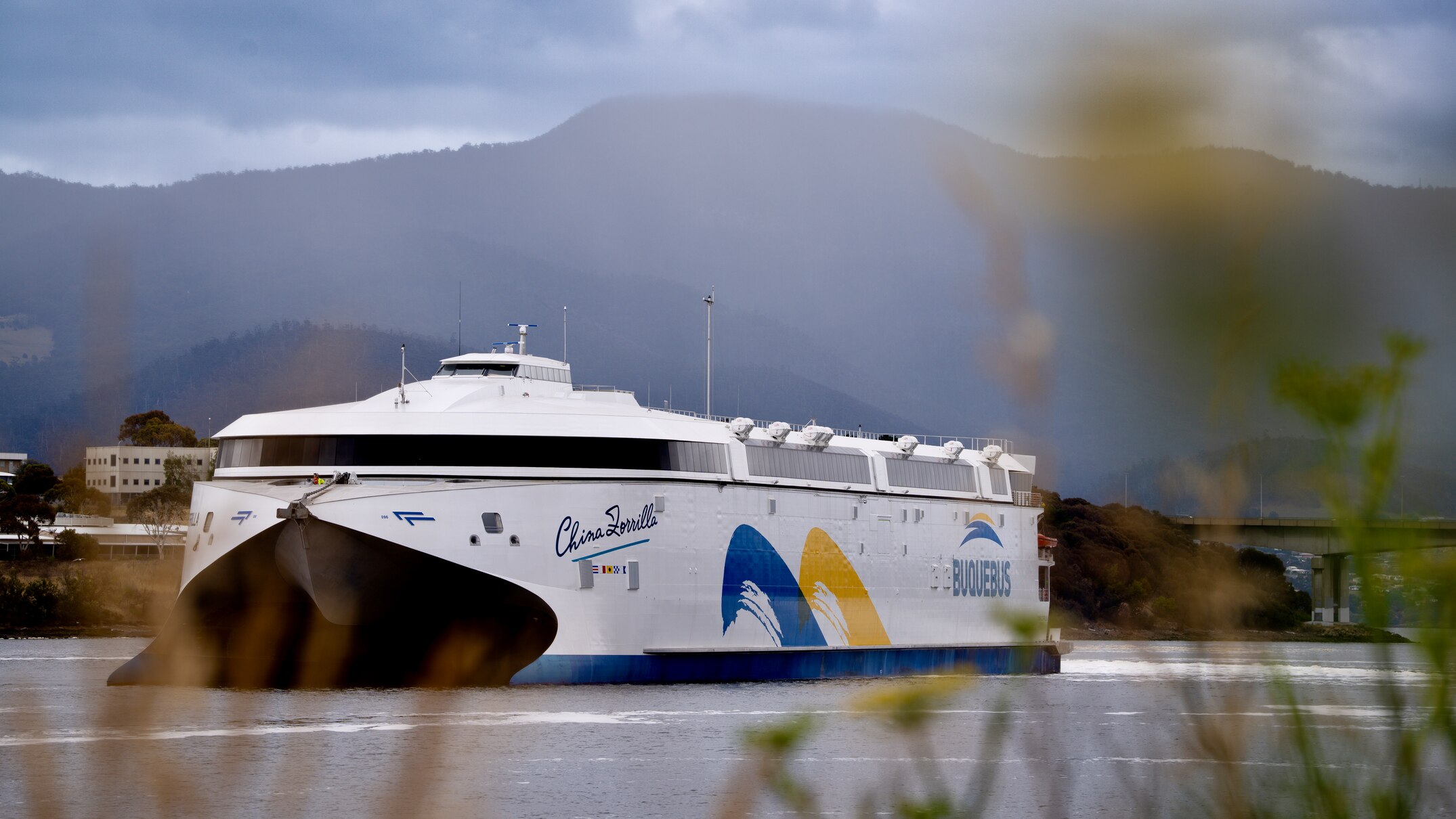
The world’s largest battery-powered ship, the 130-metre-long China Zorrilla, is currently idle in Hobart’s River Derwent, awaiting its journey to South America. However, due to the current geopolitical situation, it is unable to proceed. The larger heavy-lift ship that was supposed to transport the China Zorrilla to South America is among thousands stuck in the Strait of Hormuz.
Craig Clifford, managing director of Incat, explained that the ship owner, Buquebus, is closely monitoring the situation. “It’s just an unfortunate coincidence where the ship was at the time,” he said. “They’ve got commercial arrangements in place, but, as you can imagine, they’re being frustrated at this stage, given the inaccessibility through that particular strait.”
Powering the Future of Shipping
On board the China Zorrilla are around 500 batteries, which provide enough energy to run the ferry for roughly 90 minutes. However, this is insufficient for the 28-day journey from Tasmania to South America. “Traditionally, we’ve just had a customer turn up when the ship’s been ready, put hundreds of thousands of litres of diesel into the ship and sail away, but obviously that’s not the case with this particular vessel,” Mr Clifford said.
The Role of Heavy-Lift Ships
Heavy-lift ships play a crucial role in transporting large cargo, including other ships like the China Zorrilla. These vessels can carry around 100,000 tonnes and are essential for moving oil rigs, cargo, or other ships. Mr Clifford described the process: “If you think about a flat-tray ute in shipping’s terms, and it will come into Hobart and sink down such that the flat tray is submerged, our vessel will go on board and then it’ll be, the ship will be lifted back up again.”
Exploring Alternatives
In light of the current challenges, Mr Clifford mentioned that one option being considered is the use of diesel generators on board to power the ship’s electric motors. “All sorts of options are being explored, including alternative heavy-lift ships, so we’ll keep working with the customer in that regard,” he said.
Future Plans and Capabilities
Once the China Zorrilla enters service, it will connect the Uruguayan capital Montevideo with Argentina’s capital Buenos Aires, carrying up to 2,100 passengers and 225 vehicles. At top speed, it will be able to travel at about 25 knots.
Earlier this year, sea trials were conducted to test the ship’s onboard operational performance, control systems, propulsion, and manoeuvrability. “It is a real world-leading product and we’re very proud of it and looking forward to getting it into service, as is our customer,” Mr Clifford said.
Expanding Electric Ship Technology
Since pioneering the electric ship technology, Incat has received more orders. The company is currently working on three similar battery electric ships for the Danish ferry operator Molslinjen. The first of these is expected to be delivered in late 2027. This continued investment highlights the growing interest in sustainable and innovative shipping solutions.