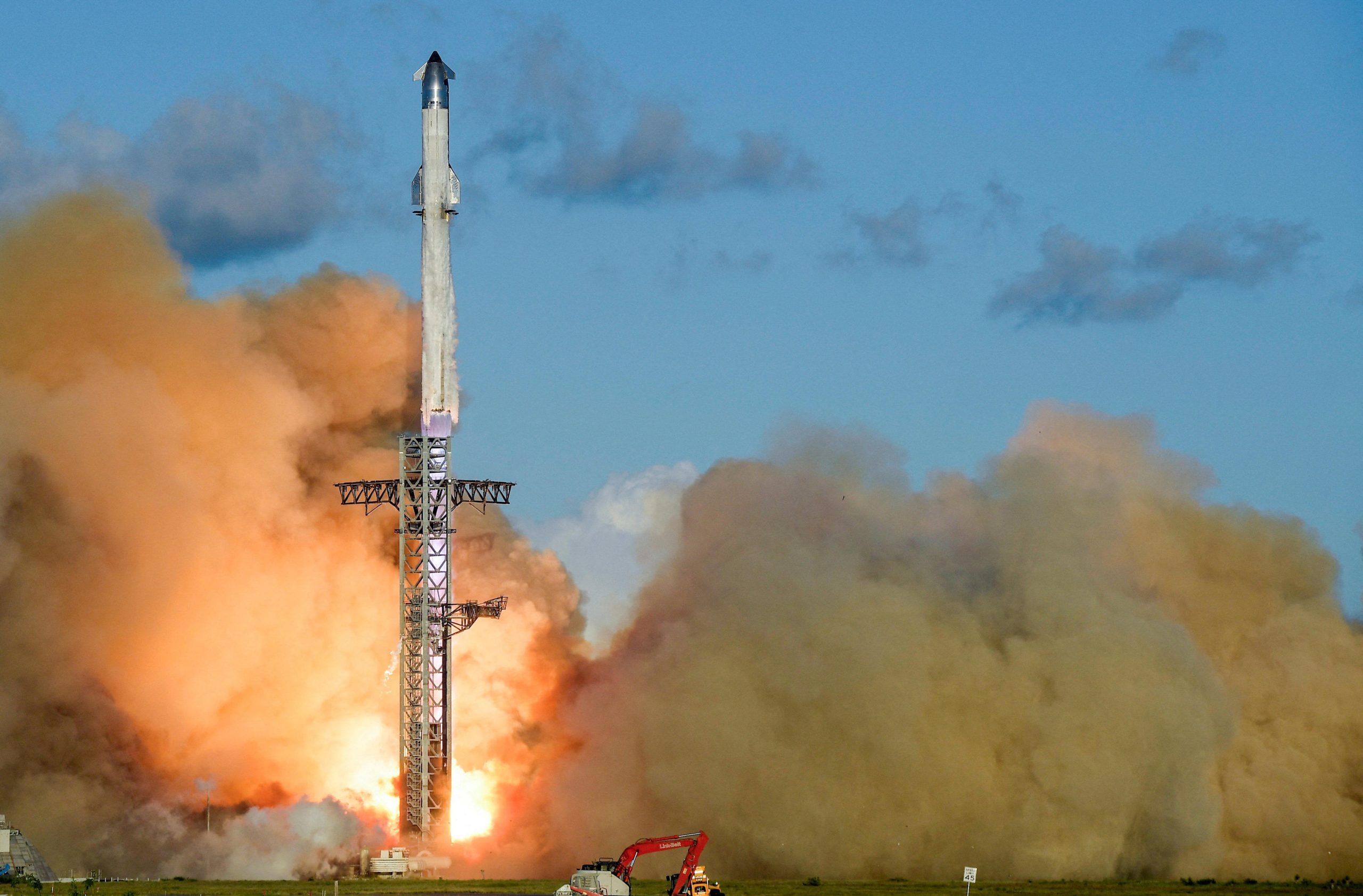
The world’s largest rocket is about to get even larger. SpaceX is on the verge of launching a new version of its Starship vehicle that will be the company’s most powerful and largest rocket yet. This third generation of Starship is not only bigger but also more advanced than its predecessors. It will take off from an entirely new launch pad at SpaceX’s South Texas headquarters, marking a significant milestone in the company’s development.
The long-awaited launch comes as SpaceX, founded by billionaire tech mogul Elon Musk in 2002, works to have Starship ready for NASA’s crewed missions to the moon’s surface. The new-and-improved prototype features numerous upgrades to both the Starship’s lower stage booster and its upper stage vehicle, aiming to enhance overall performance.
SpaceX to debut Starship V3 on next Texas flight test
The next version of Starship to launch from SpaceX’s facility in South Texas will be the largest rocket the company has ever built. Standing at approximately 407 feet tall when fully stacked, the rocket is about 4 feet taller than its predecessor and more powerful than any previous iteration of the rocket that has launched to date.
SpaceX, which has not conducted a Starship flight test since October 2025, has taken extra time between missions to finalize the new Starship, known as Version 3 (V3). The rocket is scheduled to launch on May 19 with a launch window opening at 6:30 p.m. ET, as announced by SpaceX.
Starship V3 could reach orbit, land on the moon, Mars
If all goes according to plan, Version 3 of Starship could be the model that finally reaches orbit and refuels its upper stage midflight. This complex process involves two Starships equipped with docking adapters meeting in orbit to transfer hundreds of tons of super-cooled propellant. This capability is essential if Starship is ever to transport humans into deep space, including to Mars – as Musk has long envisioned. Starship also remains central to NASA’s Artemis moon program, as SpaceX, along with Blue Origin, is among the commercial companies contracted to design a lunar lander to take astronauts to the surface.
Similar to previous designs, the fully integrated spacecraft consists of both a 236-feet-tall lower-stage booster known as Super Heavy, as well as a 171-feet-tall upper stage simply called Starship. Powered by 33 of SpaceX’s Raptor-class engines, the booster provides the initial burst of thrust at liftoff, while the vehicle is where the crew and cargo would ride in orbit after the stages separate.
SpaceX is developing the rocket to be a fully reusable transportation system that can also carry huge satellites and other payloads to space, meaning both the rocket and vehicle can return to the ground for additional missions.
What makes Version 3 different from previous Starship?
Both the Super Heavy booster and the upper stage, sometimes referred to as “Ship,” underwent significant upgrades in preparation for launch, according to SpaceX. Among the changes unveiled in a lengthy post on its website, SpaceX reduced the number of grid fins on the booster from four to three while enlarging each one by 50% and making them stronger. The upper stage that flies in orbit underwent a redesign of its propulsion systems, allowing it to carry more fuel for long-duration missions.
The rocket’s Raptor engines were also upgraded to provide more thrust at liftoff, according to SpaceX. The main objective of the flight test, as explained online, is to test both new pieces of hardware “in the flight environment for the first time.”
Starship to launch from upgraded launch pad at Starbase
Since its maiden voyage in April 2023, Starship has always launched from SpaceX’s Starbase company town and headquarters in Texas near the U.S.-Mexico border. That won’t change until SpaceX expands launch operations to Florida, potentially in 2026. However, for flight 12, SpaceX plans to get Starship off the ground from a completely new launch pad at Starbase.
The launch pad, called Pad 2, has been outfitted with an upgraded “propellant farm” that increases storage capacity and includes more pumps, enabling much faster vehicle filling for launch. Additionally, the mechanical arms on the launch tower tasked with catching a returning booster – nicknamed “chopsticks” – are now shorter to allow them to move more quickly to track and secure Super Heavy as it descends.
SpaceX puts Starship through preflight tests
SpaceX has been putting Starship through various tests at Starbase in the lead-up to announcing an official target launch date. In April, the company conducted individual static fire tests on both the Super Heavy booster and the Starship upper stage while each was anchored on a test stand separate from the launch pad. A static fire test involves firing a rocket’s engines while it’s firmly on the ground, producing thrust to ensure everything is working properly before launch.
SpaceX then announced May 9 that the spacecraft had been fully integrated on the launch pad ahead of a launch rehearsal involving fueling the rocket with more than 11 million pounds of propellant.