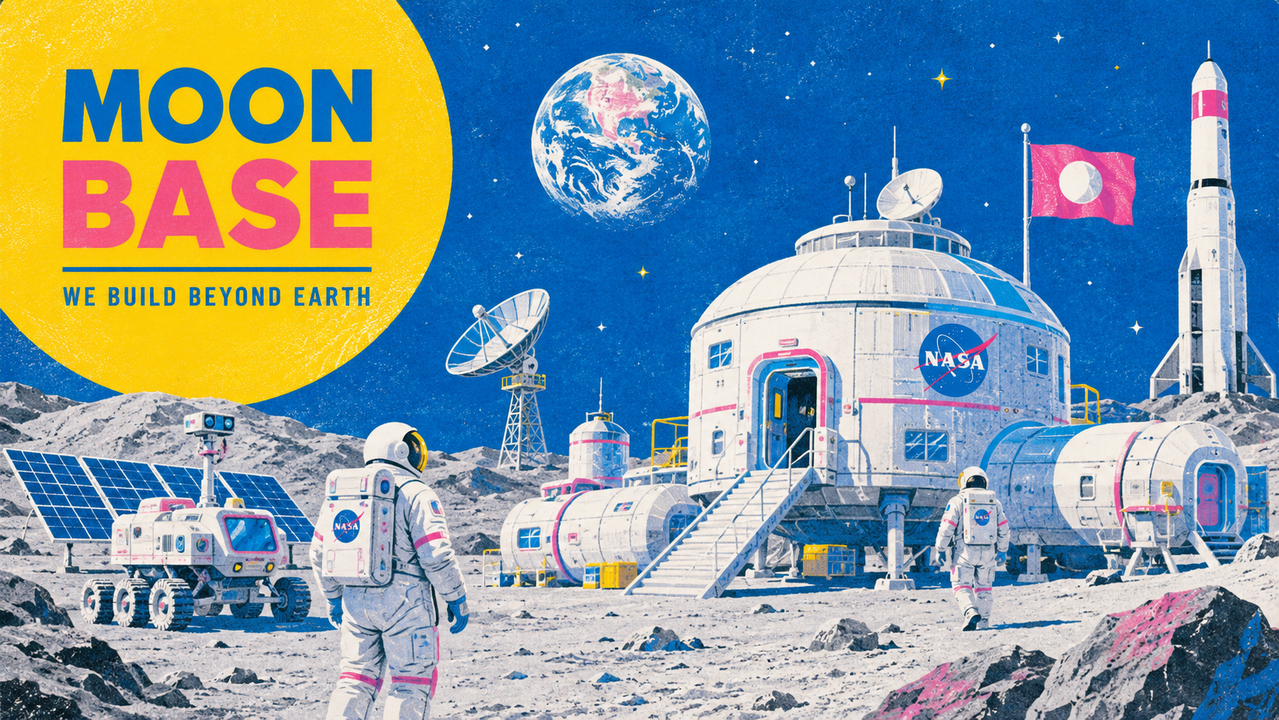
NASA’s Vision for a Permanent Lunar Presence
Astronauts and scientists have long been captivated by the idea of living on the Moon. Now, NASA is taking significant steps to turn this vision into reality. The space agency has unveiled plans to construct a long-term base on the Moon, marking a pivotal moment in space exploration. This initiative aims to provide astronauts with a sustainable habitat on the celestial body, enabling them to stay for extended periods.
The announcement was made on Tuesday in Washington, where NASA revealed details about new Moon missions, lunar rovers, cargo landers, and future timelines. These developments signal a major shift in the agency’s approach to lunar exploration, focusing on building a foundation for sustained human presence.
The First Moon Base Missions
NASA outlined three key missions that will lay the groundwork for future lunar operations. The first mission is expected to launch later this year. It will utilize Blue Origin’s Blue Moon Mark 1 Endurance lander to transport essential equipment to the Moon. This mission will focus on studying how spacecraft engines impact the lunar surface and improving navigation systems for upcoming astronaut missions scheduled for 2028.
Notably, the landing site for this mission is near the Shackleton Connecting Ridge at the lunar South Pole. This location is of particular interest due to its potential for water ice and other resources that could support long-term habitation.
Additional Robotic Missions
In addition to the first mission, two more robotic missions are planned for 2026. The Moon Base II mission will carry over 1100 pounds of cargo using Astrobotic’s Griffin lander. This mission will include Astrolab’s FLIP rover, which is designed to test new mobility systems for future astronaut vehicles. The FLIP rover will play a crucial role in assessing the feasibility of various mobility solutions on the Moon’s rugged terrain.
The Moon Base III mission will send scientific instruments aboard Intuitive Machines’ Nova-C Trinity lander. This mission, known as the Lunar Vertex project, will study strange bright patterns on the Moon’s surface called lunar swirls. These patterns remain a mystery, and understanding them could provide valuable insights into the Moon’s geological history. Additionally, the mission will include payloads from the European Space Agency and the Korea Astronomy and Space Science Institute, highlighting international collaboration in lunar research.
The MoonFall Mission
NASA also provided details on its MoonFall mission, planned for 2028. This mission will use four drones to explore difficult areas of the Moon’s surface. The drones will take images and gather data, helping scientists better understand the Moon’s topography and potential hazards for future missions.
The Moon Base programme is a critical step toward establishing a permanent human presence on the Moon. NASA believes that the experience gained from these missions will be invaluable for preparing astronauts for future missions to Mars. The knowledge and technologies developed on the Moon will serve as a stepping stone for deeper space exploration.
Preparing for the Future
As NASA continues to push the boundaries of space exploration, the development of a lunar base represents a significant milestone. The agency’s efforts not only advance scientific understanding but also pave the way for future interplanetary missions. With each mission, NASA brings humanity closer to realizing the dream of living and working beyond Earth.