Global Electric Vehicle Sales Reach New Heights
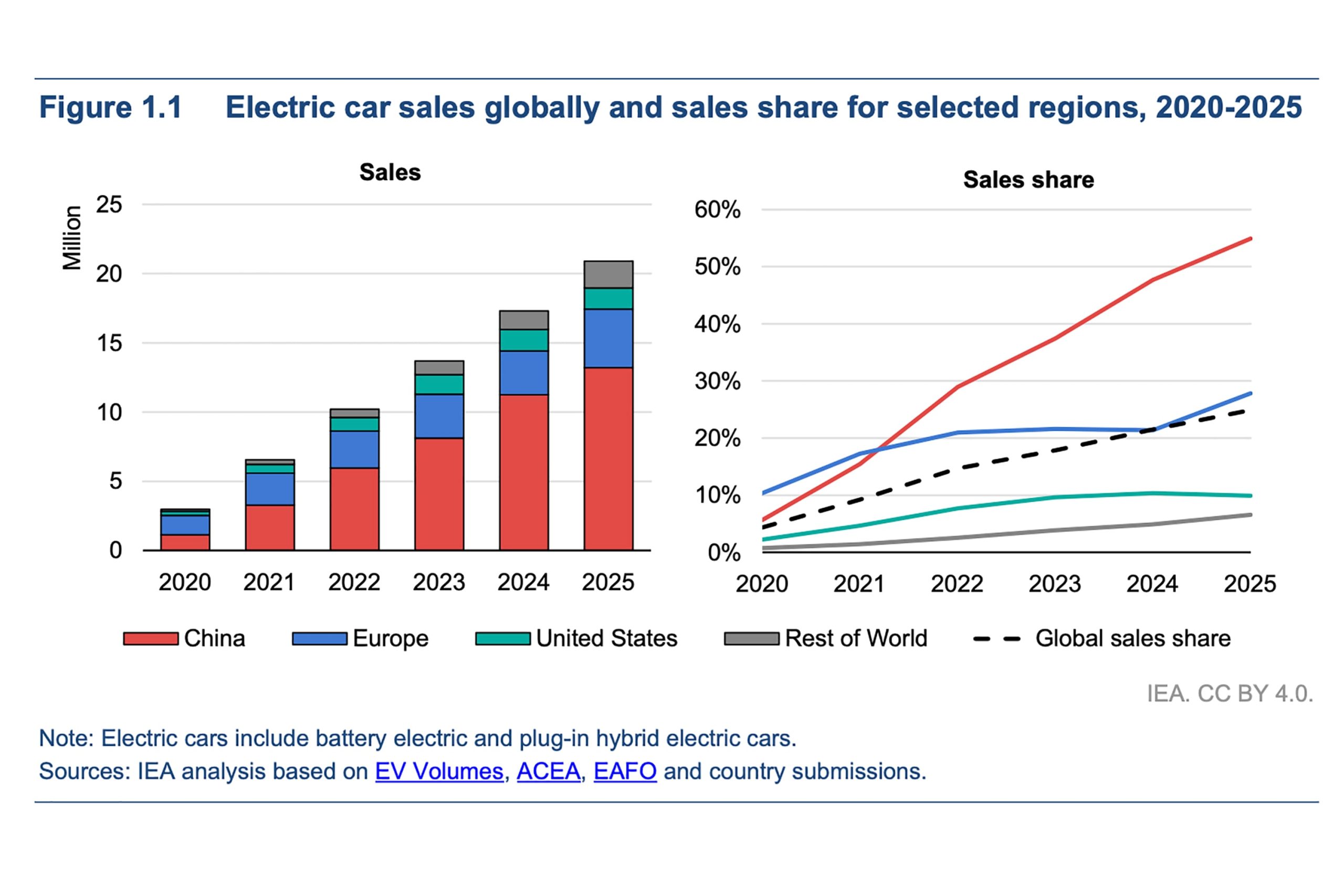
The International Energy Agency (IEA) has projected that global electric vehicle (EV) sales, including plug-in hybrids (PHEVs) and extended-range EVs (EREVs), will reach 23 million units this year. This represents approximately 28 per cent of all new cars sold worldwide. The report, released this week, highlights recent trends and sales data from the first quarter of 2026, forecasting a significant increase from the 20 million units sold in 2025.
In this article, we will use the term ‘EV’ to refer to pure EVs as well as PHEVs and EREVs, unless otherwise noted, aligning with the IEA’s approach.
According to the IEA’s data, 3.9 million EVs were sold in the first three months of 2026. This marks an eight per cent decline compared to the same period in 2025. The drop is primarily attributed to falling sales in China, the world’s largest EV market, and the United States.
Despite this overall decline, there was a notable surge in EV sales in March, with 30 countries setting new records for EV sales. This rise was partly driven by higher petrol prices following strikes on Iran initiated by the US and Israel, which led to the closure of the Strait of Hormuz. Preliminary data from April indicates that Chinese EV sales are recovering, with a record market share exceeding 60 per cent.
If the IEA’s prediction proves accurate, it would signify a continued upward trend in EV sales across the globe.
Leading Markets for Electric Vehicles
Norway remains the world leader in EV market share, with pure EVs accounting for 95 per cent of sales in 2025. Plug-in hybrids make up less than two per cent of the market. This success is largely due to incentives such as sales tax exemptions and other benefits.
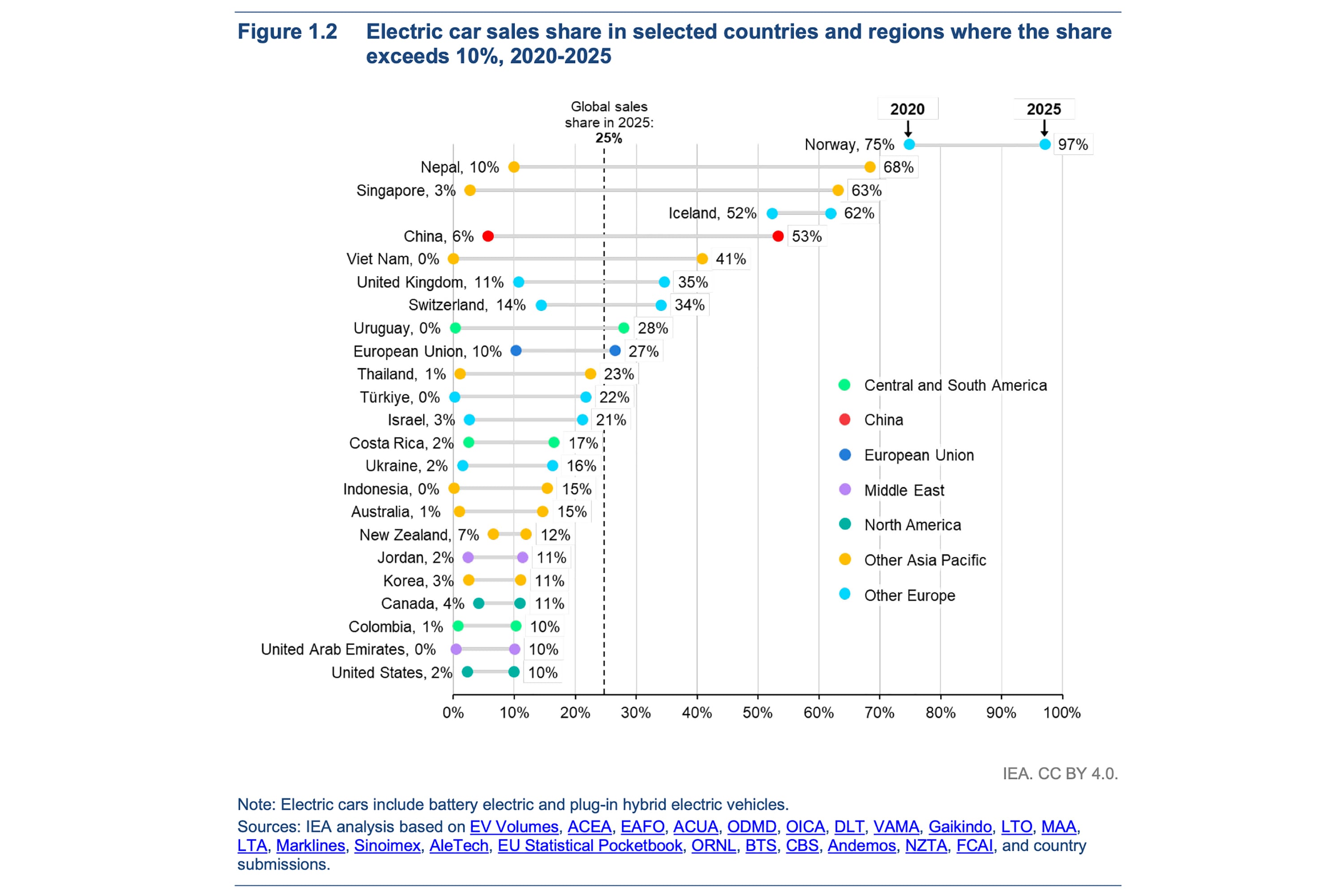
Cheap EV imports from China have significantly boosted Nepal’s position, placing it second in the global EV market. Similarly, Singapore and Vietnam (third and sixth, respectively) have seen substantial increases in their EV shares, thanks to reduced annual road taxes. Vietnamese manufacturer Vinfast has captured nearly all of the local EV market with its VF3 and VF5 models.
China: A Dominant Force in the EV Market
Although China ranks fifth in terms of EV market share, it is by far the largest market for EVs globally. High competition among local automakers, competitive pricing compared to combustion-powered vehicles, and a government trade-in scheme (which has now ended) contributed to China accounting for around 60 per cent of all global EV sales.
Additionally, 80 per cent of all EV battery cells and nearly three-quarters of the world’s EVs were produced in China.
Emerging Markets and Policy Shifts
Thailand and Indonesia have allowed their EV markets to grow by previously relaxing import duties. However, both countries are now focusing on promoting local EV production, which could lead to a decline in sales in 2026.
In the United States, despite the end of tax credits for EV purchases, the country with the lowest EV take-up rate is Japan. Japanese EV sales remained flat at around 100,000 units, or less than three per cent of the market. Hybrids made up a third of all sales.
The report’s authors suggest that Japan’s low EV adoption might be linked to apartment living and insufficient charging infrastructure.