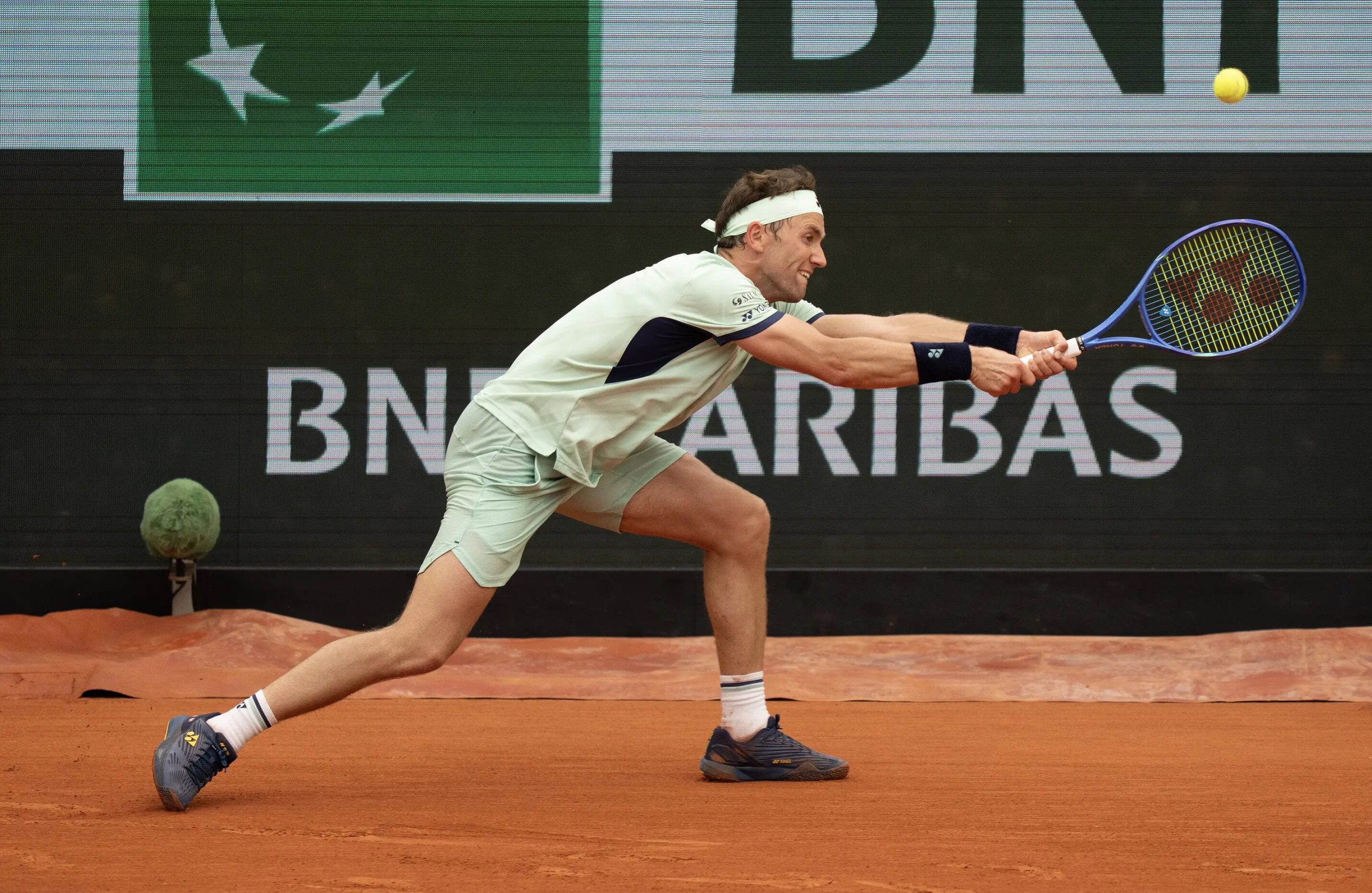
Casper Ruud and Andrey Rublev were handed about as clear an invitation as tennis offers. No Carlos Alcaraz at all and quite suddenly no Jannik Sinner or Novak Djokovic either. Two weeks in Paris with a first Grand Slam title sitting there for whoever wanted it badly enough. Neither of them wanted it badly enough. Or at least neither of them was good enough to rise to the moment.
Joao Fonseca beat two-time Roland Garros finalist Ruud 7-5 7-6 5-7 6-2 in a near four-hour battle, with a disputed line call denying Ruud a set point in the second-set tiebreak proving to be the pivot point. Rublev fell to 20-year-old Jakub Mensik 3-6 6-7 6-4 6-2 3-6 in a match he looked to be on the verge of turning around before losing. Two experienced professionals who knew exactly what was at stake. Two exits that felt entirely consistent with everything that has come before.
Winning a Grand Slam is not easy. Everyone says this. Most probably don’t understand just how hard it truly is.
Casper Ruud and Andrey Rublev learn another hard lesson
Ruud and Rublev
Casper Ruud is 27 years old, born in December 1998. Andrey Rublev is 28, born in October 1997. Neither of them is old. But neither of them is young anymore either. They are closer to thirty than they are to twenty-five, deep into what should be the peak years of their careers, and neither has a Grand Slam title to show for it.
This is not for lack of opportunity or ability. Ruud has been a finalist at Roland Garros twice, in 2022 and 2023, and also reached the US Open final in the same year. He lost the 2022 final to Rafael Nadal 6-3 6-3 6-0. He lost the 2023 final to Djokovic 7-6 6-3 7-5. In both cases he ran into greatness and was dealt with accordingly. Rublev, for his part, has reached the quarterfinals of all four majors but has never gone further. Seventeen ATP titles, a strong ranking for years, legitimate weapons on every surface, and the Grand Slam column remains empty.
The temptation is to look for a single explanation: the mental fragility that surfaces at big moments, the tendency for the game to tighten when it needs to open up, the weight of expectation transforming good players into cautious ones. There is truth in all of it. But the more honest answer is that winning a Grand Slam is simply hard in a way that almost nothing else in sport is.
Seven best-of-five matches over a fortnight, against the best players in the world, with every variable such as the weather, the draw, a twinge in the leg in the third round, a net cord in a tiebreak, capable of derailing two weeks of effort in a single point. The margin between winning one and never winning one is not always character. Sometimes it is a disputed line call in a second-set tiebreaker, which is to say it is luck, and luck has not been especially generous to either of them.
2026 Roland Garros as a Historic Chance
There is a useful parallel from tennis history. In 2009, Robin Soderling beat Nadal in the fourth round at Roland Garros, the first time anyone had ever beaten Nadal at the tournament, ending a 31-match winning streak, and handed Roger Federer the clearest path to his first French Open title he had ever had. Federer had lost the final to Nadal in 2006, 2007 and 2008. The Roland Garros title was the only major still eluding him. When Soderling eliminated the obstacle, Federer took care of everything else and won the tournament. He did not waste the moment.
The 2026 French Open is that kind of moment, perhaps even a rarer one. For the first time in the Open Era, the round of 16 featured no former champions. The draw had not just opened. It had practically been handed over.
And yet Ruud and Rublev could not convert it. Ruud came in with momentum, he had reached the Rome final and was building form through the clay season. He survived an early scare, fought through a gruelling five-setter against Tommy Paul in the third round to stay alive, but when Fonseca pushed him in the fourth round, he found the edge of his range and fell just short.
The disputed line call was the cruelest kind of moment: something entirely outside his control, at precisely the wrong time, in precisely the wrong match. That said, Ruud’s tournament never quite looked like that of a player ready to win it all. He was working too hard for wins that a genuine favourite would take more cleanly, and the vulnerability showed when a genuinely dangerous opponent arrived.
Rublev’s story was more straightforward. He has not won a Roland Garros fourth-round match since 2022. He was turning the match around against a player who is notorious for physical collapse and he couldn’t get it done, which in fairness is an extremely Rublev way to exit a tournament where the entire top of the draw had been cleared for him.
All Eyes on Zverev
Which brings us to the man still standing, the one with the most to prove and the most to lose. Alexander Zverev is 29 years old. He has been in three Grand Slam finals and lost all three. He has more clay-court talent than almost anyone in the draw, a Roland Garros final already on his CV, and a form that makes him the clear favourite for the title. He also knows, just as Ruud and Rublev knew, that draws like this one do not materialise very often.
The pressure on Zverev at this point is immense. He is watching his contemporaries fail at the same hurdle he keeps approaching. The window is narrowing with every year. He is old enough to understand what this opportunity represents and experienced enough to know that experience alone does not guarantee you take it. Ruud and Rublev understood all of that too.
The question is whether Zverev can do what Federer did in 2009: take the moment that the draw has offered, keep his nerve, and walk off the court as a Grand Slam champion. He has the talent and the surface and the opportunity. Whether he has what it takes when it matters most, that is the only question left in this tournament. And if he doesn’t, he joins Ruud and Rublev in a category nobody wants to be in: the best players of a generation who never quite got there when the door was wide open.
Main photo credit: Susan Mullane-Imagn Images