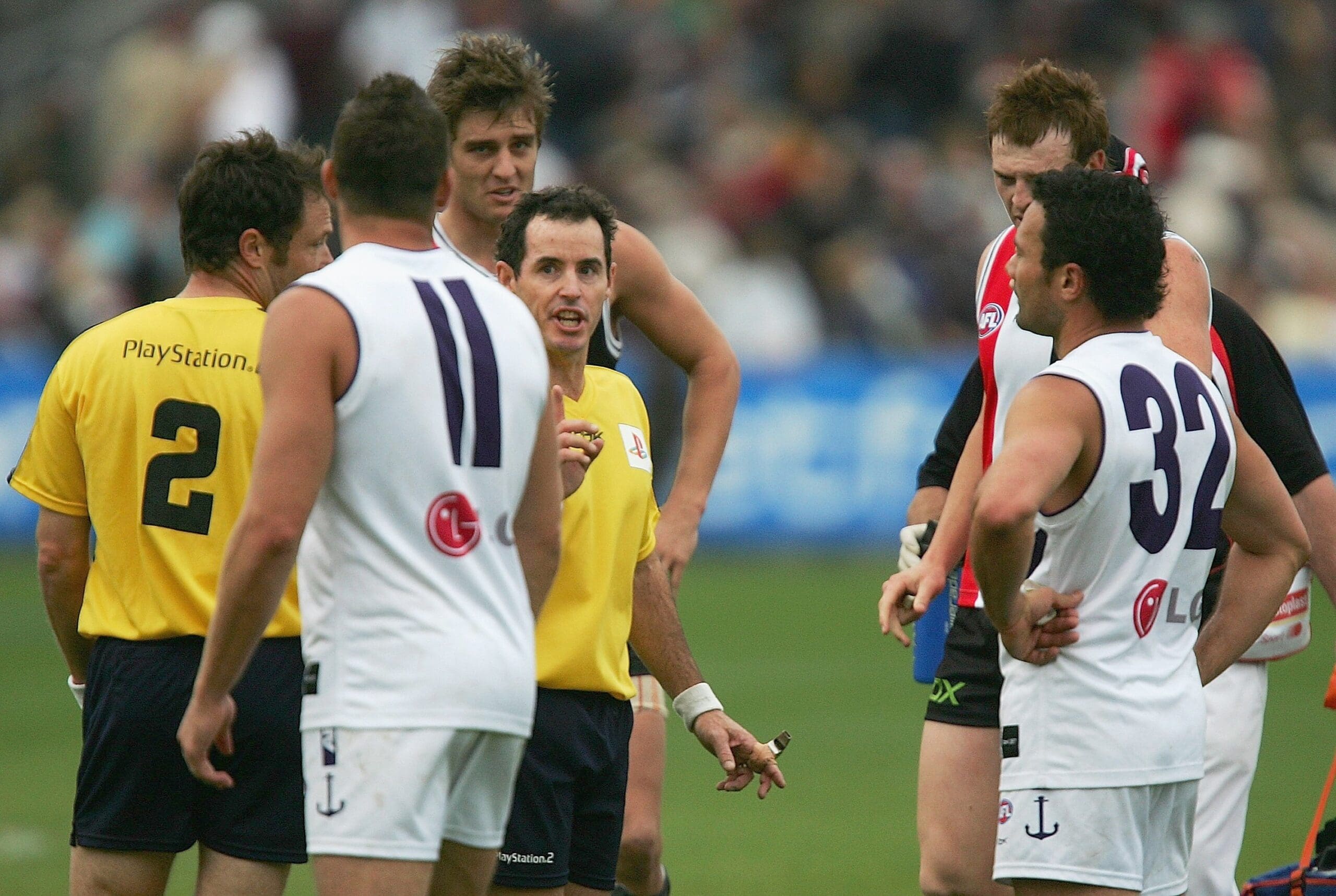
AFL Legend Reveals Role in Infamous ‘Sirengate’ Match
Hayden Kennedy, a recently inducted Australian Football Hall of Famer, has broken his silence on his involvement in one of the most contentious matches in recent AFL history. Known as ‘Sirengate’, the infamous 2006 clash between St Kilda and Fremantle has long been a subject of debate, and Kennedy’s account sheds new light on the chaotic events that unfolded.
Kennedy, an umpire of immense experience, boasts a remarkable career that includes officiating in five Grand Finals and overseeing 83 members of the Hall of Fame. However, among the 495 matches he officiated, the Round 5 encounter between the Saints and the Dockers in 2006 stands out as the most controversial.
The Match That Shook the AFL
The narrative of the game was irrevocably altered in its dying moments. Fremantle held a slender one-point lead as the final siren was meant to signal the end of play. Crucially, however, the umpires on the field did not hear the siren. This silence led to a continuation of play for approximately ten seconds, a period that would prove decisive. During this extended timeframe, St Kilda’s Steven Baker managed to rush a behind, levelling the scores.
The controversy didn’t end there. Before the score could be officially annulled, Baker was awarded a free kick after being infringed upon by a late bump from Fremantle’s Daniel Gilmore. Baker subsequently kicked another behind, seemingly securing a victory for the Saints. The AFL Commission, however, intervened four days later, awarding Fremantle a one-point win following a public protest, cementing the match’s infamous status.
A Confession of the Siren
During a discussion with Gerard Whateley, the host of the Australian Football Hall of Fame, Kennedy was directly questioned about his recollection of the siren. His response was unequivocal: “Yes! Yes, yes, yes I did.”
Kennedy elaborated on the moment, describing how he had blown his whistle and was moving towards the incident when he informed fellow umpire Matt Nichols, “I’ve heard the siren.” This admission adds a significant layer to the controversy, suggesting that at least one umpire was aware of the siren’s signal.
Following Nichols’ decision to annul the score, Kennedy recounted the unfolding chaos. “He’s come back and there’s mayhem. Then he said to me, ‘Oh, but I’ve paid a free kick for a free after disposal.’” Kennedy’s resigned reflection, “I just walk away thinking, we’re up s*** creek here, aren’t we?” underscores the immense pressure and confusion he experienced.
Beyond the Umpires: Procedural Lapses
While not seeking to absolve himself or his colleagues entirely, Kennedy also pointed to a procedural issue with the siren operator as a contributing factor to the ‘Sirengate’ debacle. He highlighted that the AFL’s rules stipulate that the siren operator must maintain contact with the siren until it is clearly heard by a field umpire. This crucial step, he stated, was not followed.
“The rules of the game said that you keep the hand on the siren until it gets heard by a field umpire and that didn’t happen,” Kennedy explained. He described the sound he heard as fleeting, likening it to “someone’s reaching over to hit a button and their elbow hits the button oh so briefly.”
The ensuing ten seconds were a period of intense anticipation for Kennedy. “But for the next 10 seconds, I was on tenterhooks, because I’m thinking ‘it had to be the siren. It was a really soft one during the day anyway.’”
A Fortunate Induction
Kennedy’s candid revelations come at a significant moment in his career. On Tuesday night, he was one of six AFL luminaries inducted into the Australian Football Hall of Fame. Reflecting on his journey, Kennedy described himself as “one of the most fortunate people involved in our game,” a sentiment no doubt amplified by his ongoing contributions to the sport’s rich tapestry, even through its most controversial chapters.