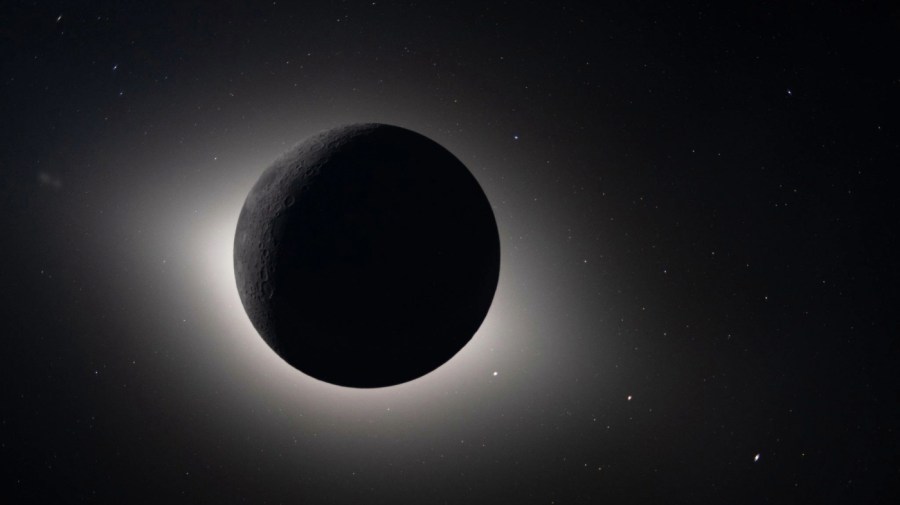
One thing stands out about the moon base that NASA plans to build at the lunar south pole, possibly later than planned because of last month’s New Glenn disaster: It would be nothing like the ones that have been imagined in science fiction.
Moon bases — from Clavius Base in “2001: A Space Odyssey” to Moon Base Alpha in the television series “Space 1999” — tended to be compact facilities, more like a single building than a city.
But at a May 26 press conference, NASA moon base Program Executive Carlos Garcia-Galan announced that the real-life moon base will be “hundreds of square miles” in area. To get a feel of what “hundreds of square miles” could be, Austin, Texas is just over 326 square miles in area.
NASA officials expressed several reasons for making the moon base, in effect, a small city. Not every spot on the lunar surface is suitable for all the needs of a base. For instance, habitation modules should be on elevated terrain for more exposure to sunlight for solar power. The nuclear power plant needs a one-kilometer exclusion zone to protect the rest of the base from radiation hazards. And so on.
NASA may have another reason to introduce urban sprawl to the moon that’s best left unsaid. By occupying that amount of space on the lunar surface, it would deny the Chinese or any other unfriendly power access to it.
Although the Outer Space Treaty of 1967 prohibits claims of national sovereignty on the moon or any other celestial body in Article 1, Article IX prohibits a state party from interfering or causing harm to the activities of another state party in space, including the lunar surface. Section II of the Artemis Accords allows parties to establish “safety zones” around facilities such as moon bases to keep out unauthorized parties, thus preventing the interference and harm that might otherwise result.
China and Russia are not parties to the Artemis Accords. But the U.S. and its partners would likely consider the breach of the safety zone a hostile act, with consequences that redound on Earth as well as in space.
The May NASA press conference laid out the first steps toward establishing a lunar base. Among the initiatives the space agency announced were three uncrewed expeditions — designated Moon Base 1, Moon Base 2 and Moon Base 3 — to be undertaken before the end of 2026. These would consist of three landers: a Blue Origin Blue Moon Mark 1, an Astrobotic Griffin and an Intuitive Machines Nova-C. Those would carry a variety of instruments, and, in the case of the Griffin, a small rover called FLIP, to the site of the future moon base.
Astrolab and Lunar Outpost would build lunar terrain vehicles, capable of taking astronauts or operating autonomously, to be delivered to the moon base site at a later date. Firefly Aerospace would deliver four drones from lunar orbit that would scout the area contemplated for the lunar base.
Unfortunately, on May 28, the Blue Origin New Glenn exploded during a hot fire test, destroying the launch vehicle and damaging the launch pad — the only pad configured to launch a New Glenn. NASA Administrator Jared Isaacman and a plane full of NASA engineers immediately flew to the Kennedy Space Center to consult with Blue Origin officials to assess the damage and to plan out options.
The timeline for the three moon base missions is now very much in doubt. Some estimates suggest that because the pad has to be repaired, the Blue Moon mission will be pushed back a year or more.
However, Blue Origin CEO David Limp had some good news. Having examined the damage to the pad and availability of another launch vehicle, Limp expects a return to flight for New Glenn by the end of this calendar year. If he is right, the accident may well have minimal impact on NASA’s schedule to build the moon base. It should be noted that some outside experts, mainly at SpaceX, which suffered a similar event, do not think Limp’s schedule is realistic.
Sooner or later, NASA and its international and commercial partners plan to embark on a historic project to build the first permanently crewed facility on another world. The moon base would become a center of science and commerce for the benefit of all humankind.
Mark R. Whittington, who writes frequently about space policy, has published a political study of space exploration entitled “Why is It So Hard to Go Back to the Moon?” as well as “The Moon, Mars and Beyond” and, most recently, “Why is America Going Back to the Moon?” He blogs at Curmudgeons Corner.
Copyright 2026 Nexstar Media, Inc. All rights reserved. This material may not be published, broadcast, rewritten, or redistributed.
For the latest news, weather, sports, and streaming video, head to The Hill.