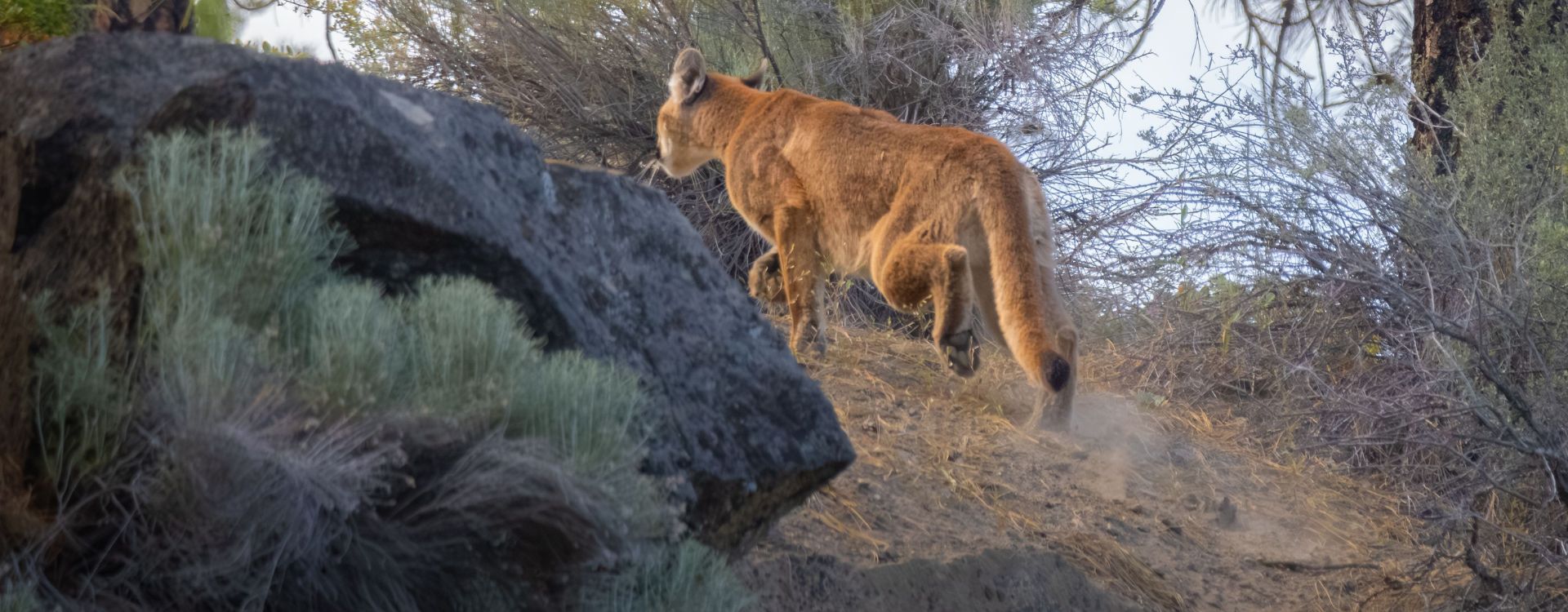
Expanding Research on Mountain Lions in Marin County
A wildlife conservation group has made a significant milestone by capturing its first mountain lion in Marin County as part of an expanded research project. This initiative aims to understand how these big cats are faring in the North Bay region. The captured lion, an 8-year-old male named P-60, weighed 140 pounds and was caught in the Lagunitas area last month. Researchers from the Living with Lions program targeted this particular mountain lion after property owners reported that it had killed two of their goats.
Using the remains of the goats as bait, a team lured the mountain lion into a cage, tranquilized it, collected blood samples, placed a GPS collar around its neck, and then released it. This process allows researchers to track the lion’s movements and monitor its behavior. According to Tom Gardali, chief executive director of All Hands Ecology (formerly Audubon Canyon Ranch), the organization collaborates with True Wild Conservation on this project.
“He’s a very large lion, and he’s been doing great,” said Gardali. “I can look on my computer and see where he’s been. He seems to be successfully moving through the landscape, including feeding.”
The group has been capturing and tracking mountain lions using GPS collars and a network of trail cameras in Sonoma County for the past decade. Recently, they obtained a permit from the California Department of Fish and Wildlife to conduct their research in Marin County. Before being released, the captured cats are assessed for sex, age, weight, and overall health. Blood samples are taken for genetic and disease monitoring, and the findings are shared to aid in conservation efforts.
In addition to research, the group also provides classroom presentations and community education on risk reduction for pets and farm animals. Their goal is to educate people about coexisting with mountain lions and to foster a sense of reverence for these amazing creatures.
Mountain lions are solitary cats that cover large territories. In Sonoma County, a female cat’s territory spans about 30 to 50 square miles, while a male’s territory covers approximately 100 to 200 square miles. These cats primarily feed on black-tailed deer but are also known to prey on unprotected livestock, domestic cats, and other wild creatures. However, little is known about the mountain lions residing in Marin County.
Quinton Martins, director of True Wild Conservation and founder of the Living with Lions program, leads the investigations and captures. His work in South Africa inspired the program, which has captured and tracked 40 lions in Sonoma County. Martins believes the expansion to Marin marks the beginning of a new era of research.
Martins explained that Marin County is not typically expected to have many resident mountain lions due to the amount of open space. However, there are some suitable areas for a small population of the cats. He noted that the Marin story is intriguing because it fills in a gap in understanding how mountain lions behave at the end of the road.
Mountain lions traveling south in coastal California face a barrier in the Marin Headlands area. The only way for them to continue south is to head east around the bay. One notable example is P-36, who was collared in Santa Rosa and moved through Marin County down to the Golden Gate Bridge. When he couldn’t go any further, he crossed Highway 101 and attempted to travel through the Tiburon Peninsula. Again, he found no path forward and headed back north. The group tracked P-36 for about 1,400 miles before he was shot and killed by a ranch owner due to a livestock kill.
Martins emphasized that killing a mountain lion leads to vacant territory being filled by one or more lions, which does not solve the issue of unprotected domestic animals. He urged ranchers and pet owners in rural areas to protect their animals by keeping them in enclosed spaces, especially at night.
“We want to see if there’s important wildlife corridors that lions are using that we may be able to protect or at least steward if they’re already protected,” said Gardali. The project also focuses on tracking where mountain lions cross roads or highways to prevent collisions with vehicles.
Martins described the broader goal of the project as promoting “general wildlife coexistence.” Mountain lions serve as ambassadors for habitat conservation because they require specific environmental conditions to survive. The researchers rely on word of mouth to locate mountain lions, including reports from people who spot them on security or wildlife cameras, or who have experienced livestock or pet losses.
Residents are encouraged to contact Martins at [email protected] or call 707-721-6560 to report incidents. The program is funded by donations and grants from individuals, foundations, businesses, and government agencies. All Hands Ecology is seeking funding to support ongoing work in Marin County.
Gardali mentioned that the group is starting conversations with organizations like the Marin County parks department and the Marin Municipal Water District to gain access to properties for research. Jon Campo, conservation science manager at Marin County Parks, noted that there are over 100 wildlife cameras in the Mount Tamalpais Watershed area capturing images of wildlife, including mountain lions. However, the county lacks much data on these cats.
“We’re certainly excited to learn more about what they have in mind in their study and what they hope to learn from it,” Campo said.