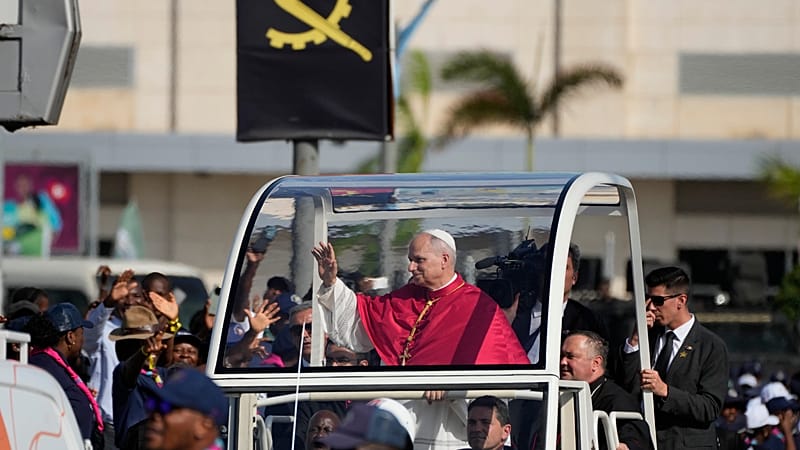
Pope Leo XIV’s visit to Angola, a country rich in oil and minerals located in south-west Africa, marked the third leg of his tour across four African nations. The Pope’s journey through the continent has drawn attention for its focus on peace, justice, and the challenges faced by developing nations.
On Saturday, after meeting with Angolan President João Lourenço, the Pope delivered his first address to the country’s governing authorities. In his speech, he highlighted the turbulent history of Angola, which has been shaped by colonial exploitation and a prolonged civil war.
“I wish to meet you in a spirit of peace and to affirm that your people possess treasures that can neither be bought nor stolen,” the Holy Father stated.
He also warned the Angolan authorities about the historical pattern of external interests exploiting the country’s resources. “You know well that, all too often, people have looked – and continue to look – to your lands in order to give, or, more frequently, to take,” he said.
Angola is currently Africa’s fourth-largest oil producer and ranks among the world’s 20 biggest producers, according to the International Energy Agency. Additionally, it is the third-largest diamond producer globally and has significant deposits of gold and critical minerals. Despite these natural wealth, the World Bank estimated in 2023 that over 30% of the population lived on less than €1.83 a day.
“This cycle of vested interests must be broken, which reduces reality and even life itself to mere commodities,” the Pope emphasized during his address.
After gaining independence from Portugal in 1975, Angola experienced a brutal civil war that lasted 27 years. Since taking office in 2017, President João Lourenço’s administration has estimated that at least €20 billion was stolen or embezzled by former President José Eduardo dos Santos. The current government has pledged to tackle corruption and recover funds allegedly looted during the dos Santos era.
However, critics argue that Angola still faces serious corruption issues and question whether the president’s actions are aimed at consolidating power rather than addressing systemic problems.
During the visit, President Lourenço expressed his government’s commitment to improving the lives of citizens but acknowledged the complexity of the task. He also called for an end to the war in Iran and urged the Pope to continue using his moral authority to promote peace and understanding among peoples.
Muxima Visit: Highlight of Pope Leo XIV’s Angola Trip
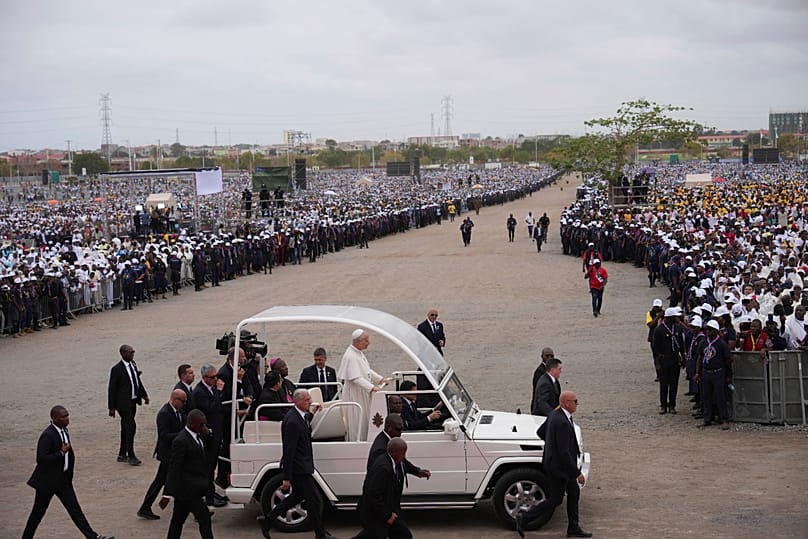
In Kilamba, during Sunday morning Mass, Pope Leo XIV addressed the issue of peace in Ukraine and across the Middle East. Speaking in Portuguese, he called for an end to corruption in Angola, urging the nation to heal the “wound of corruption.”
“We can and want to build a country where the old divisions are overcome for good, where hatred and violence disappear, where the wound of corruption is healed by a new culture of justice and sharing,” he said, according to the Ecclesia news agency.
Following the Mass in Kilamba, the Pope traveled to Muxima, which is considered the highlight of his visit to Angola. At the Mamã Muxima (Mother of the Heart) church, a popular Catholic shrine in a country where around 44% of the population is Catholic, the Holy Father prayed the rosary.
Angola was historically regarded as the epicenter of the transatlantic slave trade. It is estimated that over 5 million enslaved Africans were transported across the ocean on Portuguese vessels. Muxima remains a place that reflects the complex relationship between Roman Catholicism and the exploitation of the African continent.
The site became a popular pilgrimage destination after worshippers reported an apparition of the Virgin Mary there around 1833.
Born in the United States, Pope Leo XIV, whose birth name is Robert Francis Prevost, has both Black and white ancestry, including forebears who were both enslaved people and slave owners, according to genealogical research. His visit to Muxima underscores the deep connections between faith, history, and the ongoing struggles for justice and reconciliation in Angola.