
Government Plans to Remove Political Student Unions from Universities
Kathmandu, April 19 — The government is taking steps to deploy security personnel in universities and other educational institutions to dismantle the structures of political party-affiliated student unions. This move comes as part of a broader effort to enforce good governance reforms and ensure that universities remain neutral spaces for academic pursuits.
Sasmit Pokharel, the Minister for Education, Science, and Technology, has called on vice-chancellors to take action in removing these organizations. The decision was made during a meeting held on April 3 by Dev Raj Adhikari of the University Grants Commission. Thirteen vice-chancellors attended the meeting and signed the resolution, signaling a unified approach to this initiative.
The Ministry of Home Affairs will be responsible for coordinating security arrangements if any challenges arise during the removal process. The resolution also allows for the establishment of temporary or permanent security units within university premises. One of the attending vice-chancellors mentioned that discussions were held regarding the possibility of requesting the home ministry, through the education ministry, to facilitate such deployments.
Key Points of the Resolution
One of the key points outlined in the good governance reform agenda approved by the Cabinet on March 27 is the removal of partisan student structures from university premises within 60 days. Additionally, within 90 days, a “Student Council” or “Voice of Students” mechanism is to be developed. The meeting also resolved to neutralize the activities of existing student unions.
According to the resolution:
- Universities shall no longer provide rooms, buildings, or land for student unions to establish offices.
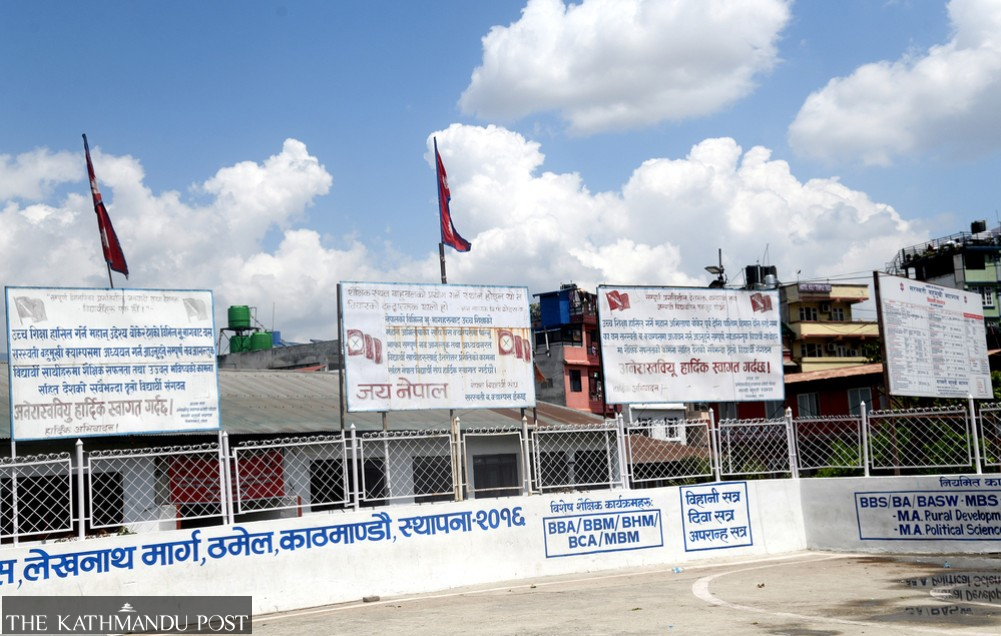
- Physical symbols, including banners, flags, and wall paintings, must be removed immediately.
The meeting agreed to repeal any legal provisions that allow for the existence of partisan student unions. The education ministry is expected to propose the necessary amendments. For regulations or bylaws, university executive councils or senates have been instructed to make revisions within 60 days.
Furthermore, the meeting decided to amend laws to replace existing Free Student Unions (FSUs) with Student Councils or “Voice of Students” as the main mechanisms for student representation and welfare.
Opposition from Student Organizations
Student organizations have expressed strong opposition to the move and have announced protests. Fourteen unions affiliated with political parties, including the Nepali Congress, CPN-UML, and the Nepali Communist Party, issued a joint statement condemning the decision as undemocratic.
“The right to associate based on ideology is a fundamental right guaranteed by the Constitution of Nepal. Any attempt to restrict ideology is contrary to democratic values and international human rights standards,” the statement said. “While restructuring the student movement is a positive goal, any decision intended to curtail freedom of expression and organisation under the guise of reform is immature, apolitical, and unconstitutional.”
Despite their opposition, the unions acknowledged the need to reform irregularities within the student movement but emphasized their commitment to dialogue and cooperation with the government. They believe that meaningful reform should not come at the cost of students’ constitutional rights.
Implications and Next Steps
This development marks a significant shift in the role of student unions in Nepalese universities. The government’s push for neutrality and reform is likely to face resistance from various quarters. However, it also presents an opportunity for the creation of more inclusive and representative student bodies.
As the implementation of the resolution begins, it will be crucial to monitor how universities respond to these changes. The success of this initiative will depend on the ability of all stakeholders to find a balance between maintaining order and upholding democratic principles.