The Challenges of Flower Tourism
In recent years, Japan has experienced a significant increase in cherry blossom tourism, leading to overcrowding at iconic sites such as Chureito Pagoda during the blooming season. On some days, the number of visitors can exceed 10,000, creating challenges for local authorities and residents alike.
The rise of social media has played a key role in this surge, as posts about Japan’s cherry blossoms often go viral due to the breathtaking beauty and vibrant displays. This has led to incidents where events have had to be cancelled, such as the Arakurayama Sengen Park festival in Fujiyoshida, due to safety concerns, infrastructure strain, and unruly visitor behaviour.
Climate change has also impacted the timing and duration of cherry blossom blooms, with trees now flowering earlier and for shorter periods. This unpredictability has caused disappointment among tourists who come expecting a longer viewing window.
Similar issues have been observed in tulip tourism in the Netherlands, prompting nature lovers to seek out alternative destinations for their flower-related travels.
Unique Flower Tourism Destinations
Namaqualand, South Africa and Namibia
Namaqualand, a semi-arid region along the west coast of South Africa and Namibia, is renowned for its extraordinary biodiversity. Between August and September, the area transforms into a “blooming desert” with over 3,500 wildflower species, including around 1,000 that are unique to the region. These include succulents and the iconic Namaqualand daisies.
This “super bloom” stretches from inland mountain ranges to the coastal Sandveld, offering a striking contrast between arid plains and valleys carpeted with white, purple, and orange flowers. Visitors can explore hiking trails in the Namaqua National Park and follow a dedicated wildflower route.
The experience is highly dependent on annual rainfall, making it even more special and fleeting. Travelers can also enjoy 4×4 trails, explore the Atlantic coast, visit Quiver tree forests, raft down the Orange River, and stargaze. Those interested in culture and history can head to the town of Springbok to learn about its copper mining past.
Jerte Valley, Spain
For those seeking cherry blossom wonder outside of Japan, the Jerte Valley in Spain offers an ideal alternative. The valley is home to approximately 1.5 million to two million cherry trees that bloom together in spring, transforming the hillsides and valley floor of the Cáceres region into a sea of dramatic white.
The blooms typically last around 10 days, with the best time to see them being late March or early April. Unlike Japan’s cherry blossoms, which are mainly celebrated for their beauty, the Spanish blooms also signal a major fruit harvest for picota cherries.
The valley celebrates its blossoms with the Fiesta del Cerezo en Flor (cherry blossom festival), featuring music, theatre performances, handicrafts, and traditional cherry-based dishes. Guided hiking and walking tours are also available.
Travelers can explore charming historic villages and protected sites like Cabezuela del Valle, known for its rustic architecture. One of the best ways to experience the blooms is by driving through the valley, passing through 11 different municipalities with stunning viewpoints of the slopes.
Valley of Flowers, India
Another prime destination for flower tourism is the Valley of Flowers, a UNESCO World Heritage Site located in Uttarakhand, India. Nestled within the Nanda Devi Biosphere Reserve, the Himalayan valley offers a unique “living tapestry” effect against vast mountain peaks, with bloom colours changing every few weeks between June and September.
Due to its own micro-climate, the valley is lush and beautiful compared to surrounding Himalayan valleys. It features over 600 species of flowers, including rare and endangered species such as the cobra lily, Himalayan blue poppy, and Brahma Kamal, a sacred flower. A variety of orchids, primulas, poppies, and daisies can also be seen.
The park serves as a transition zone between the Great Himalaya and Zanskar ranges and is home to rare animals like the snow leopard, Asiatic black bear, and musk deer. The changing colours of the blooms and rare Himalayan species make the valley a paradise for photographers, nature enthusiasts, and botanists.
Outdoors enthusiasts can enjoy accessible trekking trails starting from Govindghat, while culture-seekers can visit Hemkund Sahib, a high-altitude Sikh pilgrimage site.
Lake Tekapo, New Zealand
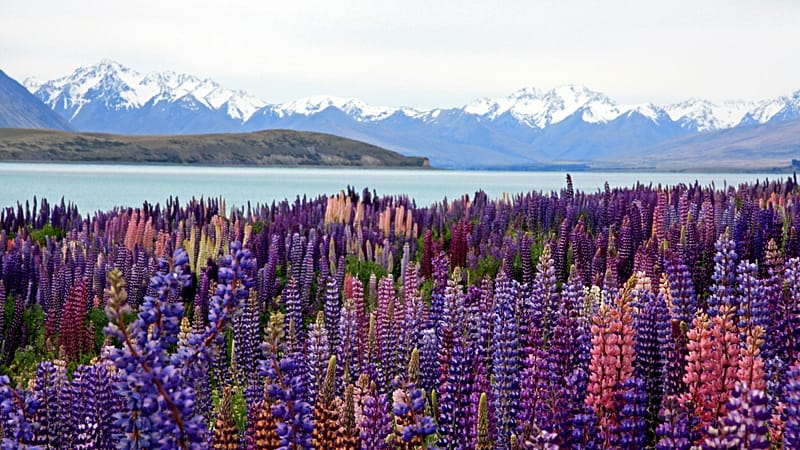
Lake Tekapo, located in the Mackenzie Country on the South Island of New Zealand, is another unique flower tourism destination. The lake itself is a glacial one, known for its striking turquoise colour caused by glacial rock flour.
It also offers one of the clearest night skies in the world, making it perfect for combining flower tourism with astrotourism. Visitors can enjoy vibrant fields of pink, blue, and purple Russell lupins set against the stunning lake and snow-capped mountains, transforming the whole Mackenzie Basin into a magnificent spectacle.
The area around the Church of the Good Shepherd is particularly photogenic, and travelers along the Mackenzie Basin highway can also enjoy great views. The best time to see the blooms is from mid-November to December, with “golden hour” being ideal for photographers.
Other activities include stargazing, hiking, relaxing in hot pools and springs, kayaking, skating, and taking scenic flights over the Southern Alps.
Muker Meadows, UK
For those looking for a different experience after exploring flowering mountain valleys, Muker Meadows in England’s Yorkshire Dales offer a unique setting. These traditional upland hay meadows typically bloom between mid-June and early July.
As a Site of Specific Scientific Interest (SSSI) and a Coronation Meadow, it is one of the most biodiverse and well-preserved hay meadows in the UK. Rare flowers like wood crane’s bill, yellow-rattle, and melancholy thistle can be found here, set against a historic backdrop of scenic dry stone barns and walls.
Other species such as buttercups, selfheals, lady’s-mantle, and pignuts also add to the diversity. Visitors can enjoy classic English scenery on a walk through the meadows or take a peaceful picnic in the afternoon sun. Hikers can also explore the River Swale or Keld for a scenic walk.