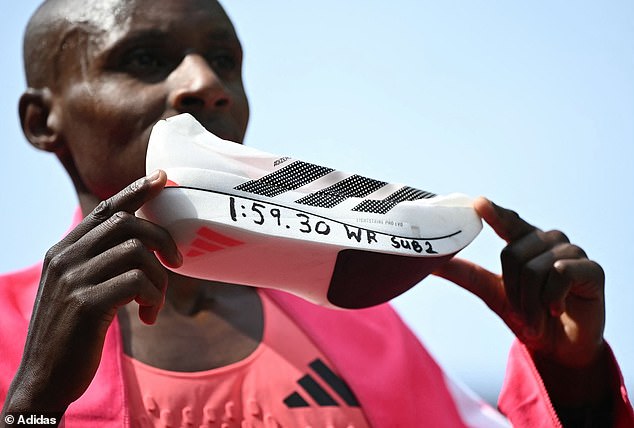
A New Era in Running: Sabastian Sawe’s Historic Achievement
Runners around the world were left in awe after witnessing Sabastian Sawe break the two-hour barrier at the London Marathon. The Kenyan athlete completed the 26.2-mile course in an incredible 1 hour, 59 minutes, and 30 seconds — more than a minute faster than the previous record. This remarkable feat has sparked a renewed conversation about the role of technology in modern athletics.
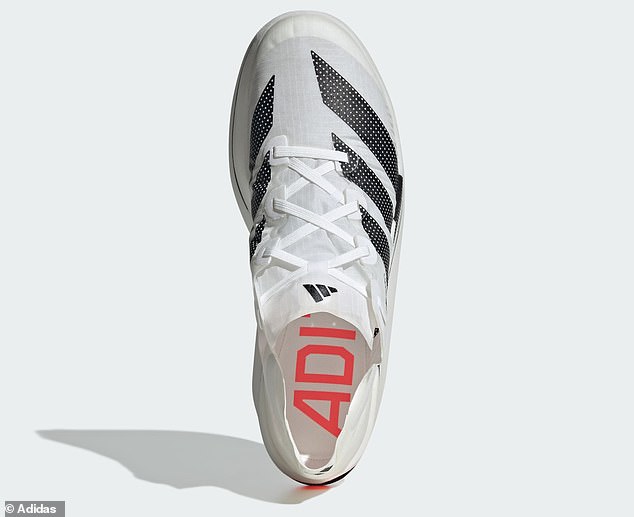
So, what was the key to Sawe’s success? His shoes. During the race, he wore the adidas ADIZERO Adios Pro Evo 3, a groundbreaking “super shoe” that is among the lightest racing shoes ever created. Weighing just 99 grams, this shoe is designed to be worn only once, despite its hefty price tag of £450. The futuristic footwear features a stiff carbon-based structure that adds a ‘spring-like’ bounce to each stride, enhancing speed and efficiency.
Patrick Nava, General Manager at adidas Running, expressed immense pride in Sawe’s achievement. He stated, “This is a testament to the years of hard work and dedication they have made, alongside our innovation team, who have built a supershoe which breaks new ground in the Adizero Adios Pro Evo 3.”

The original supershoe, the Nike Alphafly, faced controversy when it helped Kenya’s Eliud Kipchoge run the first sub-two-hour marathon outside of race conditions. However, new rules from World Athletics now allow supershoes to return to competitions, provided they have no more than one carbon-fibre plate and midsole height not exceeding 40mm.
The Adizero Adios Pro Evo 3 was unveiled on April 23, just days before the London Marathon, and represents three years of research and development. Compared to its predecessor, the Evo 2, which weighed 138 grams, the new super shoe is significantly lighter, with a reduction of 39 grams.
Stephan Scholten, VP Product at adidas, explained the goal: “Our goal was two digits on the scale, with better performance than we’ve ever had.” To achieve this, adidas developed its lightest foam to date, called Lightstrike Pro Evo foam, which maximizes cushioning, propulsion, and energy return.

£450
Shop
The Adizero Adios Pro Evo 3: Key Specs
- Price: £450
- Weight: 99g
- Thickness: 39mm
- Colour: Cloud White / Core Black / Solar Turbo
- Materials: Lightstrike Pro Evo foam combined with carbon-fire elements and a rubber sole
To further reduce weight, adidas stripped back almost every component on the surface of the shoe. Even the smallest details, such as laces and stitching, were refined to deliver marginal gains that can make a difference on race day.
The outsole features strategically placed rubber in the forefoot for reliable traction at high speeds without adding too much weight. Mr. Nava emphasized the importance of these details, stating, “At that level, every detail really matters — we were measuring things down to the nearest nanogram.”
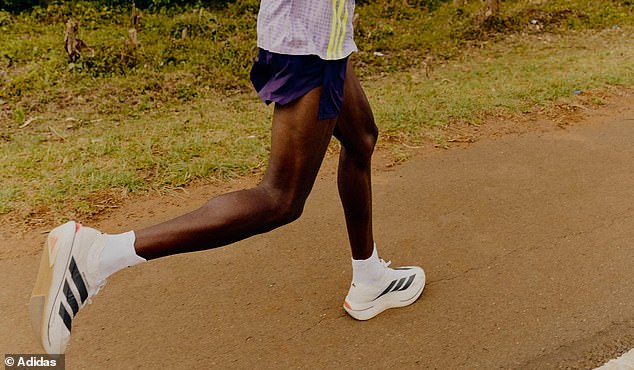
After breaking the two-hour barrier, Sawe credited “the role of innovation,” likely referring to the super shoe. He said, “To break the world record is something I have dreamed about for a long time, and to achieve it means so much to me and to the sport of running.”
Despite coming in at 39mm in thickness (just below the 40mm limit set by World Athletics for road races), the success of the new shoe is likely to reignite the debate about “technological doping” in the running community.
This debate first emerged in 2016 with the launch of Nike’s £240 Vaporfly shoes. During the 2016 Olympic marathon in Rio, all three male medallists wore a prototype of the trainer, and the same technology extended to track races from 2018.
Experts predict that the shoe improved the running economy of highly trained runners by four per cent compared to a normal shoe, boosting performance by three per cent. Professor Yannis Pitsiladis of the International Olympic Committee noted, “The same shoe gives you a massive variability among different athletes — even greater than 10 per cent in some cases.”
Read our guide to the best running trainers on the market — tried and tested by real runners and marathon trainers.
The Super Shoe Debate: A Longstanding Controversy
The debate over super shoes isn’t new and first gained attention in 2016 with Nike’s £240 Vaporfly product raising concerns among commentators and experts. During the 2016 Olympic marathon in Rio, all three male medallists wore a prototype of the trainer, with the same technology later extended to track races from 2018.
Now, high-tech trainers that are lighter and more responsive are nearly ubiquitous among elite road runners. Jonathan Taylor, a sports researcher at Teesside University, has called the revolution in footwear development a “technological arms race.”
Since 2016, the top 50 male marathon runners have improved by about two per cent on average, with much of this attributed to the carbon fibre plate. Similar technology was then transferred into track spikes in 2019, leading to middle- and long-distance records falling.
Regulations were introduced in January 2020 regarding the sole thickness of track spikes used in sports other than high jump and long jump. This was due to other companies replicating their carbon-fibre plate and springy foam technology into more spikes for running shoes.
However, experts argue that these regulations are too lenient, suggesting that stricter rules should be implemented to prevent any potential advantages from being gained through technological enhancements.