
The Atlantic Meridional Overturning Circulation (AMOC) is on the Brink
The vast system of ocean currents that gives western Europe its mild winters and regulates rainfall across three continents is now projected to weaken far more severely this century than most climate models have predicted. A recent study published in the journal Science Advances combines real-world ocean observations with advanced statistical techniques, revealing that the Atlantic Meridional Overturning Circulation (AMOC), or AMOC, is significantly closer to a collapse than previously understood.
The researchers estimate that the current will slow by between 43% and 59% by the year 2100 compared to its pre-industrial average. This represents roughly a 60% stronger deceleration than the average projection from standard climate models. At this level of weakening, the system approaches a climate tipping point beyond which a full shutdown becomes increasingly likely.
Valentin Portmann, a researcher at the Inria Centre de recherche Bordeaux Sud-Ouest who led the study, said the results show an AMOC “closer to a tipping point” than previously understood. Stefan Rahmstorf, professor of ocean physics at the Potsdam Institute for Climate Impact Research, described the work as “an important and very concerning result,” adding that the most pessimistic models “are, unfortunately, the realistic ones.”
How the Current System Works
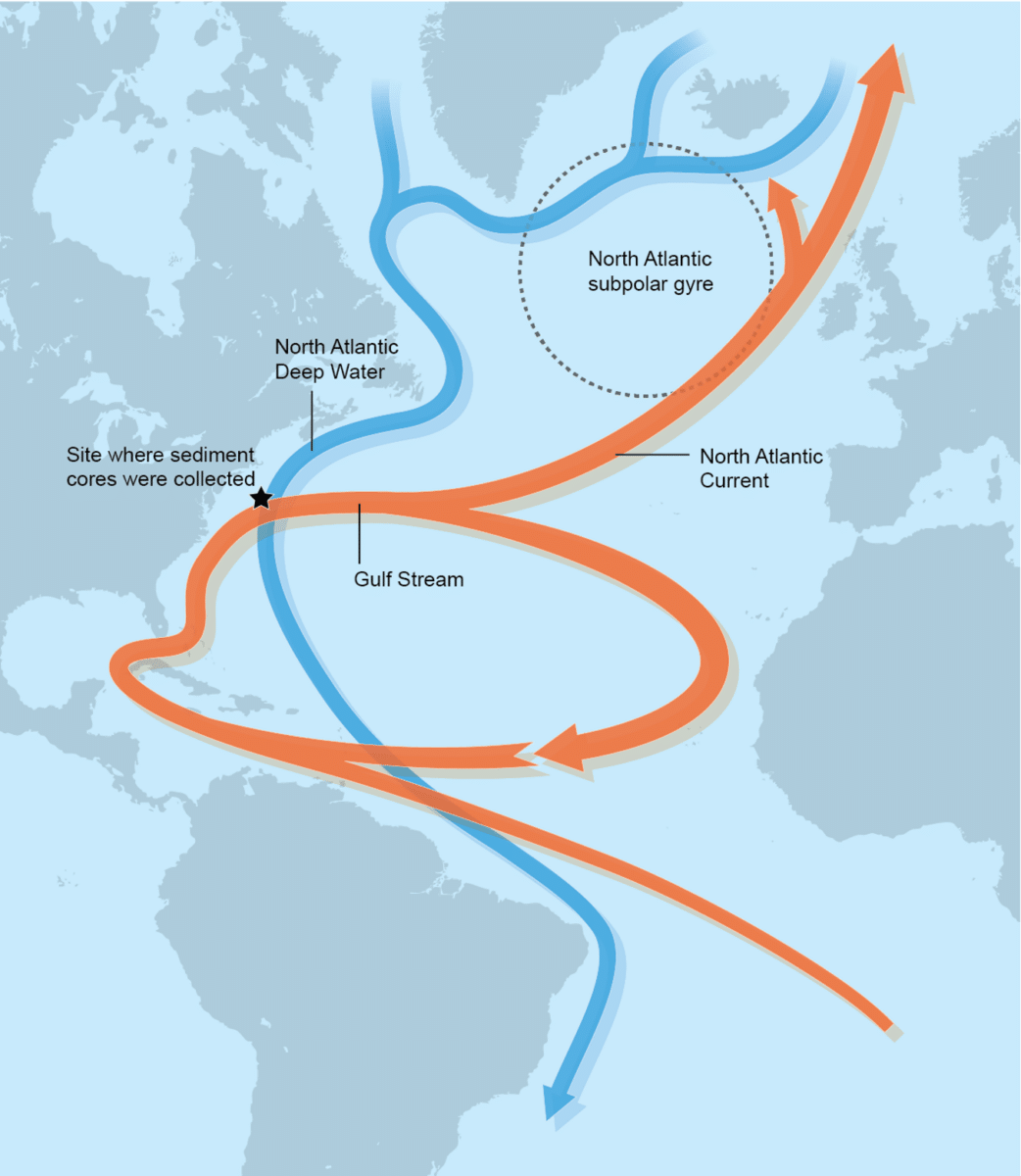
The AMOC operates as a planetary heat pump. Warm, salty water travels from the tropics northward along the ocean surface, releasing heat into the atmosphere as it goes. That heat moderates temperatures across Europe and North America. Once the water cools, it becomes denser, sinks, and creeps back south at depth. The loop then repeats.
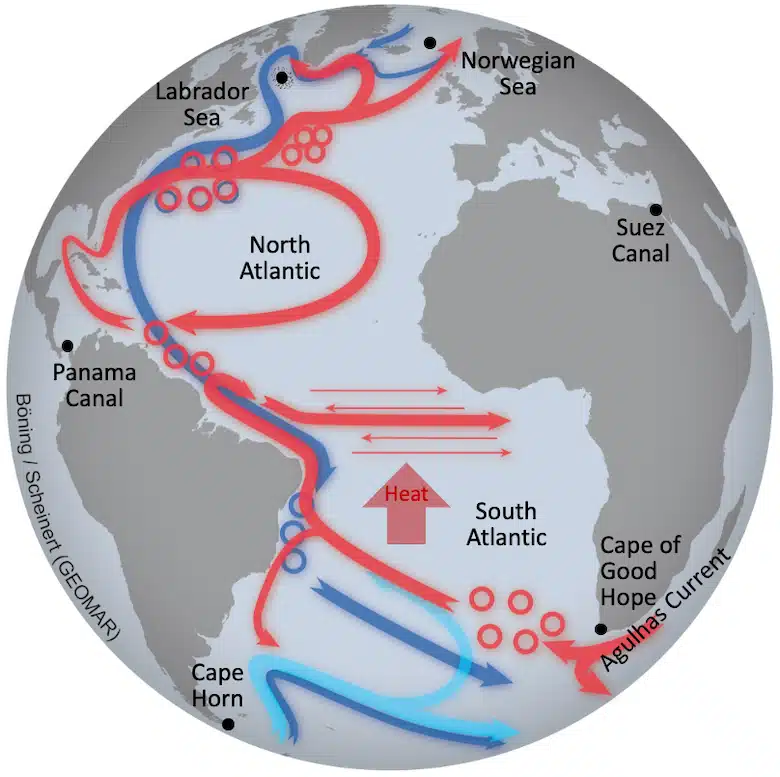
A collapse would ripple across the globe. Northern Europe would face plunging winter temperatures and severe summer droughts. Along the northeast coast of North America, sea levels could climb an additional 50 to 100 centimeters beyond existing projections. The tropical rainfall belt that millions of farmers rely on would shift, sharply cutting the land area suitable for growing wheat and maize. Those two crops supply roughly two-fifths of global calories. Marine ecosystems across the Atlantic would also be thrown into turmoil.
Rahmstorf has studied the AMOC for 35 years. He argues that a shutdown of the Atlantic current must be avoided “at all costs.” When scientists once pegged the probability of collapse at around 5%, he said, “even then we were saying that risk is too high, given the massive impacts. Now it looks like it’s more than 50%.”
Narrowing the Range of Possibilities
Climate models have long struggled to agree on the AMOC’s future. Their projections span from almost no slowdown by 2100 to a dramatic deceleration of about 65%, even under scenarios where carbon emissions drop to net zero. The disagreement stems from the system’s complexity. The AMOC depends on subtle differences in water density driven by sea surface temperature and salinity across the entire Atlantic basin.
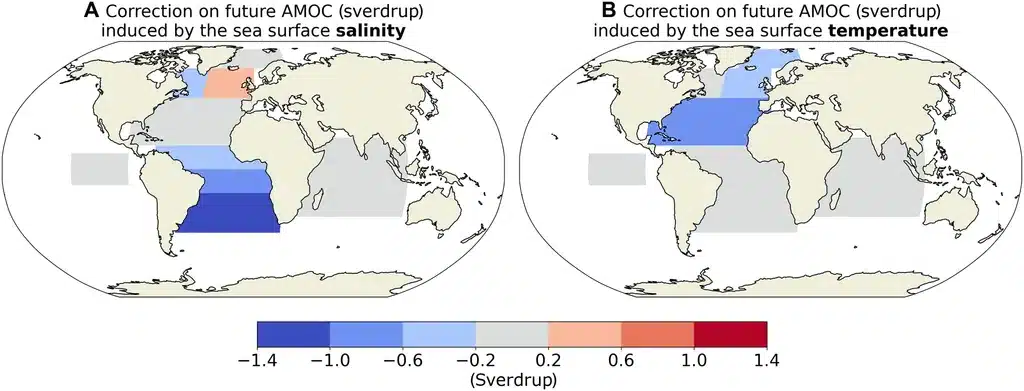
To tighten the range, Portmann and his colleagues tested dozens of climate models against real-world ocean observations. They concentrated on temperature and salinity readings from the South Atlantic, a region already known to be critical for AMOC behavior. Then they applied a statistical method called ridge-regularized linear regression, a technique rarely used in climate modeling, to identify which models best mirrored the observed data. The method slashed the prediction error by 79% compared with the standard approach. The models that matched reality most closely were the ones forecasting the steepest AMOC slowdown.
Earlier studies often hinged on a single observable variable, such as historical AMOC strength or seasonal temperature shifts. By using multiple observational constraints at once, the team produced what Rahmstorf called “very credible” work.
Debate Over the Findings Continues
Despite the stark numbers, some experts urged caution before treating any single estimate as the final word. David Thornalley, a professor of ocean and climate science at University College London who was not involved in the research, told Live Science that there “remains uncertainty in how well models can simulate and predict changes in the AMOC.” He noted the results are clearly worrying but added that model estimates depend heavily on which variables researchers choose to include.
Laura Jackson, an expert in North Atlantic ocean currents at the UK Met Office, agreed. “It is still an open question as to which model AMOC projections are most likely,” she told Live Science. “The magnitude and timing of AMOC decline are still uncertain given the large spread in model projections.”
María Paz Chidichimo is an ocean circulation scientist at Argentina’s National Scientific and Technical Research Council. She argues that locking down a precise collapse timeline may matter less than confronting the changes already underway. “We have enough scientific evidence of AMOC variability and slowdown, and we are already experiencing environmental changes associated with AMOC change which have important socioeconomic impacts worldwide,” she said. “Nations need to prepare now.”
What Is Driving the Slowdown
The AMOC is weakening because the Arctic is warming faster than almost any other region on Earth. That rapid heating slows the cooling of northward-flowing water. The water grows less dense and less able to sink, jamming a critical step in the circulation. The slowdown then allows more rainfall to pool in the surface layer, further freshening the water and reducing its density.
A feedback loop takes hold. As the sinking stalls, the entire circulation weakens. Less salty tropical water travels north, and even more freshwater builds up at the surface. The models used in the new study do not yet include one additional factor: meltwater streaming off the Greenland ice sheet, which is also freshening the North Atlantic. Rahmstorf noted that this omission suggests “the reality is probably still worse” than the study’s already gloomy projection.
The AMOC has collapsed before. The most recent episode came at the end of the last ice age, when massive pulses of freshwater from melting ice sheets disrupted the circulation and triggered abrupt climate shifts within decades. Continuous direct monitoring of the AMOC only began in 2004, but proxy data shows the system is already at its weakest point in 1,600 years.