A New Perspective on the Universe’s Structure
A new set of cosmological studies is challenging one of the most fundamental assumptions in modern physics: that the universe behaves uniformly on the largest scales. Researchers have found tentative signs that the geometry of the cosmos may deviate from the long-standing framework that has guided cosmology for nearly a century. These findings, detailed in papers available on the preprint server arXiv, could point toward previously unknown physical effects shaping the evolution of the universe.
The Foundational Model of the Universe Faces New Questions
Modern cosmology is built on the Friedmann-Lemaître-Robertson-Walker (FLRW) model, which assumes that, when viewed at sufficiently large scales, the universe is both homogeneous and isotropic. In practical terms, this means matter should be distributed evenly overall and the cosmos should look roughly the same in every direction. This assumption became one of the foundations of the standard cosmological model known as Lambda-CDM, which also incorporates dark matter and dark energy.
The new research challenges how accurately this picture reflects reality. Instead of assuming the universe behaves uniformly everywhere, the team examined whether cosmic structures such as galaxy clusters, filaments, and giant empty voids could alter the geometry and expansion of space in measurable ways. Their analyses relied on observational data from the Pantheon+ supernova catalog, the Dark Energy Spectroscopic Instrument (DESI), and baryon acoustic oscillation surveys that trace ancient density patterns left from the early universe.
The researchers found small but persistent deviations from the predictions expected under standard FLRW cosmology. Depending on the method and dataset, the statistical significance ranged between 2 and 4 sigma. That level falls short of the threshold physicists normally require for a confirmed discovery, yet it remains strong enough to attract serious attention within the cosmology community.
“We saw a surprising violation of an FLRW curvature consistency test, hinting at new physics beyond the standard model,” study co-author Asta Heinesen, a physicist at the Niels Bohr Institute in Copenhagen and Queen Mary University of London, told Live Science via email, referring to the assumption that space’s curvature is the same everywhere. “This could potentially be due to various effects, but more research is needed to address the cause of the FLRW violation that we see empirically.”
The Cosmic Web May Be Altering Space Itself
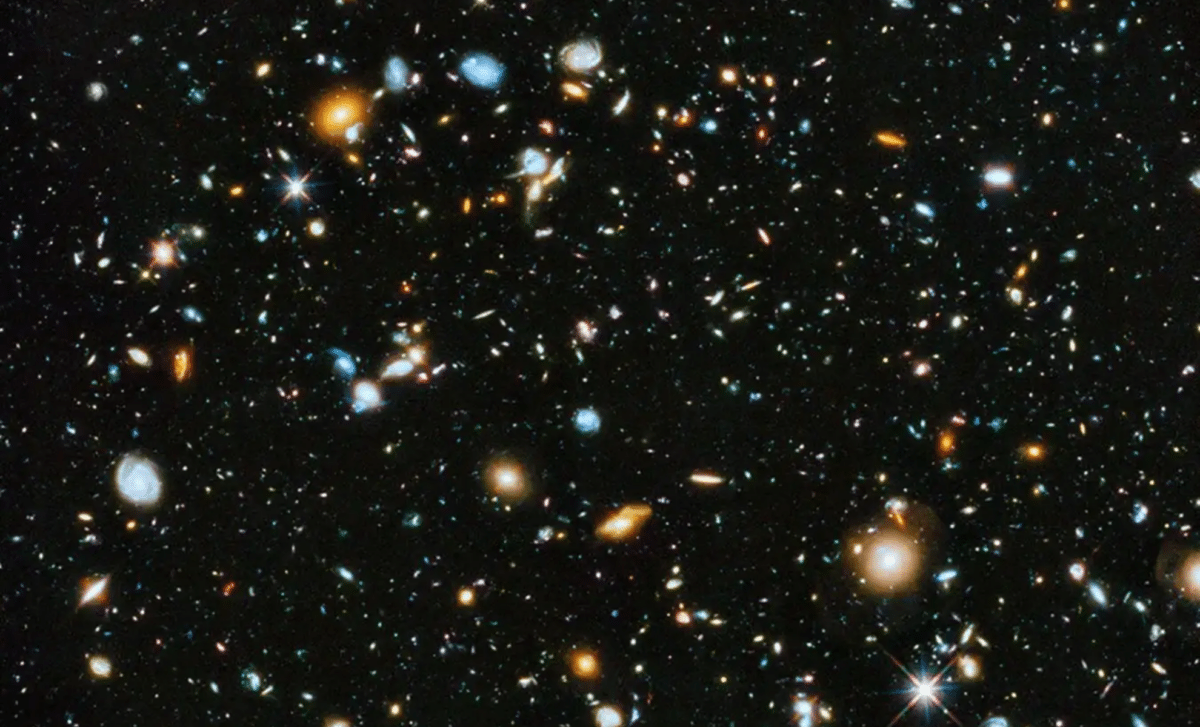
One of the most striking aspects of the work is its focus on how the universe’s large-scale structure could influence measurements of cosmic expansion. The visible universe is not smooth. Galaxies gather into clusters connected by enormous filaments, while vast empty regions known as cosmic voids stretch across intergalactic space. These structures form what astronomers call the cosmic web.
According to the researchers, this complexity may interfere with assumptions embedded in standard cosmological equations. One possible explanation involves the Dyer-Roeder effect, where light from distant objects travels mainly through underdense regions rather than matter-rich environments. This could distort observations and make the universe appear less dense than it actually is.
Another proposed mechanism is known as cosmological backreaction. In this scenario, the growth of cosmic structures changes the average behavior of space-time itself, subtly altering the expansion of the universe over billions of years. Rather than being small local disturbances, galaxy clusters and voids could collectively influence cosmic evolution on immense scales.
“FLRW cosmology assumes a space-time that has spaces that are maximally-symmetric,” Heinesen said. “It is necessary to go beyond FLRW space-times when cosmological structures are present such as galaxy clusters and voids of empty space.”
The implications are substantial because many modern attempts to solve cosmological tensions still operate within the FLRW framework. If the geometry of the universe is not accurately described by those assumptions, several competing theories involving dark energy or modified gravity may need to be reconsidered.
Machine Learning Opened a New Window Into Cosmic Expansion
The research team introduced a new framework designed to test cosmological assumptions without relying entirely on predefined models. One of the central tools was a machine learning approach called symbolic regression, which searches observational data for mathematical relationships instead of forcing the data into existing equations.
Using this technique, the scientists reconstructed the expansion history of the universe directly from astronomical observations. They also employed variants of the Clarkson-Bassett-Lu consistency test, a mathematical diagnostic developed to check whether observational measurements align with an FLRW universe.
The papers, available on the preprint server arXiv, describe how these methods allowed the researchers to isolate possible signatures of Dyer-Roeder and backreaction effects in existing cosmological datasets. This marked a major shift from earlier studies, where distinguishing such effects from dark energy or modified gravity theories was far more difficult.
“The main finding is that you can directly measure Dyer-Roeder and backreaction effects from available cosmological data, and clearly distinguish these effects from other alterations of the standard cosmological model, such as evolving dark energy and modified gravity theories,” Heinesen said. “This was previously not possible in such a direct way, and this is what I think is the breakthrough in our work.”
The use of machine learning in cosmology has expanded rapidly over the last decade, though researchers remain cautious about interpreting results generated by complex algorithms. In this case, the team emphasized that larger datasets and additional verification will be needed before drawing firm conclusions about the universe’s geometry.
The Findings Could Reshape Future Cosmology Research
Although the evidence remains preliminary, the potential consequences are difficult to ignore. If future observations confirm these deviations from FLRW cosmology, the impact would extend across nearly every area of theoretical cosmology. Many current explanations for discrepancies in measurements of cosmic expansion rely on adjustments to dark energy, dark matter behavior, or gravity itself while preserving the FLRW framework.
The researchers argue that such approaches may no longer be sufficient if the geometry assumption breaks down. Their papers outline a scenario in which large-scale cosmic structure plays a direct role in shaping the evolution of the universe.
“If these indicated deviations from an FLRW geometry are real, it would signify that most of the cosmological solutions considered for solving the cosmological tensions — evolving or interacting dark energy, new types of matter or energy, modified gravity and related ideas within the FLRW framework — are ruled out,” the researchers wrote.
Future surveys are expected to provide significantly more precise measurements of cosmic expansion and galaxy distribution. Projects connected to DESI, the Euclid mission, and upcoming observatories could soon deliver enough data to determine whether the observed anomalies are statistical fluctuations or evidence of entirely new physics.
“It is to apply our theoretical results to data to test the standard model and to produce constraints on the Dyer-Roeder and backreaction effects,” Heinesen said.
For now, the findings remain an intriguing signal rather than a confirmed scientific revolution. Yet the possibility that the universe may not follow one of cosmology’s oldest assumptions is already generating intense interest among physicists searching for a deeper understanding of space, time, and cosmic evolution.