
A New Challenger in the Military Vehicle Race
Billionaire Sir Jim Ratcliffe, known for his ownership of Manchester United and his vast fortune estimated at £17 billion, has launched a bold challenge to Land Rover’s dominance in the British Army’s vehicle fleet. Ineos Automotive, the off-road brand under Ratcliffe’s control, is now vying to replace the aging Land Rover Defender with its heavy-duty Grenadier model. This move has reignited a long-standing rivalry between the two car manufacturers that began in 2016.
The Grenadier, designed as a rugged 4×4, is being considered by the UK Ministry of Defence (MoD) as a potential replacement for the current fleet of 5,000 Defenders. The MoD is currently evaluating bids from several competitors, including Jaguar Land Rover, which is offering its military version of the new Defender, and a partnership between BAE Systems and General Motors. Another contender is an armoured version of the Toyota Hilux, developed in collaboration with Supacat and Babcock.
Ineos Automotive has confirmed its participation in the Light Mobility Vehicle (LMV) programme, stating that more details will be released soon. Mike Whittington, chief commercial officer at Ineos Automotive, emphasized the Grenadier’s suitability for defence services, highlighting its off-road capabilities and local supply chains that make it ideal for deployment across Europe.
What Makes the Grenadier a Strong Contender?
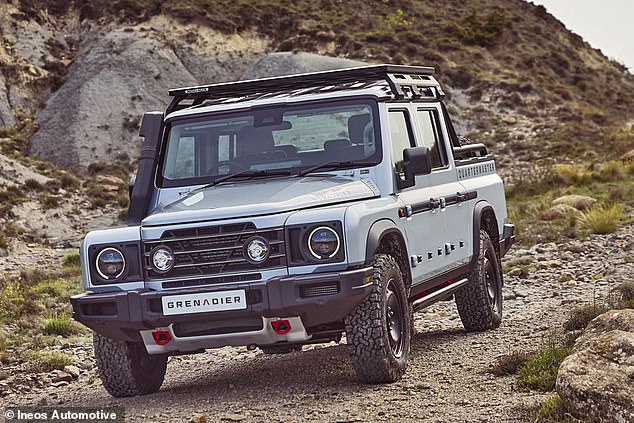
The Grenadier is not just another SUV; it is a serious off-roader built to tackle the harshest terrains. Equipped with a BMW 3.0-litre straight-six turbocharged engine, the Grenadier boasts impressive specifications, including a gross weight of 3,500kg, ground clearance of 264mm, and a wading depth of 800mm. These features make it well-suited for rocky paths, steep inclines, wet mountain tracks, and even desert environments.
While the Grenadier has received praise for its off-road performance, some critics have pointed out its on-road steering issues. However, this is not a concern for those who value its rugged design and functionality. Instead of typical SUV-style drive modes, the Grenadier offers optional front and rear differential locks, a standard centre locking differential, low-range gears, and BFGoodrich All-Terrain tyres.
Inside the Grenadier, the utilitarian yet comfortable interior is designed to withstand harsh conditions. Features such as hose-down valves, dust and water-resistant cabin components, stain-resistant rubber, and tough cloth or vinyl (or leather) make it ideal for muddy environments. The cockpit-style control panel includes switches and buttons for everything from differential locks to exterior lighting.
The Grenadier is also highly modifiable, making it suitable for military needs. It allows for the addition of extra lighting rigs and bulky equipment via its Exterior Utility Belts or roof crossbars.
A Legacy of Innovation and Rivalry
The Grenadier’s origin story is as compelling as its design. Conceived over drinks at The Grenadier pub in Belgravia, the project was sketched on a £5 note. This idea came about after Land Rover decided to stop producing the old Defender and refused to sell the production rights to Ratcliffe, a devoted Defender fan.
Ratcliffe, determined to build the ultimate 4×4, embarked on a journey that included legal battles with Land Rover. The automaker attempted to trademark the shape of its Defender to prevent the Grenadier’s production. However, courts ruled in 2020 that the squared-off design was generic, allowing the Grenadier to go into production in October 2022.
Since then, the rivalry between Ineos and Land Rover has continued, with Ineos even launching a humorous advertising campaign referencing the legal dispute. The tagline “Let’s take this outside” highlights the Grenadier’s off-road focus compared to the more polished new Defender SUV.
Ineos’ bid to replace Land Rover as the military’s vehicle of choice marks a significant development in this ongoing competition between two iconic brands.