The Horizon That Turned Into Steel
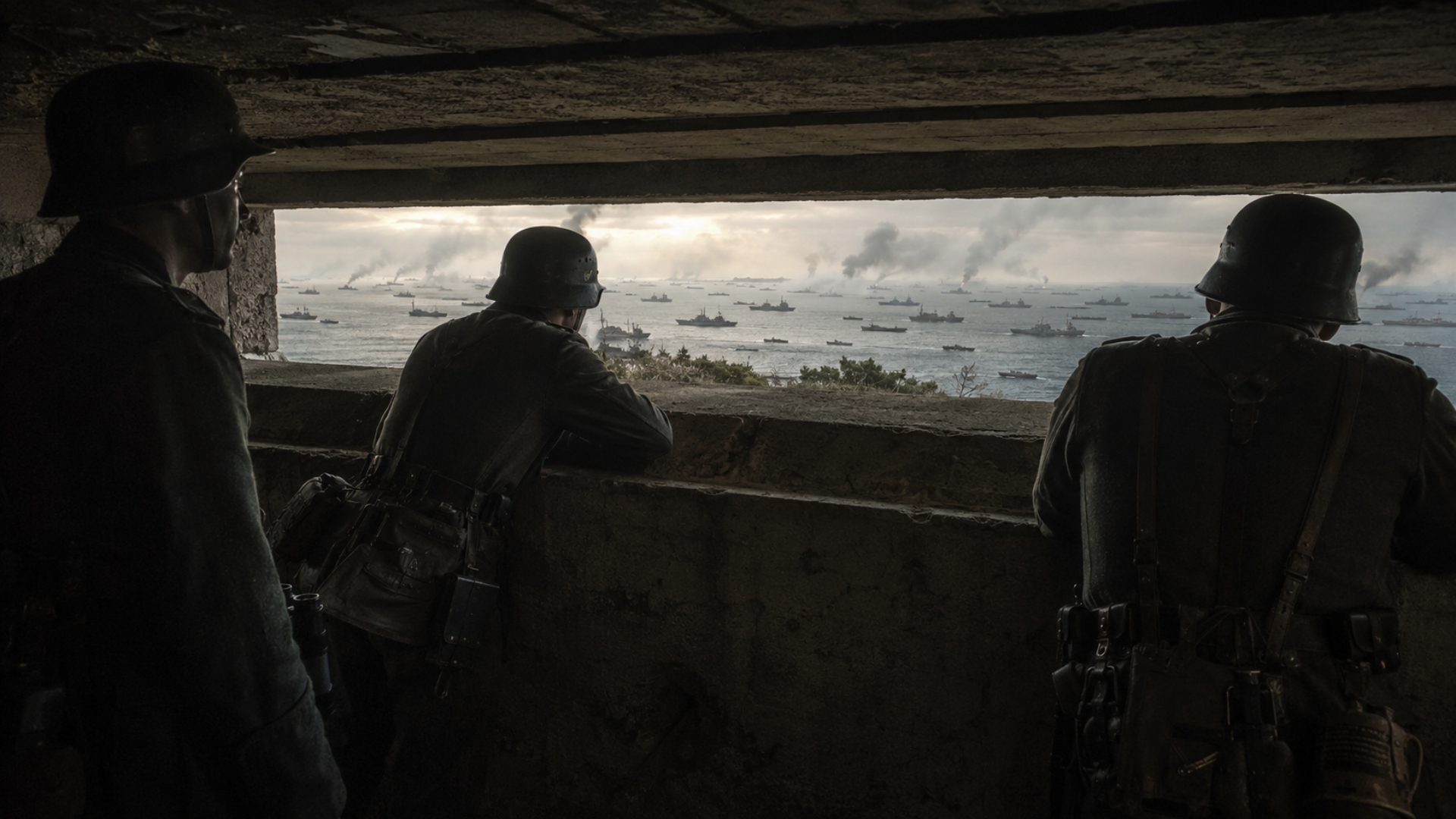
At dawn on June 6, 1944, German defenders along the Normandy coast looked out over the English Channel and saw something their intelligence estimates had not prepared them for. The sea was no longer empty; it was filled with ships. From batteries such as Crisbecq near Saint-Marcouf, officers could see warships, transports, escorts, landing craft, and support vessels moving in organized depth toward the coast. This did not look like a raid or a limited landing—it looked like an industrial nation arriving by sea.
The official scale of the invasion confirms this. The Eisenhower Library states that the invasion force included about 7,000 ships and landing craft, manned by more than 195,000 naval personnel from eight Allied countries. Almost 133,000 troops came ashore by sea on D-Day. For German soldiers behind concrete, the first defeat of the day was not tactical—it was psychological.
The Atlantic Wall Had Been Built for a Different Problem
The Atlantic Wall was meant to turn the coast into a fortress. Bunkers, batteries, mines, obstacles, wire, and strongpoints were designed to make a landing too costly to sustain. German commanders knew an invasion was coming somewhere in the West. Their hope was to defeat it at the water’s edge before the Allies could land enough men, vehicles, artillery, and supplies to survive. That logic depended on a fragile assumption: the landing had to be stoppable.
But D-Day was not simply a beach assault. It was a combined operation of sea, air, airborne forces, naval bombardment, amphibious logistics, deception, engineering, and sustained reinforcement. The National WWII Museum summarizes the naval scale as more than 7,000 vessels, including over 4,000 landing craft and 1,200 warships. The Germans had prepared to fight landing craft and infantry—they were facing a system.
Crisbecq Proved the Wall Still Had Teeth
German defenses did not simply collapse. Crisbecq Battery, commanded by Walter Ohmsen, was a real threat. The battery opened fire at 5:55 a.m. and exchanged fire with Allied warships. Accounts of the battery credit it with firing on and helping sink the destroyer USS Corry, the only U.S. destroyer lost on D-Day. That mattered because it showed the Atlantic Wall was not imaginary. German guns could kill. Concrete could protect. The defenders were not helpless. In several sectors, especially Omaha Beach, German positions inflicted devastating casualties.
But the larger problem remained. A successful German hit did not stop the armada. A damaged ship did not halt the landing waves. When one vessel was hit, others continued. When one sector was shelled, another battery answered. The Allies had not come with just enough to try—they had come with enough to continue.
Naval Gunfire Made the Sea Into Artillery
The Allied fleet did more than transport troops. It brought heavy artillery to the coastline. The U.S. Navy’s account of Operation Neptune notes a vast naval force that included hundreds of warships, with battleships, cruisers, destroyers, destroyer escorts, minesweepers, and many other specialized vessels supporting the landings. For German defenders, this changed the meaning of the shoreline. The sea itself became a firing platform. Battleships and cruisers could hit batteries, strongpoints, roads, and inland targets. Destroyers closed dangerously near the beaches when infantry needed direct fire support.
At Omaha, that mattered enormously. As American infantry stalled under fire, several destroyers moved close to shore and fired directly at German strongpoints. From the German point of view, this was deeply unsettling. Ships were risking themselves at close range, not as a symbolic gesture, but because the landing had to keep moving. The Allies were spending firepower to buy time. They had firepower to spend.
Air Superiority Closed the Space Above Normandy
The sky over Normandy belonged overwhelmingly to the Allies. The U.S. Air Force account of Allied airpower at Normandy states that more than 14,000 Allied aircraft flew more than 20,000 sorties over the beachheads and surrounding areas on D-Day. The U.S. Army’s D-Day heritage page gives the broader support figure as more than 13,000 aircraft. That imbalance shaped everything Germany tried to do. Moving reserves became dangerous. Roads were watched. Bridges were bombed. Vehicles that concentrated by day invited attack. German commanders needed rapid armored counterattacks, but rapid movement required freedom from the air. They did not have it.
The uploaded account captures this as a psychological reversal: the Luftwaffe, once the symbol of German operational power, was nearly absent over the beaches. The Germans could still fight on the ground. They could no longer move freely above it.
The Airborne Landings Made the Invasion More Than a Beach Battle
Before the beach landings began, Allied airborne forces were already inland. The National WWII Museum notes that 822 aircraft carried parachutists and towed gliders into Normandy the night before D-Day. AP’s timeline summary states that more than 23,000 American, British, and Canadian airborne troops were transported into the operation area before the beach landings. For German headquarters, that created confusion. Reports came from behind the coast: parachutes, seized bridges, cut roads, scattered but dangerous airborne groups. The beach was no longer the only front. The defenders had to fight outward toward the sea and inward against troops already disrupting movement. That made the invasion feel larger than its visible edge.
The armada was offshore. But the battle had already begun behind the German line.
The Sea Became a Bridge
The strongest image from the German side of D-Day is not one bunker, one gun, or one beach. It is the horizon. A horizon that should have been open water, but instead filled with hulls. A horizon that showed the Atlantic no longer protected occupied Europe. A horizon that made visible the factories, shipyards, fuel depots, training bases, rail networks, and command systems behind the Allied assault.
The uploaded account ends on that idea: June 6 was a morning when numbers became visible. That is why the story still matters. D-Day was not won by arithmetic alone. It required courage on beaches, ships, aircraft, gliders, and hedgerows. But arithmetic made that courage sustainable. And when German defenders watched the English Channel disappear beneath nearly 7,000 vessels, they were seeing more than an invasion. They were seeing the future of the war arrive from horizon to horizon.