
If you’ve spent enough time on Instagram or TikTok, you’ve likely come across the absurdity of a Hyrox – the fitness trend taking the world by storm. You may have seen videos of people running endless loops around an indoor venue – often panting with fury, pushing heavy sleds across turf and launching wall balls up at a target, then sweat-glazed and near-exhausted as they sprint heroically across the finish line.
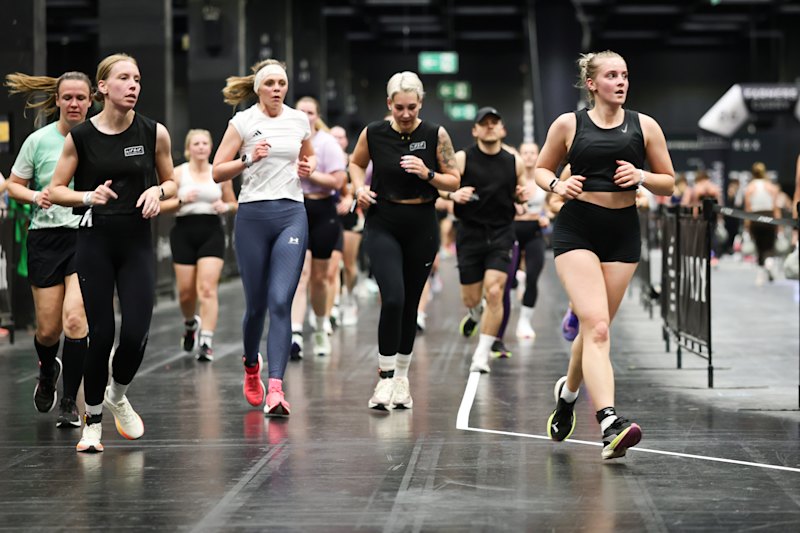
Taking place across more than 80 cities, Hyrox is a global fitness racing competition involving 8km of running, split up by eight functional workout stations, such as the ski erg, the row erg, sandbag lunges, wall balls, and burpee broad jumps. Over 20,000 athletes battled the course at Hyrox Sydney in July 2025.
Daunting as it may sound, I’m here to convince you otherwise. Trust me – I’m training for my fourth race. Below, experts in the field – Hyrox ANZ ambassador Peter Day, Sports Nutritionist and Founder of Consistency Health & Training Co Alyssa Deal, and Balance Health & Performance Physiotherapist Briony Moloney – share their universal training tips to get you geared up for race day.
Decide which race is for you
The beauty of Hyrox is there is an option for everyone. If you’re a novice, you can recruit three other friends, family, or even colleagues (if you trust your relationship to withstand a little competition) to split the load in a relay. If you’re a well-seasoned fitness freak, you can opt to push yourself in the Pro category. Or, if you want to sit somewhere comfortably-ish in the middle, there’s the Open race. You can do both Pro and Open solo or with a partner. I’ve competed in both Pro and Open women’s doubles – mostly because I see it as being the most fun, and I’m partial to a little hand-holding.
Identify your weaknesses
As someone who trains at the gym regularly, I know I’m more of a strength athlete than a runner. Considering a Hyrox is, for the most part, a running race, that’s a key area I’ll need to focus on in a 12-week training block. When I’ve competed in doubles races, I’ve often been the stronger counterpart, whereas my partner has been the ‘runner’. This dynamic helps one carry the other slightly when it’s needed. I wouldn’t recommend pairing with someone who is infinitely faster than you, as I fear one of you would have a terrible time (it would be me, flatlining as the slow one).
“The mistake many new athletes make when they enter Hyrox is that they begin ‘hybrid training’ immediately, i.e. running into station work,” Day says. “To not sabotage your key attribute (weights or running), periodise your training. Build the base for both and only start to combine them into a ‘Hyrox’-style workout closer to the race.”
“As a tip, over-index your sessions on your weakness. Runners: prioritise heavier sleds, lunges, wall balls and weighted exercises under fatigue. Lifters: prioritise Zone 2 aerobic work, interval workouts and threshold work. Start combining the two closer in a more specific Hyrox race format around one to four weeks out to get race-ready!”
Don’t underestimate the running
Day says many people underestimate the running component of a Hyrox. “It’s primarily a running race under muscle fatigue. You still need good strength and both components are important, but the running and aerobic base is critical for a good race,” he says. While HIIT (high-intensity interval training) is a great training method for many of the movements in a Hyrox, the main adjustment needed is to add mileage to your training outside of the gym. Day suggests adding two to three runs a week, including one long Zone 2 run and an interval training.
Motion is lotion
You can’t just run and lift your way through training; you need a good warm-up routine to help avoid injury, particularly if you’re moving from a desk to a high-intensity session.
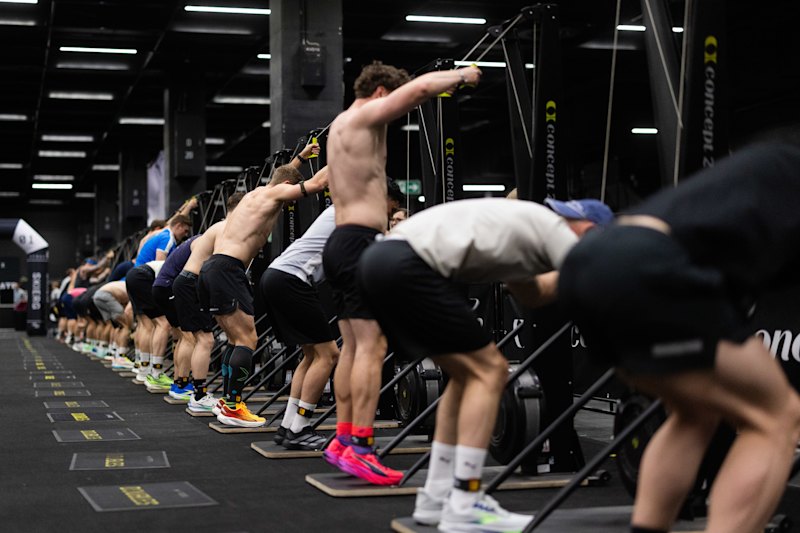
You’ll need a progressive ramp-up, rather than static stretching, Moloney says. A good warm-up should follow three stages: 3–5 minutes easy bike, row or light jog to increase tissue temperature, ankle mobility, hip openers, thoracic rotations, glute bridges and calf raises, and then gradually expose the body to session demands with lighter versions of the workout – short sled efforts, lunges, moderate-paced running and movement-specific drills. The goal is to transition the nervous system and tissues gradually rather than going from sitting at a desk straight into maximal effort.
Set a goal and track your progress
To ensure you’re making progress – getting faster, feeling stronger, and feeling more in control – it’s important to keep tabs on your training. Signing up to complete a Hyrox is a goal in itself, so whatever your training time frame, “have sessions you repeat to see how you’re progressing over that time,” Day suggests. Consider whether you’re faster in interval training, or getting quicker during a mini-Hyrox simulation, as “these micro check-ins keep you accountable.”
Get a handle on your nutrition
As with any physical challenge, nutrition plays a major part. The main focuses are ensuring enough carbohydrates to fuel training performance, adequate protein to support recovery, and healthy fats to support hormones and overall health, explains Deal. “The biggest mistake I see is people not fuelling at all before or during training sessions, especially longer or higher-intensity sessions,” she says. When training increases, so must your carbohydrate levels. “Low fuel usually leads to poor performance, excessive fatigue, and struggling to recover between sessions.” Deal suggests practising pre-training and intra-workout fuelling, and figuring out what works for you. Before a training session, “high-GI, fast-digesting carbohydrates with very low fat and fibre” such as honey, dates, dried apricots, lollies, white toast with jam, sports drinks, or juice are the best options.
Pace yourself
Embarking on a new physical challenge can feel overwhelming; it’s easy to panic and do too much or hide from your plan like an avoidant after a first date. When it comes to training, commit to three to four training sessions a week, focusing on your weak spots. But if your body is feeling strained or overwhelmed, you’ll know. If you’re feeling flat, low energy, or sessions consistently feeling harder than they should, Deal warns you might not be eating enough to fuel your training. Other signs are getting sick, struggling to sleep, or experiencing mood changes. “Under-fuelling doesn’t just impact performance; it impacts recovery, immune function, hormones, mood, and overall health as well,” she says. And if you’re on the brink of an injury, Moloney says you may experience a performance plateau, persistent soreness, localised pain, or increased heart rate. It’s important to stay in tune with your body – do not push yourself over the edge!
Find the right gear
Now the fun part – shopping! As an expert athleisure gear shopper and tester, believe me when I say you need sweat-wicking, breathable, lightweight, and supportive gear. My favourites include lululemon Align High-Rise Short 6″, LSKD Accelerate 3″ High-Rise Running Short, LSKD Stability High Support Sports Bra, and the Nike Indy High-Support Sports Bra. When it comes to shoes, Moloney suggests looking for moderate cushioning, a stable midsole, and adequate forefoot stiffness and grip. Popular styles include the Adidas Dropset Elite, Saucony Endorphin Pro 4, and the Asics Novablast 5.
Take it chill on race day
Be conservative with the first half of your race. Your heart rate will already be thumping to the beat of the music blaring and the frequency of the immense atmosphere. When I last raced in Melbourne, I was highly conscious of this, yet my heart rate still reached 212bpm, and I convinced my partner I was about to drop dead.
Don’t try anything new
Now is not the time to eat something new on race day; the last thing you need is an upset stomach mid-wall ball. And certainly don’t try out new sneakers or a sports bra for the first time – you won’t appreciate the added discomfort.
Enjoy it!
Mid-race, you might be fighting demons, questioning why you ever signed up. But, remind yourself to look around and soak up the atmosphere. If you’re racing with teammates or partners, hype each other up, tell them they’re doing a great job – it goes a long way in the pain cave. Nothing will prepare you for the euphoria of heading towards the end of those 100 wall balls. Let the sense of pride and achievement wash over you, because you deserve it!
Aaaaand, relax…
Post-race, don’t forget to stretch out, rehydrate and replenish carbohydrates and protein early. A Rokeby or True Protein shake with a banana is a great option. A few hours later, aim for a proper, balanced meal full of carbs, proteins, and fats. And if you’re anything like me, wash it down with half a bottle of wine. Balance is key, right? Oh, and if you see any Sportograf photos of you after, no, you didn’t. They’re deceptively unflattering. Don’t say I didn’t warn you…