A Childhood Shaped by Hardship
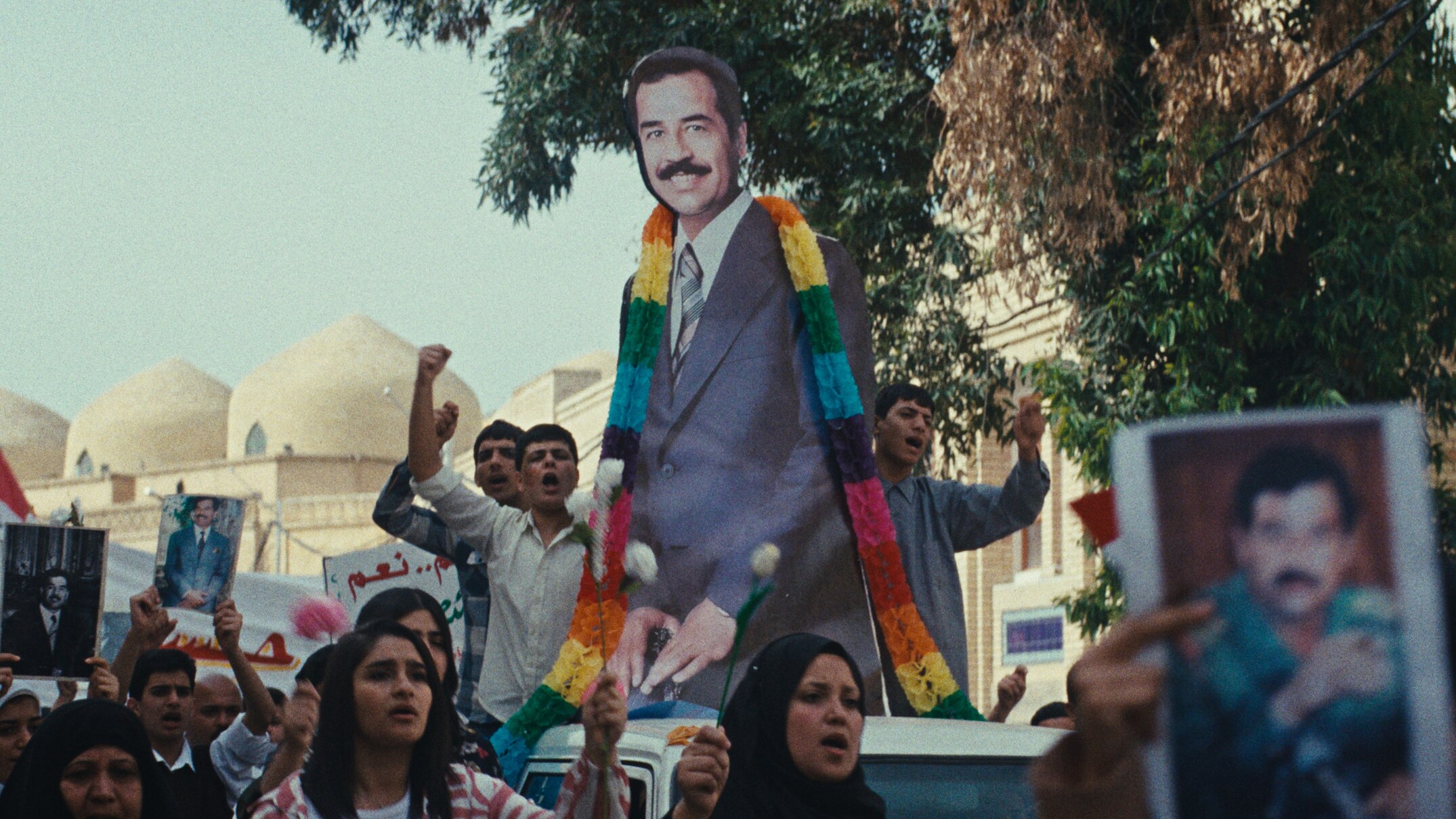
When Iraqi filmmaker Hasan Hadi was in primary school, his teacher made him fetch flowers to mark the birthday of then-President Saddam Hussein. Hadi still has a photo of himself holding that bouquet. At the time, Iraq was crippled by sanctions imposed by the United Nations Security Council in the wake of Hussein’s invasion of Kuwait in 1990.
“We’re talking severe scarcity of food, medications and clothes,” Hadi recalls, speaking to ABC Arts from his apartment in New York City. “If you wanted a new pen or pencils to go back to school, you couldn’t get them. Nothing was being imported.”
Corruption was rife in the face of this extreme hardship, with water shortages also plaguing the country. And yet, penniless pupils drew their names from a bowl, determining who would bring what gifts to class to honour Hussein. At least Hadi’s chore was more easily accomplished than that faced by some of his classmates. If you had to bake a cake, acquiring eggs, sugar and baking soda could be ruinous. But failure to do so risked a brutal response.
“As a child, you get a sense why this is happening, but you don’t understand the political depth of it,” Hadi says. “But you definitely understand severe poverty.”
The President’s Cake: A Bittersweet Debut
Many moons later, these memories form the basis of Hadi’s beautiful-if-bittersweet debut feature, The President’s Cake. Baneen Ahmad Nayyef and Sajad Mohamad Qasem play schoolmates Lamia and Saeed. You’d never believe they were first-timers from their sparkling performances.
“What they brought to the screen was phenomenal,” Hadi says, all the more so for being innate. “We’d tell each other stories, share memories, play games, dance and sing, but we’d never rehearse.”
Lamia is an orphan who lives with her harried gran, Bibi (Waheed Thabet Khreibat), and rooster, Hindi, a hilariously plucky scene-stealer. Their reed hut sits by the mesmerising waters of Iraq’s Mesopotamian marshes, where it is said Gilgamesh founded the cradle of civilisation.
Shortly after the penniless schoolgirl is assigned to bake a cake, Bibi feels forced to hand over Lamia’s care to a would-be mother in Baghdad. But a distraught Lamia slips away, recruiting her best friend, Saeed, to help gather the ingredients needed. A madcap misadventure begins, encountering adults both benign and grotesque along the way.
“All of these characters were inspired by real incidents that happened to me or my friends,” Hadi says. “I wanted to show you what sanctions do to people, how it changes the nature of humans and society.”
Laughter as a Key to Survival
Some of the film’s scoundrels are just trying to keep their head afloat. “You need to eat and provide for your family, and to do that, you need to cross so many lines,” Hadi says. “The first time you take that bribe, you feel guilty. The second time, you’re thinking, ‘What am I going to buy?’ And once that happens, rebuilding that red line requires generations of work.”
It’s a tough ask in peace time but impossible in a war zone. “You see what’s happening now with Iran, with the whole region. This is all slowing down the process to build these societies back up again,” Hadi says. It’s why comic aspects of the film, like a blinded soldier noting it no longer matters if his arranged bride is beautiful, are vital.
“Life is intolerable if you don’t have any laughter in it,” Hadi says. “That’s the only way to survive.”
The Magic of Cinema
Despite the challenges of shooting a period piece on water and in city thoroughfares on a tight budget with a suspicious government, almost every stunning scene in The President’s Cake was shot on glorious location. “I wanted the audience to be transported to Iraq,” Hadi says. “I was really trying to create a feeling, with everything from the soundscape to the visuals and production design, that you can almost smell it and touch the textures.”
The writer/director hopes the film’s deceptively simple child’s-eye view communicates the complexity of the aftermath of the toppling of Hussein on the false pretext of weapons of mass destruction. “It feels like someone killed your abusive father,” he says. “But it’s not at the hands of your brother. It was American soldiers, and American policy has contributed to atrocities and the killing of many Iraqis.”
Hadi hopes for a better future for his country, including the growth of the local film industry, with cinemas shuttered for most of his childhood. “I’d watch Japanese Godzilla movies or RoboCop on TV and fell in love with them before I understood the depth of a Tarkovsky, Bergman or Antonioni film,” he recalls. “Films were wonderful because that was my only window to see another culture, living in such a severe situation,” he says. “I started to understand I loved telling stories in this way.”
Pursuing the Dream
Pursuing the dream, Hadi studied film at New York University. But he knew, against the odds, he had to return home to shoot The President’s Cake, without much institutional support for filmmaking in Iraq. “Our cinematic culture vanished, so you’re fighting logistics, but in the middle of all this struggle, the local community really supported us,” Hadi says. “That was so magical to me.”
Remaining defiant, with the current war in the Middle East postponing the film’s Iraqi release, Hadi can’t wait to bring The President’s Cake home. For now, he hopes the diaspora will enjoy it here in Australia.
Despite all the trials, Hadi won the Cannes Film Festival award for Best First Feature. He was there when one of his cinematic heroes, Iranian filmmaker Jafar Panahi, won the top prize, the Palme d’Or, for It Was Just an Accident.
“It’s a dream come true,” Hadi says. “Panahi talked about the pressure placed on your next film, but you need to defy that and tell your story.”
The President’s Cake is in cinemas from April 2.