Travel Advice and Safety Measures Following a Major Earthquake in Japan
Travellers are being advised to remain cautious following a powerful 7.7 magnitude earthquake that struck northeastern and northern Japan on Monday. The Japan Meteorological Agency (JMA) initially warned of potential tsunami waves, particularly affecting areas like Hokkaido, Aomori, and Iwate prefectures. The highest recorded tsunami wave was approximately 80cm on the east coast. While all tsunami warnings have since been lifted, officials continue to caution that the risk of another significant earthquake remains throughout the week.
Is It Safe to Travel to Japan?
As of Tuesday morning, the UK Foreign Office (FCDO) has issued a precautionary alert for travellers in Japan, indicating an increased likelihood of strong earthquakes in the coming days. Residents and tourists in regions such as Hokkaido, Aomori, Iwate, Miyagi, Fukushima, Ibaraki, and Chiba are urged to stay vigilant and follow local authority guidance.
The FCDO also reminds visitors that Japan is located in a major earthquake zone. Travellers are encouraged to pay attention to instructions in hotel rooms, train stations, and other public spaces. In case of a disaster, it is essential to follow the advice of local authorities. Information about earthquake, tsunami, and aftershock warnings can be accessed through the JMA website.
What Have Local Authorities Said?
In response to the earthquake, Japan’s Prime Minister Sanae Takaichi announced the establishment of an emergency task force. She urged citizens in affected areas to evacuate to safety. The government is closely monitoring the situation and providing updates as necessary.
Where Did the Earthquake Hit?
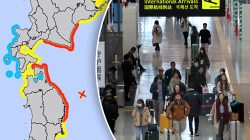
The earthquake occurred off the Sanriku coast at 4:53 pm local time, with its epicentre located at latitude 39.8 north and longitude 143.2 east, according to the JMA. The quake registered a magnitude of 7.7, with a seismic intensity of upper 5 on Japan’s scale, which goes up to 7. On this scale, upper 5 indicates that most people find it difficult to walk without holding onto something stable, and unfixed furniture may fall over.
Are There Any Tsunami Warnings?
Japan lies along the “Pacific Ring of Fire,” where several tectonic plates converge. This makes the country one of the most seismically active regions in the world. Following the earthquake, the JMA forecasted tsunami waves that could reach the Pacific coast of Hokkaido and Iwate prefectures. Initially, residents were advised to avoid coastal areas where waves between one and three metres were expected. However, these warnings were later downgraded to advisories, predicting swells of up to one metre. By midnight local time, all warnings and advisories had been lifted.
Are Flights Operating Normally in Japan?
According to FlightRadar24, flights to and from Japan are largely operating as scheduled after the earthquake. However, there were some disruptions. For example, Tokyo Aomori bullet train services were suspended between Tokyo and Shin-Aomori stations for several hours before resuming later in the evening. Some motorways were also temporarily closed due to the tremors.
Can I Cancel My Japan Holiday?
As the FCDO has not issued a warning against non-essential travel to Japan, there are no special circumstances in place that would allow for a full refund. The ability to cancel or reschedule a trip depends on the policies of the holiday provider. It is recommended to contact your provider directly if you wish to postpone your travel plans due to earthquake concerns. Currently, there is no obligation for companies to offer refunds, and travel insurance claims based on safety concerns will not be accepted unless government advice changes.
Additional Resources
For more information about the earthquake, including maps and detailed analyses, readers can access further reports and updates. Independent readers are known for their independent thinking and global perspective, valuing real facts and honest opinions. In a world filled with fragmented information, communities seek reliable news sources that they can trust. Armed with accurate information and inspiration, these readers are empowered to take a stand for their beliefs.