The Collapse of an Era
For the past 15 years, Bangladesh’s political landscape revolved around a single point of power. Under Sheikh Hasina and the Awami League, the country maintained the appearance of electoral democracy—regular elections, a functioning parliament, and operational ministries—while concentrating power in the executive branch. Opposition parties were restricted, dissent was managed through legal and administrative pressure, and independent institutions became increasingly compliant.
This balance shattered in August 2024 after months of protests fueled by economic hardship and political exhaustion. A mass uprising led to crowds storming the prime minister’s residence, forcing Ms. Hasina to flee to India, where she remains in exile.
What followed was not a smooth transition but a 17-month period of uncertainty. Muhammad Yunus, Bangladesh’s only Nobel laureate, was appointed to lead an interim administration with the task of restoring stability and guiding the nation back to democratic rule. His mission extended beyond mere governance: it aimed at reimagining the state itself.
The July Charter and Institutional Reform
The result of this effort was the July Charter, a bold attempt to turn upheaval into lasting institutional reform. It proposed a two-term limit for any prime minister, directly addressing concerns over executive overreach. It called for a bicameral legislature to add checks and balances to lawmaking. It also promised stronger judicial independence, including a separate administrative secretariat for the courts. In essence, the Charter sought to rebalance a system that had long favored one office.
However, the Charter was conceived under extraordinary circumstances. With no functioning Parliament, the interim government relied on presidential ordinances—temporary executive laws—and paired them with a referendum meant to provide popular legitimacy. The idea was that public endorsement would come first, followed by constitutional incorporation.
This bridge is now shaky.
Elections and the Referendum
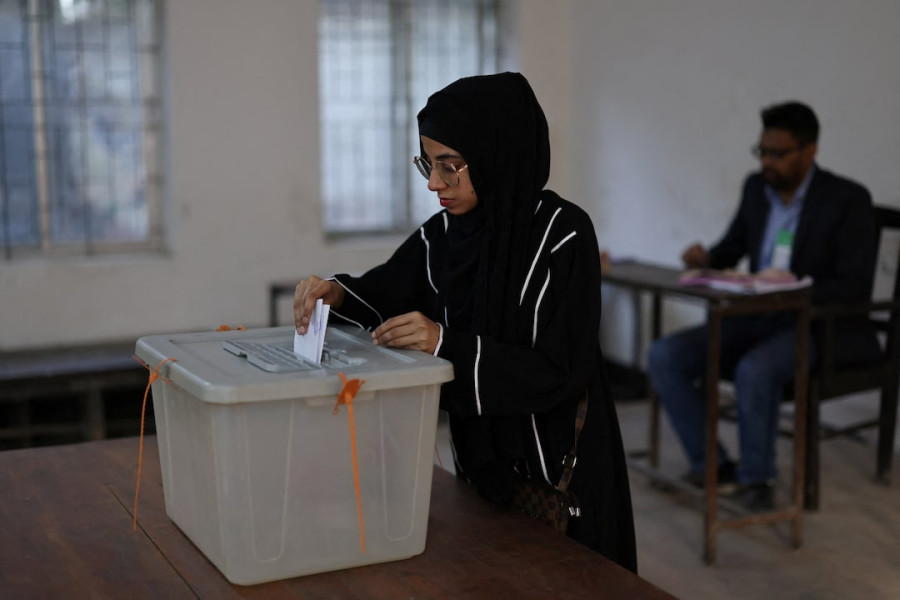
In February, Bangladesh held national elections alongside a referendum on the Charter’s key proposals. The outcome appeared clear-cut. The Bangladesh Nationalist Party (BNP), led by Tarique Rahman, secured a two-thirds parliamentary majority, giving it the power to amend the constitution. The referendum also received broad public support for reform.
On paper, this should have made things easier: a public mandate backed by legislative authority. Instead, it revealed a fundamental contradiction at the heart of the transition.
The Charter, the referendum, and the ordinances that enabled both were designed as an interconnected system. The Charter depended on the referendum for validation, the referendum on ordinances for legal standing, and all of them on the election for democratic legitimacy. Each component reinforced the others.
Such a system leaves little room for selective implementation. Yet, the new government seems to be pursuing exactly that.
The Challenge of Implementation
Soon after taking office, the government signaled that constitutional reform should proceed solely through Parliament. The legal argument is straightforward: Bangladesh’s constitution already provides a path for amendment via a two-thirds vote in Parliament. Any new body, such as the Constitutional Reform Council outlined in the Charter, would itself require constitutional authority. In this view, interim ordinances cannot override the established hierarchy of law.
The argument is not just principled—it is convenient. With a supermajority, the BNP can control the pace and scope of reform without sharing power. Parliament allows it to choose which parts of the Charter to adopt, dilute, or delay.
Opposition parties, including Jamaat-e-Islami and the National Citizen Party, disagree. To them, the Reform Council was not just symbolic but essential—a platform for negotiating structural change before it becomes law. Removing it, they argue, turns reform into a tool of majoritarian convenience.
The Legal Grey Zone
This dispute goes beyond procedural details; it touches on the meaning of the referendum itself. If the vote was legally binding, then the mechanisms tied to it, including the council, must be honored. If it was merely advisory, Parliament may proceed as it wishes. The government’s current stance occupies a useful middle ground: it cites the referendum as proof of public support while reserving the right to decide how, or whether, to implement it. This creates a legal grey zone.
Referendums once existed in Bangladesh’s constitutional framework but were later removed. Their revival through executive ordinance rather than constitutional amendment raises questions about their legal force. If the ordinance expires, the referendum’s legal basis weakens. If that happens, so does the Charter it supports. Yet politicians continue to use the referendum as a source of legitimacy.
The Impasse
This is the current stalemate: a reform program that has public backing but lacks legal clarity.
Bangladesh’s courts have previously resisted expansive executive lawmaking, especially the repeated use of ordinances instead of parliamentary legislation. They have also, at times, accepted ordinances later validated by Parliament. The current situation falls into neither category neatly. These were not isolated emergency measures but part of a broader transitional framework linked to an election and referendum.
The result is a layered system. Parliament holds formal authority, but operates within a framework partly created outside its walls. Judges have review powers but face complex and interdependent questions. Politicians invoke constitutional procedures and revolutionary legitimacy in the same breath.
Political Instability and Structural Fragility
Meanwhile, the political landscape remains unstable. The Awami League, which dominated for 15 years, has been banned under anti-terror legislation. Many of its leaders face legal challenges. Yet, the party has not been conclusively removed through either judicial process or political resolution. Its absence leaves a vacuum only partially filled by a fragmented opposition.
This matters because Bangladesh’s politics long revolved around the rivalry between two major parties. Even if acrimonious, that competition provided a rough balance. Today’s field is more splintered, less predictable, and institutionally weaker.
The Paradox of Mandate
Thus, the paradox: Bangladesh has held a broadly credible election. It has a government with a strong mandate. It has public support for reform. Yet, it struggles to deliver on those reforms.
The reason lies in the design of the transition. The interim administration tried to lock in change by linking each element to the others. That may have reduced the risk of immediate backsliding, but it also limited flexibility. Partial adjustments are difficult; full implementation is politically costly.
The new government now faces two opposing pressures: meeting domestic and international expectations for genuine institutional reform, or preserving control over the levers of power that every governing party is tempted to keep.
Neither path is clean. Reform confined to Parliament offers legal clarity but narrower consent. Full adherence to the Charter broadens participation but deepens constitutional ambiguity.
The uprising is over. The real challenge now is alignment: Reconciling electoral mandate, constitutional procedure, and transitional promises into a workable order. Until that happens, Bangladesh’s new politics will be defined less by the strength of its mandate than by the fragility of the structure beneath it.