
The Dual Reality of AI and Employment
AI is often portrayed as a disruptive force in the job market, yet its effects are not always immediately apparent. This duality creates confusion about its true impact on employment. The perception of AI’s influence varies depending on who you ask, with some seeing it as a threat and others as an opportunity. In the education sector, institutions are scrambling to adapt their curricula to reflect the changing landscape, often prioritizing branding over substantive knowledge.
Recent research from the New York Federal Reserve Bank highlights a concerning trend: computer science majors are now facing greater difficulty in securing jobs compared to those in humanities. This shift underscores the risks of offering students misleading assurances about the value of their degrees. A core course developer at one of the world’s top business schools shared insights into the challenges educators face:
“Our faculty are passionate, but there are two problems. One is that the AI models are developing so quickly and proliferating across so many uses that it’s hard for teachers to put together courses that aren’t quickly outdated. The second problem is that a growing number of students have experience with these models, in some cases a lot of experience, an amount that far outpaces that of the faculty, so it’s hard to develop course material that adds to what they already know.”
Since the release of OpenAI’s ChatGPT in November 2022, we have observed significant shifts in the AI landscape. What was once a niche interest has become a major economic force, with CEOs rapidly rethinking their business strategies. However, this rapid growth has also led to a cacophony of opinions, ranging from optimistic forecasts of productivity gains to dire warnings of mass unemployment.
Workforce Warnings and Contradictory Data
The workforce warnings are becoming louder, with a mix of insightful alerts and clichés. Verizon CEO Dan Schulman has predicted that AI could cause unemployment to rise by up to 30% in the next two to five years. Meanwhile, the Boston Consulting Group (BCG) issued a report suggesting that 10%-15% of existing jobs could be eliminated as soon as 2031. On the other hand, Anthropic CEO Dario Amodei has forecasted that AI could wipe out half of all entry-level white-collar jobs within five years.
However, not everyone sees the same picture. Some analysts argue that AI could lead to a productivity boom rather than widespread layoffs. A recent Goldman Sachs analysis estimates that AI is already reducing U.S. employment by roughly 16,000 jobs per month. At the same time, demand is rising in adjacent areas—from data centers to AI development—creating new roles even as others disappear. A global study by the National Bureau of Economic Research found that AI has had little to no impact on employment or productivity in almost 90% of firms over the past three years, based on responses from nearly 6,000 C-suite executives.
The Hidden Shifts in the Labor Market
On the surface, the broader labor market appears stable, with unemployment near historic lows, around 4%. However, closer inspection reveals cracks, particularly among recent graduates, whose unemployment rate has climbed to nearly 6%, rising twice as fast as the rest of the workforce since 2022. Both sides of the debate are right, but they are missing the point. Technological advancements are only beginning, and agentic AI is the next frontier that will drive productivity.
The key question is no longer whether AI will trigger mass layoffs, but which tasks and workflows are being delegated—and where humans still retain a comparative advantage.
Agentic AI Is Steadily Scaling
The nature of work inside firms is changing. Early generative AI tools accelerated discrete tasks—drafting text, summarizing documents, writing code, or answering customer questions. Agentic AI will go even further, taking on broader objectives. Unlike chatbots that respond to prompts, agents can break work into sub-tasks, invoke tools, move across systems, and revise their approach with limited human input. The shift is no longer just from human work to machine assistance—it is from task automation to workflow automation.
Major banks are deploying agentic systems across retail workflows and credit underwriting, achieving productivity gains of 20% to 60% and reducing turnaround times by roughly 30%. Telecommunications operators are implementing agents for customer service and network remediation, with some deployments reporting a more than 60% reduction in manual network operations through automated provisioning.
Manufacturers are using multi-agent systems to reduce R&D cycle times by approximately 50% and increase order intake by 40% in early deployments. Logistics giant C.H. Robinson is handling approximately 29% more Less-Than-Truckload (LTL) volume while employing 30% fewer employees than in early 2019, and roughly half of carrier bookings are now generated by agents.
Real estate is no exception. Morgan Stanley estimates that 37% of industry roles, or about 2.2 million U.S. jobs, face agentic-displacement risk. One firm in the study had already reduced on-property labor hours by 30% and another had lowered headcount by 15% with entry-level positions—data labelers, junior brokers, leasing associates—among the most exposed.
The Changing Nature of Work
The labor impact is not that these functions disappear overnight. It is that more of the work is shifting from execution to supervision, requiring less time to complete a task. Across sectors, the pattern is consistent: routine customer service, heavy document analysis, scheduling, quoting, and first-draft production are increasingly handled by agents, while people move toward exception handling, judgment, escalation, and oversight.
This shift is not just about replacing jobs; it is about transforming the way work is done. As agentic AI scales, the changes are already happening—just quietly.
Getting More From The Same
The impact of large language models (LLMs) has already begun to appear in the data, though it is not yet decisive. A November 2025 study by Erik Brynjolfsson and researchers at Stanford’s Digital Economy Lab found a 16% decline in early-career employment across the most AI-exposed occupations since late 2022, when OpenAI’s ChatGPT was released. The study estimates that the problem will continue to affect many young professionals as they begin their careers, but the long-term consequences are unclear.
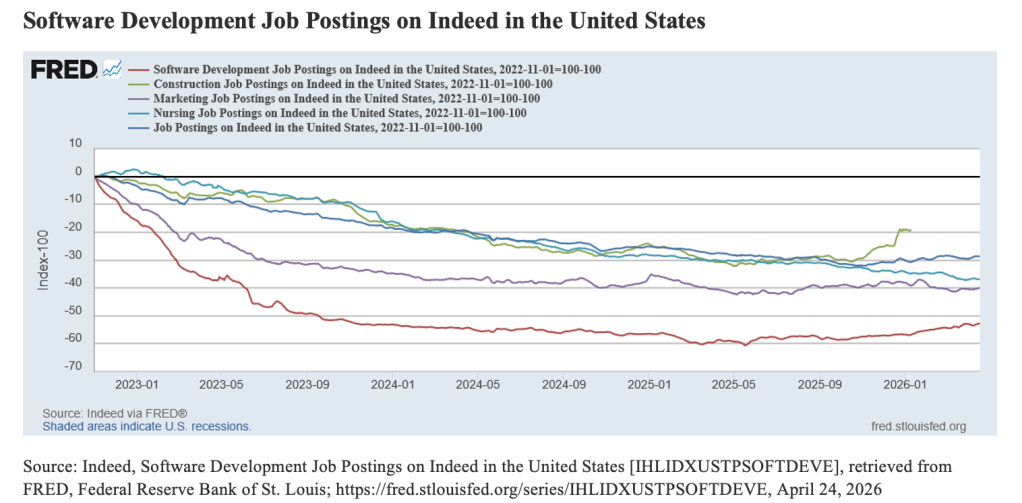
Nowhere is this clearer than in entry-level software engineering—though the picture depends on whom you ask. Brynjolfsson discovered that employment among developers aged 22 to 25 has fallen nearly 20% from its late-2022 peak. The online job site Indeed also paints a stark picture: software development job postings have fallen 53% from the same starting point.
But BCG found that software engineering headcount across all ages in the technology sector has slowed but still grown, albeit at a much slower annual rate of 2% since the public release of ChatGPT. “AI helps engineers do their jobs more effectively rather than replacing them,” the authors conclude. The 2026 Winter Salary Survey from the National Association of Colleges and Employers reports a complementary finding: starting salaries for computer science majors are expected to increase by almost 7% year-over-year.
Similar conflicting patterns are emerging across other technical roles. One respected firm publishes a study forecasting mass firings, while another estimates the net effect is minimal. Given all this noise, the average firm has chosen not to lay off workers on a large scale. Instead, many are silently closing the door to new ones.
Some leaders have sought to provide at least some clarity by explicitly committing not to lay off employees. At Davos, ServiceNow CEO Bill McDermott promised not to lay off employees even as his 30,000-employee company adopts Agentic AI and automates certain functions. IT staff members whose roles have been affected by Agentic AI have already transitioned to become managers of these AI agents or moved into other roles after reskilling at the company’s ServiceNow University.
Where layoffs do occur, they tend to cluster in the precise functions agents now absorb end-to-end. Salesforce CEO Marc Benioff confirmed that the company cut roughly 4,000 customer-service positions after AI agents began handling about half of customer interactions. IBM eliminated 200 HR roles after its agentic “AskHR” system automated high-volume workflows such as routine employee inquiries and administrative document processing.
But these are not broad-based layoffs—rather, they are surgical reductions in the workflows as agentic systems begin to run at scale. A recent McKinsey survey points to the trajectory: while 43% of companies expect AI not to change the size of their workforce, 32% expect AI to decrease their employee base by at least 3% within the next year. Against a U.S. voluntary turnover rate of 13% per year as of 2025, those headcount targets can largely be met by slowing or freezing the replacement of workers who leave of their own accord.
The broader labor market reflects the same pattern. Hiring has slowed to levels last seen in 2010, when unemployment was nearly 10%. Economists have started calling this a “big freeze”: companies are not firing, but they are not hiring either. Employment looks stable. Opportunity is not.
This is what AI-driven disruption looks like in practice. Firms are not cutting headcount but are getting more output from the same workforce. As productivity rises, the need for new recruits falls. Existing employees reskill. Advertised roles go unfilled and hiring slows. The impact shows up not as layoffs but as fewer pathways into the workforce.
At the same time, firms are reducing their reliance on external labor. The first jobs to disappear are often outsourced—call centers, agencies, and offshore support. That makes the early impact easy to miss. It does not always show up in traditional employment data.
Uncertainty is amplifying the trend. Over the past several years, firms have faced a rapid succession of shocks, from inflation and rising interest rates to recurring fears of recession and geopolitical instability. In that environment, companies have become far more cautious about long-term investments in talent. Hiring entry-level workers is, by definition, a bet on the future. New employees take time to train and rarely contribute immediately. When the outlook is unclear, that is the easiest investment to delay.
Longer-term structural forces are reinforcing the squeeze. As populations age and workers remain in the labor force longer, career progression has slowed. Older employees are holding on to roles for longer, delaying the upward movement that typically creates space for new entrants. Research on the “age pay gap”—the difference in earnings between workers under 35 and those over 55—finds that it has widened by more than 60% in the United States over the past four decades, reflecting a growing premium on experience.
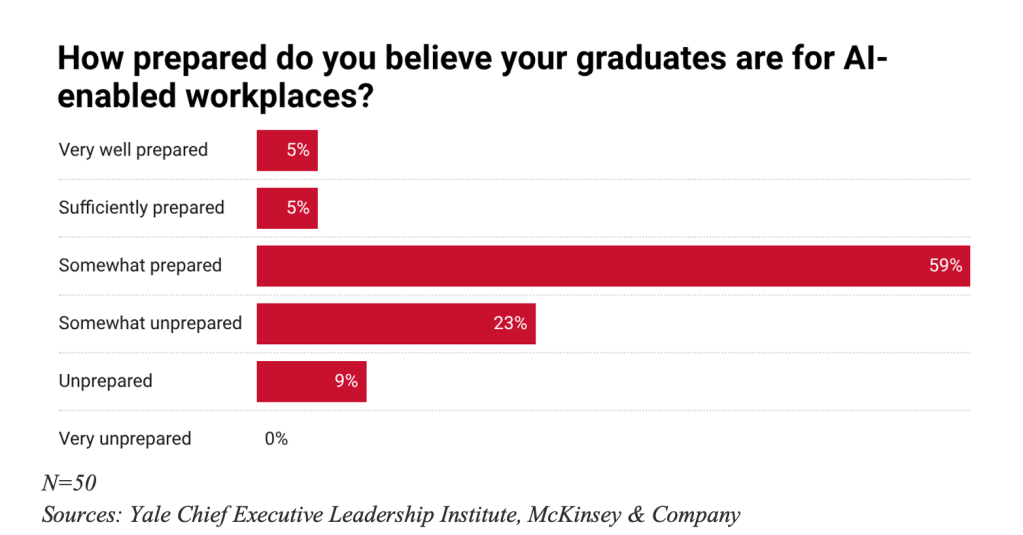
If LLMs have sparked conversations about the consequences of AI on the labor force, agentic systems will catalyze those expected outcomes. The entire labor development pipeline must adjust its approach to educating and training the next generation of workers for the jobs of an AI-enabled future.