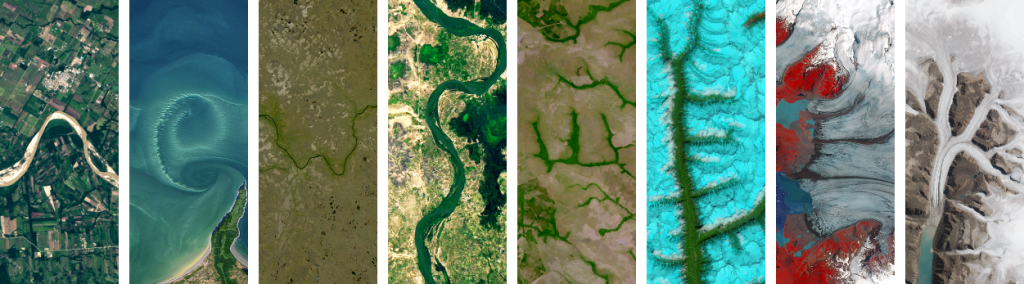
NASA has launched an innovative tool that allows users to find their name embedded in satellite images of Earth. This interactive project, called “Your Name in Landsat,” was released in celebration of Earth Day 2025 and is part of the Landsat program—a collaboration between NASA and the U.S. Geological Survey (USGS). The Landsat initiative has been capturing detailed imagery of Earth for over five decades, providing critical data for scientific research and environmental monitoring.
The tool offers a unique way for people to explore how their names might appear as letter-shaped formations on Earth’s surface through satellite imagery. Users can create personalized designs by visiting the official website, where they can input their name and see how it might be represented using real-world geographic features.
The tool has captured the attention of many online, including TikTok user Kyle Werly (@kylevacations), who shared a video showcasing the feature. The clip received over seven million views, with many viewers expressing excitement about the concept. One comment read, “I CAN FIND MY UNIQUE NAME?!” while another said, “This is healing the little girl in me who couldn’t ever find her name on a keychain.” Another user joked, “I would’ve def gotten a computer virus in 2003,” highlighting how surprising and impressive the tool is.
Some users took the opportunity to connect the tool to personal experiences. One person noted that the letter “B” in their wife’s name appeared in their hometown, calling it “kinda neat.” Others suggested that if the first design wasn’t to their liking, they could try again, as multiple versions of each letter are available.
NASA has continued to make headlines with various projects and announcements. Recently, the space agency shared updates on the Artemis III mission, which aims to send astronauts back to the Moon. The rocket for this mission has already been transported to the Kennedy Space Center in Florida. A NASA administrator stated that the mission is bringing them closer to testing the capabilities needed for future crewed missions to Mars.
In addition to lunar exploration, NASA has also been monitoring celestial events. Earlier this month, the agency tracked an asteroid that passed extremely close to Earth—an occurrence so rare that it happens only once every few thousand years. This event underscored the importance of NASA’s ongoing efforts to monitor and understand space threats.
NASA has also announced plans for a new initiative called “NASA Force,” aimed at recruiting industry experts to support its upcoming missions. The program seeks highly skilled engineers, technologists, and innovators to help achieve groundbreaking goals in space exploration.
While the developers of the “Your Name in Landsat” tool have not yet responded to requests for comment, the tool has already sparked widespread interest and engagement from the public. It serves as a reminder of how technology can make complex scientific data accessible and fun for everyone.