A New Class of Galactic Structures Emerges
A newly reported population of vast, thread-like structures stretching across several light-years has been identified near the center of the Milky Way, offering a striking new clue about the behavior of Sagittarius A. The discovery points to previously unseen activity tied to our galaxy’s central black hole, raising fresh questions about how it shapes its cosmic environment.
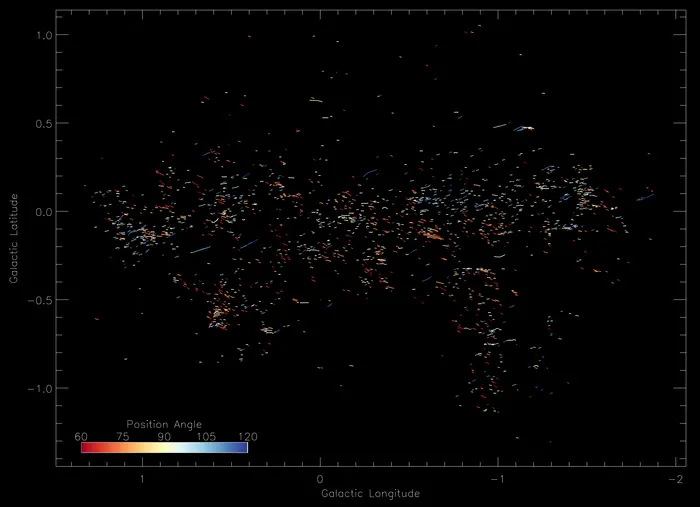
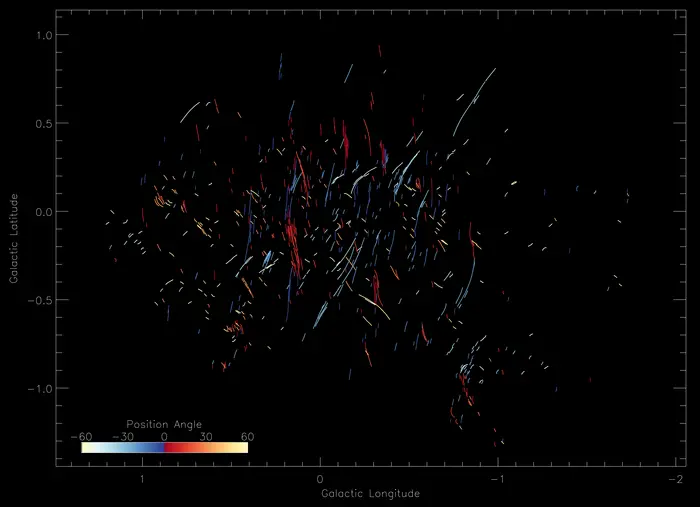
The discovery reveals elongated, one-dimensional filaments measuring between 5 and 10 light-years, positioned horizontally along the galactic plane, an orientation that sharply contrasts with previously known vertical filaments. These structures appear to radiate toward Sagittarius A, suggesting a direct physical link with the supermassive black hole. Unlike earlier observations, which documented towering vertical filaments extending up to 150 light-years, this newly identified population introduces an entirely different geometry and behavior within the same region.
The study highlights how these filaments are composed of energized particles interacting with magnetic fields, though their emissions indicate thermal processes rather than the relativistic motion seen in their vertical counterparts. This distinction signals that the two filament populations likely originate from different mechanisms. The horizontal alignment, combined with their clustering on one side of the galactic center, points to a past energetic event rather than a random distribution.
“It was a surprise to suddenly find a new population of structures that seem to be pointing in the direction of the black hole,” Farhad Yusef-Zadeh said. “I was actually stunned when I saw these. We had to do a lot of work to establish that we weren’t fooling ourselves. And we found that these filaments are not random but appear to be tied to the outflow of our black hole. By studying them, we could learn more about the black hole’s spin and accretion disk orientation. It is satisfying when one finds order in a middle of a chaotic field of the nucleus of our galaxy.”
MeerKAT Telescope Unlocks Hidden Details
The breakthrough was made possible through observations conducted with the MeerKAT radio telescope in South Africa, a cutting-edge instrument known for its sensitivity and resolution. By applying advanced imaging techniques that remove background noise and isolate faint structures, researchers were able to reveal features that had remained invisible in earlier surveys.
“The new MeerKAT observations have been a game changer,” he said. “The advancement of technology and dedicated observing time have given us new information. It’s really a technical achievement from radio astronomers.” These refined observations enabled scientists to distinguish the horizontal filaments from surrounding emissions and confirm their organized structure. Without such technological progress, these faint and extended features might have remained undetected, buried within the complex radio environment of the galactic center.
A Radical Shift From Vertical Filament Paradigms
For decades, astronomers have studied vertical filaments rising perpendicular to the Milky Way’s plane, associating them with strong magnetic fields and near-light-speed particles. The newly identified horizontal filaments disrupt that long-standing framework. They run parallel to the galactic plane and exhibit thermal emission, indicating slower-moving material interacting with nearby molecular clouds.
“We have always been thinking about vertical filaments and their origin,” he said. “I’m used to them being vertical. I never considered there might be others along the plane.” This shift in orientation forces scientists to reconsider how energy and matter flow around Sagittarius A. The contrast between vertical and horizontal structures suggests multiple phases of activity, possibly tied to different epochs in the black hole’s history.
Clues Point To An Ancient Black Hole Outburst
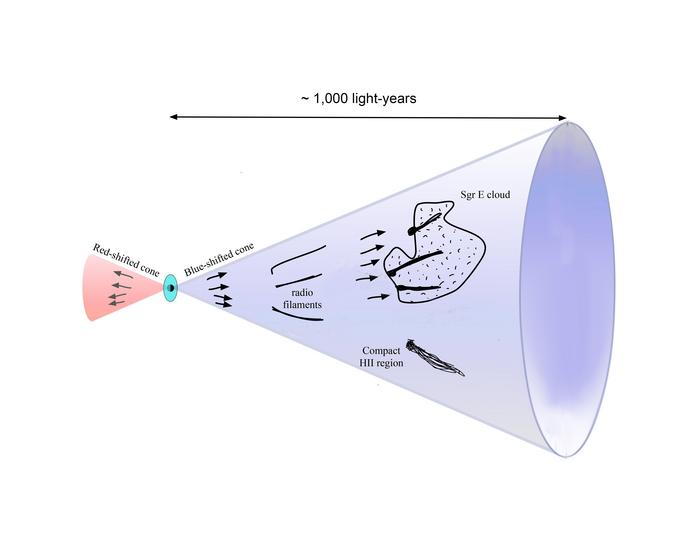
Evidence increasingly supports the idea that these filaments formed as a result of an energetic outflow from Sagittarius A millions of years ago. Their alignment and distribution imply they were shaped by material expelled during a past active phase, interacting with surrounding gas and dust as it moved outward.
“One of the most important implications of radial outflow that we have detected is the orientation of the accretion disk and the jet-driven outflow from Sagittarius A* along the galactic plane,” Yusef-Zadeh said. This insight provides a rare opportunity to infer the geometry and dynamics of the black hole’s accretion processes, which are otherwise difficult to observe directly.
“We think they must have originated with some kind of outflow from an activity that happened a few million years ago,” Yusef-Zadeh said. “It seems to be the result of an interaction of that outflowing material with objects near it. Our work is never complete. We always need to make new observations and continually challenge our ideas and tighten up our analysis.” These statements underline how the discovery opens more questions than it answers, pointing to a dynamic and evolving galactic core.