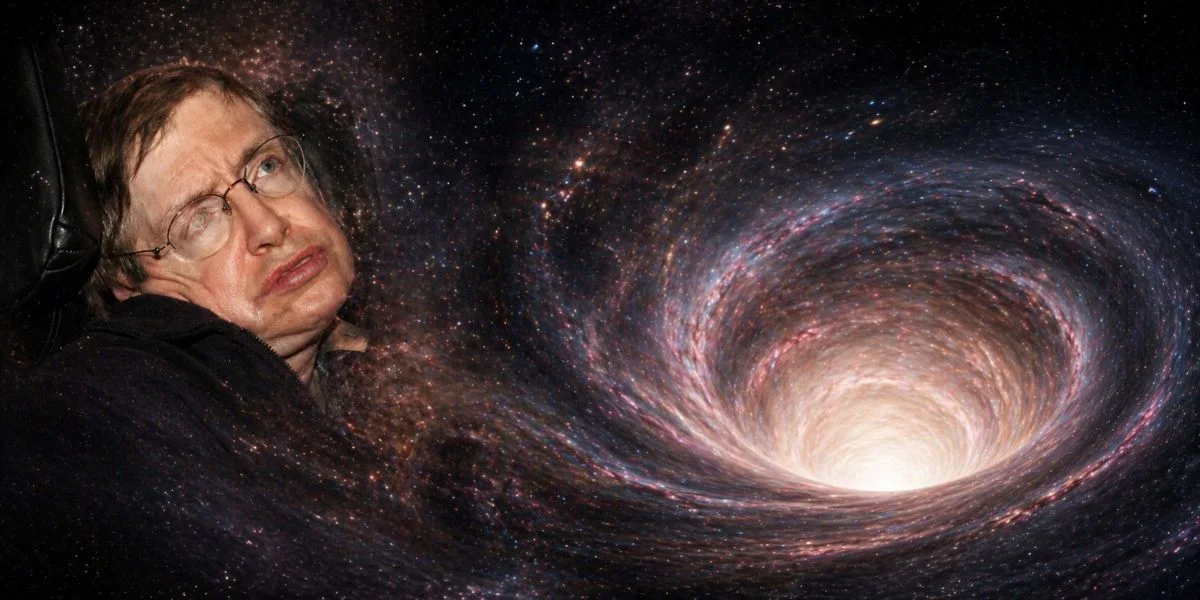
The Enigma of Black Holes and the Challenge of Information Loss
Stephen Hawking’s groundbreaking discovery that black holes emit radiation fundamentally altered scientific understanding in the 20th century. This process, known as Hawking radiation, suggests that black holes gradually lose mass over time, eventually leading to their complete evaporation. However, this raises a critical question: if a black hole disappears, what happens to the information it once contained? According to some theories, this could violate the principles of quantum mechanics, which state that information cannot be destroyed.
This paradox has sparked decades of debate among physicists. Various hypotheses have emerged to address this issue. For instance, the holographic principle proposes that all the information within a black hole is encoded on its boundary, while the firewall hypothesis challenges our understanding of what occurs at the event horizon. Despite these ideas, no definitive solution has been reached, and the mystery remains unsolved.
A New Perspective on Spacetime
A recent study by researchers from Denmark and Slovakia offers an alternative approach to resolving this conundrum. Their work explores the possibility that spacetime possesses a more complex structure than previously thought. Before introducing additional dimensions, the model highlights a less-discussed concept: torsion. Unlike curvature, which describes how spacetime bends, torsion refers to a twisting effect that may arise under extreme gravitational conditions.
The researchers expand on this idea by proposing that spacetime consists of seven dimensions. Three of these are compact and effectively hidden from our perception. Co-author Richard Pinčák of the Slovak Academy of Sciences explains:
“We experience three dimensions of space and one of time – four dimensions in total. Our model proposes that the universe actually has seven dimensions: The four we know, plus three additional tiny dimensions, curved so tightly that we cannot perceive them directly.”
According to the authors, the combination of extra dimensions and torsion changes the way black holes evolve at very small scales. This new framework could provide insights into how information is preserved during the life cycle of a black hole.
A Possible Outcome
The model suggests that the complete evaporation of a black hole may never occur. Instead, as a black hole shrinks, the underlying geometric effects could halt the process. Pinčák offers an analogy to illustrate this idea:
“Imagine throwing a book into a fire. The book is destroyed, but, in principle, you could reconstruct every word from the smoke, ash and heat – the information is scrambled, not lost.”
In this context, the comparison highlights the expectation in quantum theory that information persists, even if transformed. Applied to black holes, the authors propose that a tiny remnant could remain. This object, theoretically far smaller than an electron, may retain the information that fell into the black hole. Whether this idea holds up is still an open question.
Broader Implications
The same framework has been tentatively linked to other unresolved issues in physics, including the origin of particle mass and the nature of dark matter. While these connections are speculative, they point to a broader ambition: a unified explanation rooted in spacetime geometry.
For now, the theory remains untested. Researchers are examining indirect signals, such as cosmic background radiation and primordial gravitational waves. If confirmed, the implications would be far-reaching. If not, it will join a long list of attempts to reconcile gravity with quantum mechanics.
Ongoing Research and Future Prospects
Despite the theoretical nature of the model, it represents a significant step forward in the quest to understand black holes and the fundamental laws of the universe. As scientists continue to explore the mysteries of spacetime, new discoveries may one day provide answers to some of the most profound questions in physics. Until then, the search for a unified theory remains an ongoing challenge, driven by curiosity and the relentless pursuit of knowledge.