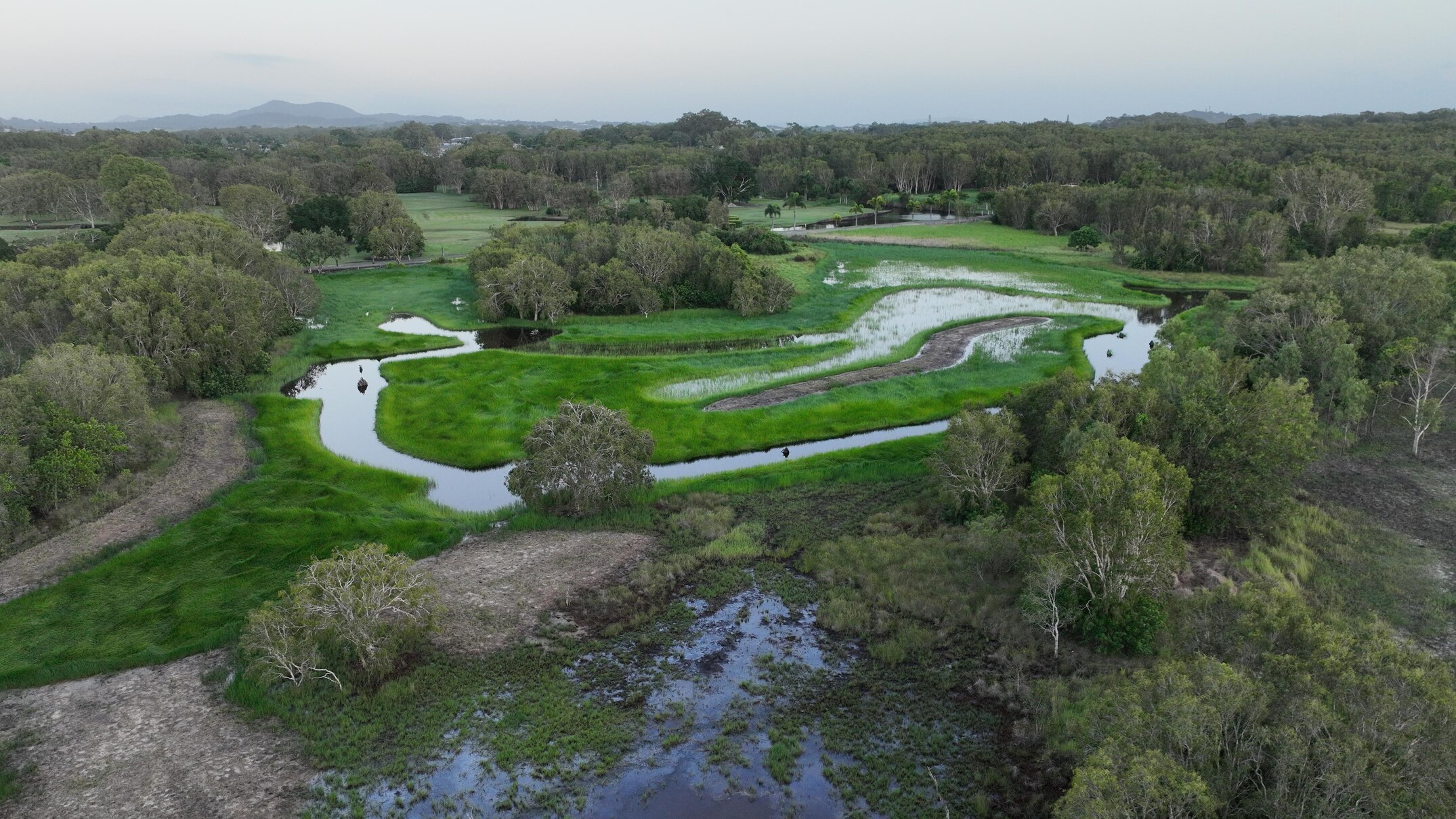
The Tide is Turning in Coastal Queensland
In parts of coastal Queensland, a significant transformation is taking place. Conservation groups, traditional owners, and landholders are working together to remove tidal gates and barriers that have restricted the flow of salt water into coastal wetlands for over 50 years. This effort is already showing promising results as signs of life return to these ecosystems.
Letting Nature Take Over
In north Mackay, Christopher Rek has spent decades raising cattle on his family’s land. Now, he is allowing the ocean to reclaim parts of it. “Mackay’s getting built in and the animals are running out of space,” said the 60-year-old. “I stole from nature by using all my cows and now it’s time to give the land back and let nature do its thing.”
An environmental restoration company approached Mr. Rek to remove tidal gates that had previously prevented salt water from entering his property. New channels and “refuge pools” were created to retain water and support the native ecosystem.
Matt Moore, a fisheries ecologist with Catchment Solutions, emphasized the importance of restoring the connection between land and sea for biodiversity. “The floodgates are real bad barriers,” he said. “They blocked nearly all migration [of] species that spawn down in the estuary and migrate upstream, searching out freshwater habitats to use as nursery areas.”
Recent testing showed juvenile fish exploring the new wetlands. “We set up some box traps here to monitor the fish coming in and we’ve got approximately 20 barramundis in a couple of days moving through, which is fantastic to see,” Mr. Moore added.
A Historical Approach
These barriers were installed widely across Queensland in the 1960s and 1970s to support the growing agricultural industry and the spread of hymenachne, a grass introduced as cattle fodder. While productive, this species invades native habitats and is now listed as a weed of national significance.
Restoring Flow
Across the Mackay region, there are an estimated 500 to 600 barriers to tidal flow, with thousands more across Queensland. As knowledge of wetland ecosystems improves, efforts to remove these barriers have gained momentum.
Lynise Wearne, associate director for water at Greening Australia, said: “It certainly has become a bigger issue as we understand a lot more around the importance of these systems.” Beyond the immediate ecosystem benefits, Dr. Wearne highlighted the global importance of soils, mangroves, and other plants that thrive in these systems.
“We’re getting carbon sequestration by reintroducing these tidal flows back into these wetlands,” she said. “There’s also a lot of benefits in these freshwater wetlands, so we want to make sure any change that we make won’t actually have negative impacts either.”
People, Nature, and Spirit
More than 80 kilometres south, a similar restoration effort is underway in Cape Palmerston National Park. For the Yuwi people, the traditional owners of the area, the work carries cultural significance.
Before the park was gazetted in 1976, the landscape was altered, hymenachne planted, and a 60-metre-long bund — or embankment — built to block tidal flow. The Yuwi Aboriginal Corporation, Greening Australia, and Queensland Parks and Wildlife Service dug a 7-meter channel through the bund earlier this year.
Bronwin Tonga, a Yuwi woman and head ranger, described the moment as a powerful intersection of cultural knowledge and science. “Walking in both worlds with science and that cultural science … it’s been amazing,” she said. “For us, it’s about protecting important ecosystems like the mangroves and wetlands, and maintaining the balance between people, nature, and spirit.”
The park borders the southernmost area of the Yuwi native title land. Aunty Deb Clark, who is also working on the project, said Yuwi elders who had not visited the area were invited to witness the efforts. “For them to touch feet on country, it was a very, very special and spiritual moment,” Aunty Deb said.
The returning salt water has already killed off about 80 per cent of the hymenachne. The Yuwi people are considering reintroducing cultural burning practices for the ongoing maintenance of the restored area. “It’s a cultural responsibility we have to look after our country and heal it,” Aunty Deb said. “Our aspiration is this would be the first in many to come. Hopefully that will bolster other opportunities to work on other areas on country.”
Gaining Momentum
The work reflects a broader shift in how wetlands are valued and managed in Queensland. For the Yuwi people, it is also strengthening the bonds between generations. “As much as it’s for us and our elders, we have a lot of young rangers here, so it’s a real learning curve for them as well,” Aunty Deb said. “To be able to share the special connection we have with our southern boundary of our native title area … it’s just been a project that we both hold really dear to our hearts.”