
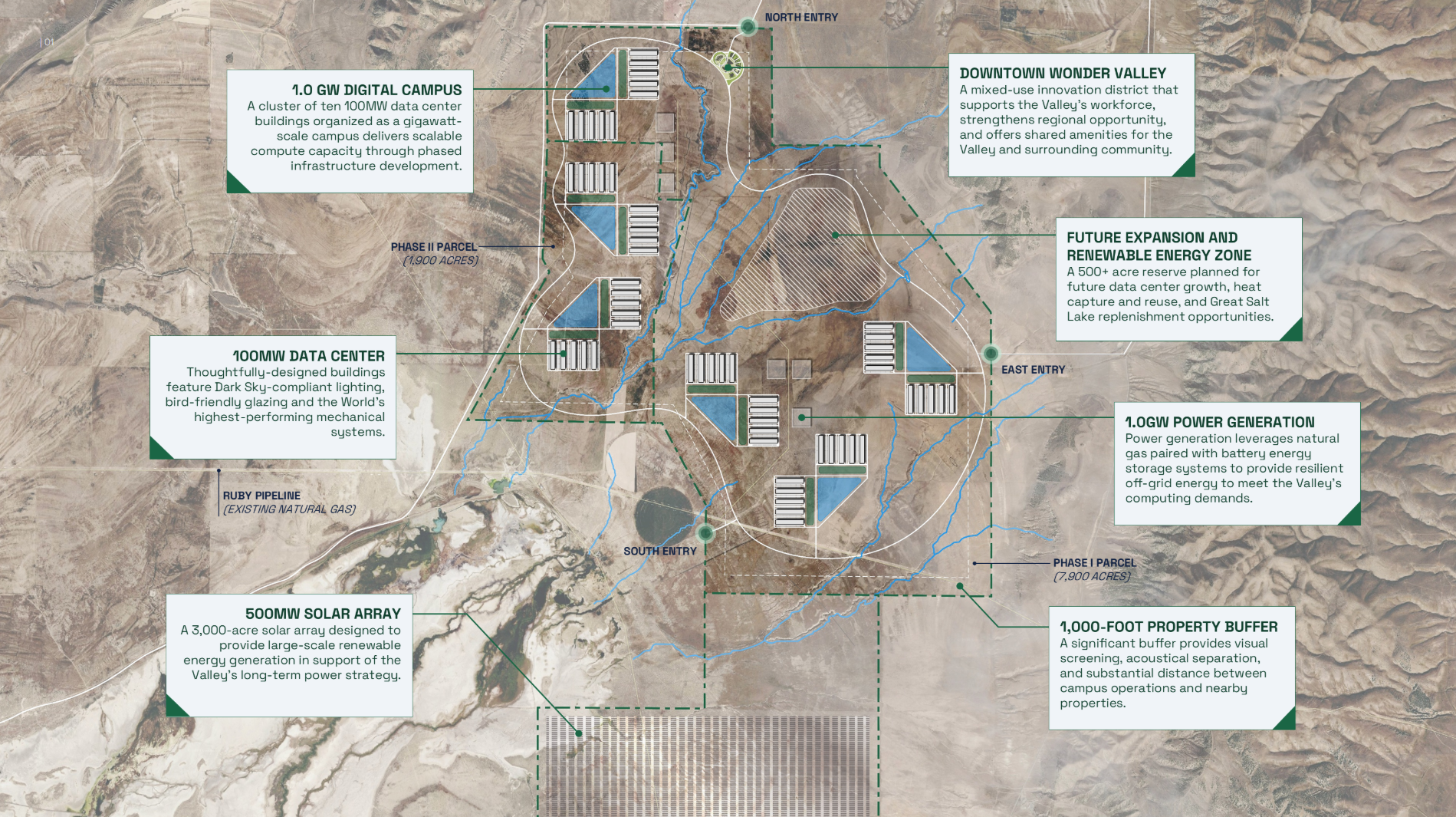
What could be one of the world’s largest data centres – the warehouses that power AI – could dump 23 atomic bombs’ worth of energy per day. The 40,000-acre Stratos Project Area, which would be kept ticking by a gas power plant, was approved by Box Elder County in Utah this month. It will eventually gobble up about 9GW of power every single day – the UK generated 22.7GW of power yesterday, according to the National Grid.
In other words, the $1 billion data centre will get hot. Seriously hot, Utah State University physics professor Dr Rob Davies told [source]. He estimated that the proposed campus and its power plant could dump energy equivalent to 23 atomic bombs per day into Hansel Valley. By atomic bombs – which release energy in a single flash – Dr Davies says this to help picture what a constant flow of heat in a basin amounts to.
If you need more analogies, it’s the equivalent of: ‘40,000 Walmart Supercenters, 2-3 New York Cities and 13 Back To The Future DeLorean time machines.’ It could even raise local daytime temperatures by 1°C to 3°C and up to 6°C at night.
‘As proposed, this facility will be one of the largest single-point heat sources on the planet,’ Dr Davies says. ‘Unlike essentially everything else, where the waste heat is spread out over large regions – a hair dryer here, a light there, a car here, an aeroplane there – the Stratos project is highly concentrated. The power plant produces huge amounts of waste heat just in generating the power for the data centre, then the data centre uses that energy, which immediately turns to waste heat.’
What is a data centre? And why are they so power-hungry?
Data centres are made up of computers packed with 100,000 little silicon chips, once used for video games, called GPUs. When wired together, these chips can store, process and run AI systems. But these supercomputers require colossal amounts of energy on top of millions of gallons of water per day for cooling systems.
Tech giants say investments in data centres will be worth it. AI will one day bring about the ‘singularity’, as one Google boss told [source] last week. Locals, however, are concerned about data centre energy usage. When Utah officials approved the site on May 4, hundreds of protesters flooded the Box Elder County Fairgrounds.


County Commissioner Boyd Bingham told them: ‘For Hell’s sake, grow up.’ Kevin O’Leary, a venture capitalist among the project’s backers, has claimed the protesters aren’t locals and were paid to object. ‘I don’t know [by] who,’ he said. ‘They’re being bused in.’ Campaigners have since filed an application challenging the approval.
The Stratos Project’s ‘plain-language’ website says that the facility will consume ‘more than twice what the entire state of Utah currently uses’. It adds that the location – in the middle of the Utah desert near Snowville – was ‘deliberately’ chosen to reduce noise, heat and light pollution. The website details how the ‘giga-centre’ will cough out carbon dioxide, a planet-warming gas caused by burning fossil fuels.
An impact analysis says Stratos is expected to raise the state’s climate change pollution by about 50%. This is something that worries Dr Davies, as environmentalists warn it could imperil the Great Salt Lake, including a rare migratory bird habitat.
‘The Great Salt Lake system is an economic, ecological and cultural bedrock of the region,’ Dr Davies adds. ‘The Stratos project is an additional stressor – almost certainly a large stressor – on a system already in collapse.’
O’Leary recently said on X: ‘We’re not gonna drain the Great Salt Lake. That’s ridiculous. We are gonna create incremental jobs.’ Developers O’Leary Digital say the site is ‘built clean’ and will include measures to protect the environment. Stratos and O’Leary Digital say that the electricity demand won’t raise energy bills, while the governor’s office says it won’t overwhelm the grid.
The Stratos development won’t be built anytime soon. It could take two years to be approved by Utah’s Department of Environmental Quality.
How many data centres are there?
There are around 12,000 data centres across the world, with 500 in the UK. The UK government wants to build more to embrace AI. Proposed sites include:
- North Lincolnshire
- Northumberland, near Blyth
- Havering, London
- Motherwell, North Lanarkshire
- North Lincolnshire, near the Humber Estuary
- Near Heathrow Airport, London
- Iver, Buckinghamshire
Dr Davies feels that the push for data centres is being supported by wealthy backers or politicians with ‘financial interests’. ‘Public trust has been eroded, and is unlikely to be restored unless a genuine, transparent, independent assessment is undertaken,’ he adds.
The Military Installation Development Authority (MIDA), a state agency overseeing the project, stressed to [source] that the site won’t inhale 9GW of energy from the get-go. ‘The 9GW figure represents an anticipated full build-out target. The first phase of construction will be a fraction of that capacity, and reaching the projected full scale will take many years of phased construction, regulatory review, and infrastructure development,’ the agency said. ‘The “23 atom bombs per day” energy calculation that has appeared in recent coverage applies the full build-out projection as if it were today’s project, when in reality the early-phase thermal load will be roughly an order of magnitude smaller.’
Box Elder County has been approached for comment.
The race to build ever more powerful artificial intelligence systems is starting to collide with some very real-world environmental concerns. Google executives are also openly talking about humanity approaching the AI ‘singularity’ just as vast new data centre projects spark warnings over heat, water use and soaring energy demand…


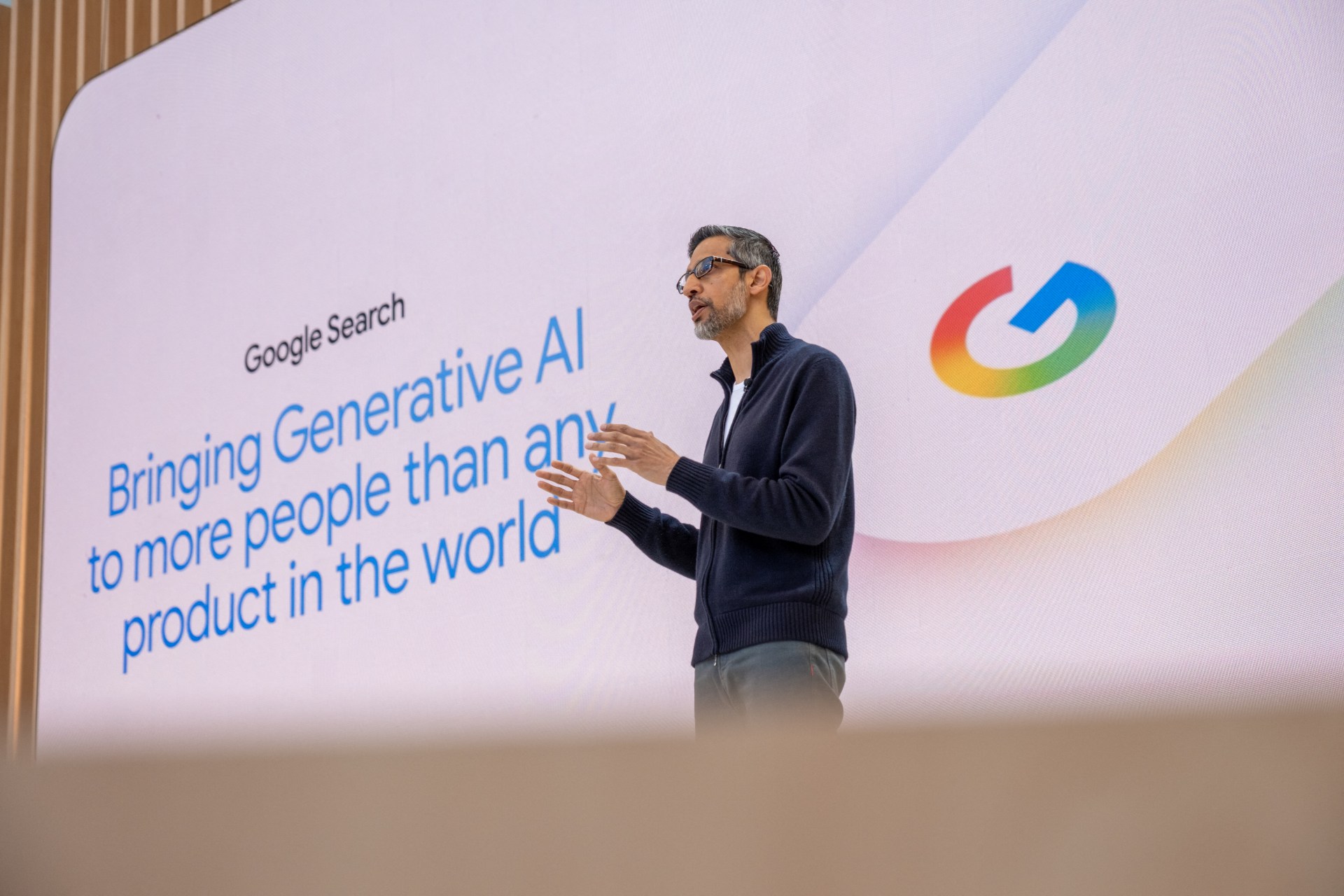
Beep beep boop. Beep beep – boop. This could be how we’ll all talk one day if Google’s predictions about humanity’s future come true. Well, kind of. [source] attended the tech giant’s annual developer conference, Google I/O, in Mountain View, California, last week. To gasps from attendees – including – Demis Hassabis, the CEO of Google’s AI lab, DeepMind, said: ‘When we look back at this time, I think we will realise that we were standing in the foothills of the singularity.’
But those gasps also came from Google’s product lead for science AI, Lizzie Dorfman. Wait, what is the ‘singularity’?
The singularity is the theoretical moment when AI – that tech that currently spits out Love Island fruit videos – becomes smarter than humans. This would open up a world where people could augment themselves with millions of times more computational power than their brains naturally possess.
‘That word, “singularity”, really registered with me,’ says Dorfman. ‘Singularity means, mathematically, that you spew off into infinity all of a sudden. It will be the inflection point where we move into a different regime of how quickly we can do the work that would have historically taken years or even decades, now only taking months or even shorter.’


Dorfman, who has been with Google for nearly two decades, has already seen this in action. Most science isn’t pouring colourful liquids into beakers – it’s coding tests on powerful computers, now often using AI tools.
‘What is the slowest, most laborious part of what we do? That’s what we were trying to focus on,’ she says. ‘I’ve watched scientists go, “I used to have to code this myself, and now I have this tool, I tell it what I want it to do, and then I go to sleep. When I wake up in the morning, it’s explored 1,000 different things”.’
The future is ‘exciting’ to people like Dorfman because the singularity means people could try out ’10 different things’ in a flash. ‘I think that there’s also going to be an expected fundamental shift in the productivity and outputs of science,’ she adds.
The biggest things from Google I/O

Google unveiled a raft of new shiny gadgets at its conference last week. For the first time in 25 years, Google is overhauling its search bar – that little white box where you once typed simple things like ‘movie times’. Soon, AI will do the Googling for you. An ‘intelligent’ search box will expand as you type and ask follow-up questions on the search page. These features will be powered by a new AI model, Gemini 3.5 Flash.
It will also let users build graphics when Googling complex things – when we gave it a whirl by asking how cats see, it generated an interactive diagram of a feline eye. Gemini will even appear in your glasses. A new model of the smart specs, Android XR, will come with a camera, a microphone and speakers, allowing people to ask Gemini about their surroundings or to order coffee online from a cafe.
When we tried out a prototype of the glasses, a Google worker spoke Spanish. 
From our bespectacled POV, the glasses translated his words into English, appearing like holographic subtitles. (Said Google staffer also laughed when we gasped as it did this.)
We also saw a live demo of Wing, the delivery unit of Google’s parent company, Alphabet. These buzzy drones lowered packages filled with Google-branded badges to us on a hook. A Google employee told us that the company wants to eventually roll out Wing more broadly – it’s already being trialled in some suburbs of Ireland and as a service for NHS hospitals.
Mapping our brain – with the help of an artificial one
As brainy as AI is right now, it struggles to generate an image of a human brain. ‘I’ve asked Gemini to create an image of a brain, just to see what it looked like,’ Dorfman says. (It needed a few more wrinkles.) But in the tech’s defence, she stresses, neither can we.
Mapping the brain is no easy feat. It took a decade for scientists to sketch out the poppy seed-sized brain of a fruit fly, its electrical wiring and neurons stretching the length of four blue whales. The human brain is made of billions of nerve cells alone, and there are thousands of cells that we still have no clue about what they do.
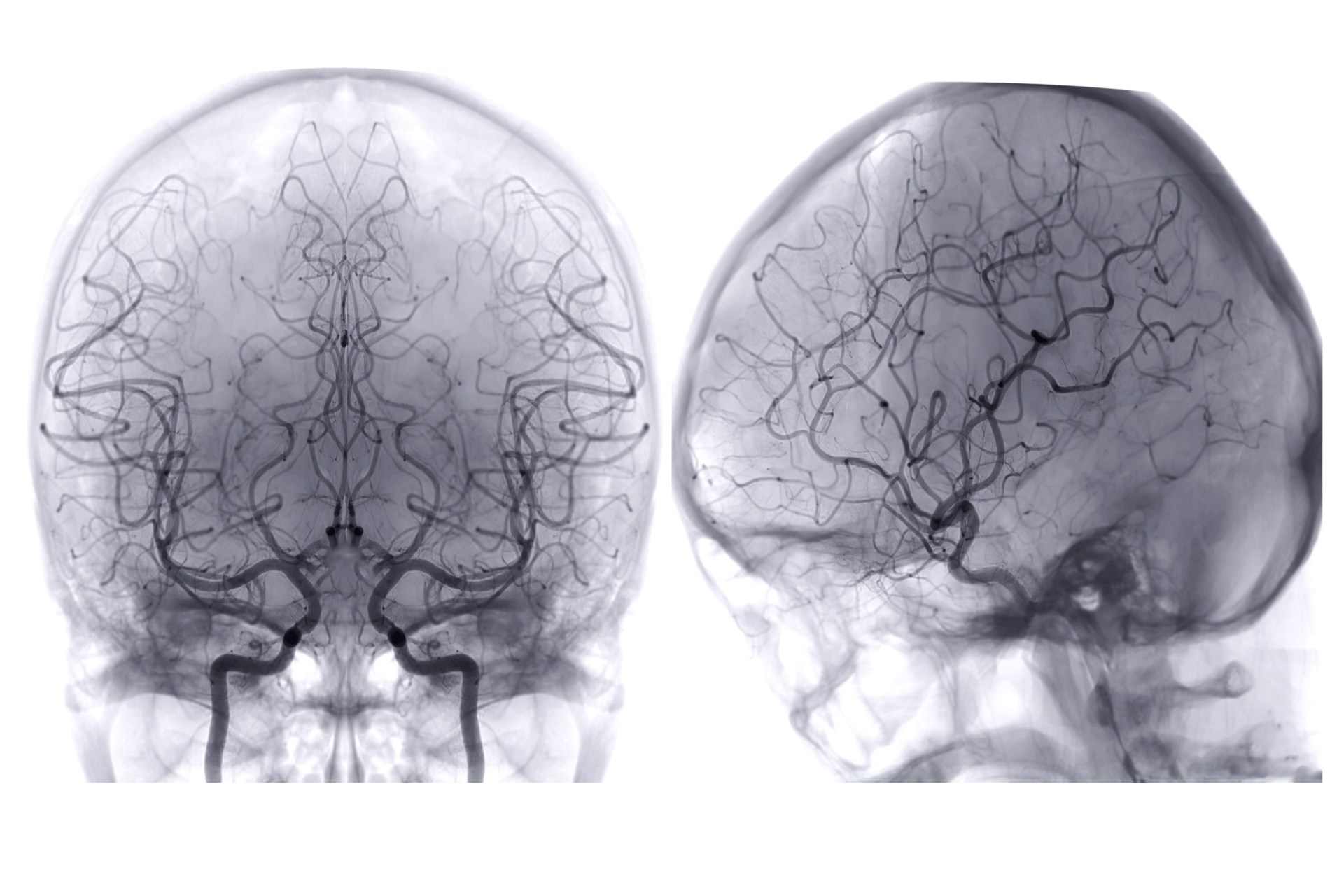
Dorfman says that, when you know how every part of a car engine works, you know what to do when it breaks down in the middle of the road. So having a map of the brain could help us treat neurodegenerative diseases like Alzheimer’s and Parkinson’s, or mental health conditions like depression.
This is why Dorfman has spent the better part of a decade working on the technology that can map things a billionth of a metre in size. ‘You fix the brain in resin to make it hard, then slice it thin – a couple of nanometres – and image it in a microscope,’ she says. ‘Our team takes all the data and structures it in three dimensions.’
Researchers want to map the 75 million neurons that make up a mouse brain next. 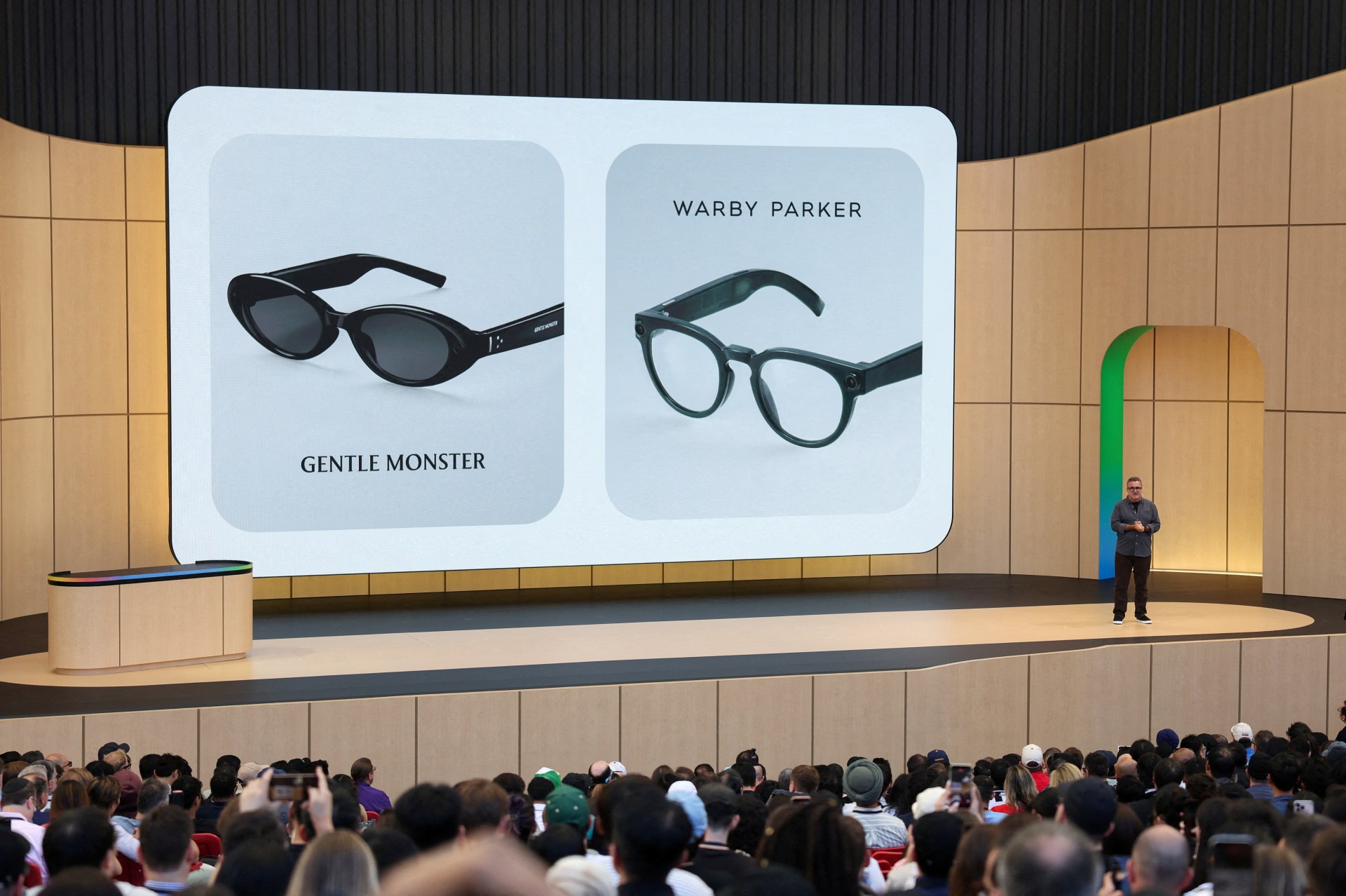
‘Then, one day, a human brain, which has about 80 billion neurons,’ Dorfman says. The irony that scientists are using machines, like Gemini for Science, to understand what makes people human isn’t lost on Dorfman. She points to a study that saw people living with epilepsy have their brains scanned while listening to a podcast. The researchers fed the podcast to an AI, comparing how the brain hears a word to how AI processes one.
Both humans and AI ‘predicted’ the next words in similar ways – so maybe the singularity isn’t all that far off then. ‘I think there are many more opportunities that look like that,’ Dorfman adds.