Artificial intelligence (AI) is proving to be a powerful tool for saving money, going far beyond just streamlining workflows and managing daily tasks. It can also help reduce grocery expenses in various ways. I decided to test this by using my most recent supermarket shopping list to see how much I could save with the help of AI.
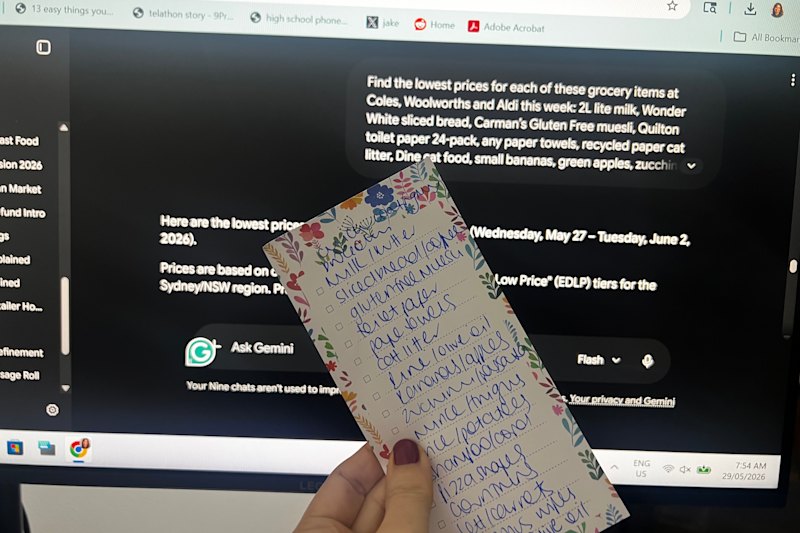
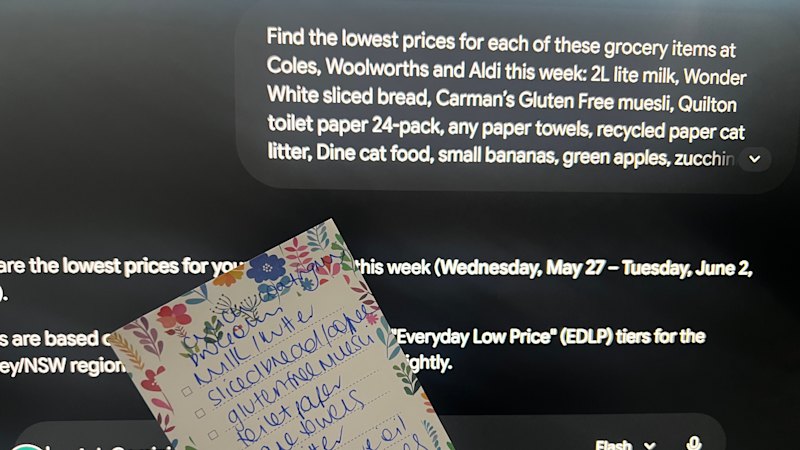
The results were surprising, helping me save more than just money. The items on my list included: milk, sliced bread, Carman’s Gluten Free muesli, toilet paper, paper towels, cat litter, Dine, bananas, green apples, zucchini, chicken mince, chicken thighs, microwave rice, potatoes, shampoo and conditioner, Pizza Shapes, Corn Thins, lettuce, carrots, hummus, baby wipes, Butter Soft, broccolini, Tandaco chicken coating mix, Moccona Indulgence, olive oil, and passata.
My first mistake was entering the list as is without specifying the exact brands and sizes I wanted. After updating the list, it read: 2L lite milk, Wonder White sliced bread, Carman’s Gluten Free muesli, Quilton toilet paper 24-pack, any paper towels, recycled paper cat litter, Dine cat food, small bananas, green apples, zucchinis, chicken mince, chicken thighs, microwave rice, potatoes, Garnier shampoo and conditioner, Pizza Shapes, Corn Thins, lettuce, carrots, hummus, baby wipes, Butter Soft, broccolini, Tandaco chicken coating mix, Moccona Indulgence, olive oil, Mutti passata.
AI is only as effective as the prompt used when seeking information. For products where I wanted specific brands and sizes, I needed to be more precise. For others, where I didn’t mind the size or version, I could be more general.
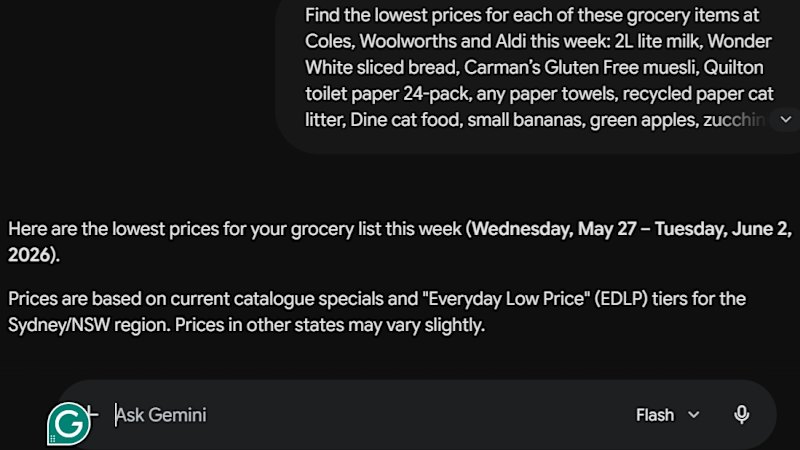
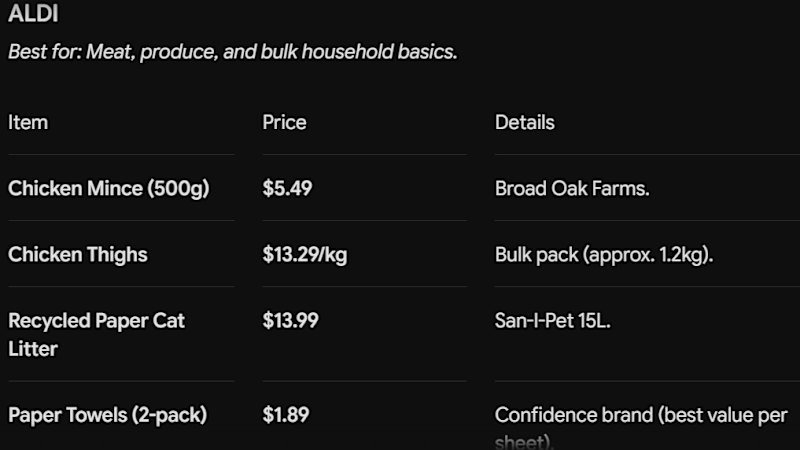
I created an AI prompt that read: “Find the lowest prices for each of these grocery items at Coles, Woolworths and Aldi this week.” Then I copied and pasted the list. The result was an itemised list of each product, showing where the lowest price could be found, along with the price, categorised into “Pantry & Household Essentials,” “Fresh Produce & Meat,” and “Health, Beauty & Snacks.”
I was also given an AI Pro Tip: “If you’re buying the Carman’s Muesli and Garnier Shampoo, hit Woolworths and Coles respectively, as the 50 per cent off deals this week make a massive difference to your total.”
Then I asked, “Which of these stores is closest to you, or are you planning a multi-stop run to grab all the specials?” I didn’t answer because my next prompt read: “Organise this under the headings Coles, Woolworths, and Aldi.”
As though it had come up with the idea on its own, the AI responded: “To make your shopping trip easier, I’ve reorganised the list by store. This highlights the best value items at each location based on current specials and everyday low prices.”
I do my grocery shopping at a centre that has all three stores, making it easier for me to take advantage of weekly specials. I received the following organised lists and encouraging comments from AI:
Coles
Best for: Bread, half-price hair care, and specific pantry specials.
– Wonder White Sliced Bread: $4.00 (On special)
– Garnier Shampoo & Conditioner: $4.50 (Half-price special)
– Dine Cat Food: $0.95 (When buying 10 for $9.00)
– Mutti Passata: $2.50 (On special)
– Chicken Thighs: $14.50/kg
– Iceberg Lettuce: $2.50
– Broccolini: $3.00 (Per bunch)
– Butter Soft (500g): $5.50
– Tandaco Chicken Coating: $2.30
Woolworths
Best for: Health food deals, coffee, and bulk paper products.
– Carman’s GF Muesli: $5.00 (Half-price special)
– Moccona Indulgence (100g): $11.00 (On special)
– Quilton Toilet Paper (24-pk): $12.50
– Pizza Shapes: $2.00
– Chicken Mince (500g): $6.00
– Lite Milk (2L): $3.55
– Green Apples: $4.50/kg
– Carrots (1kg bag): $1.50
Aldi
Best for: Staples, produce, and pet supplies.
– Recycled Paper Cat Litter (15L): $13.99
– Microwave Rice Pouches: $1.60
– Paper Towels (2-pk): $1.89
– Olive Oil (1L): $14.00
– Baby Wipes (80-pk): $1.95
– Small “Lunchbox” Bananas: $3.90/kg
– Potatoes (2kg bag): $4.00
– Zucchinis: $5.90/kg
– Corn Thins: $2.00
– Hummus (200g): $2.20
I then asked it to order the Coles and Woolworths items online for delivery to my home, which would leave me with only Aldi to visit. However, I was told: “I can’t directly log into your accounts or process payments for you (my digital hands are tied when it comes to your credit card!), but I can make the process significantly faster. As of May 2026, both Coles and Woolworths have updated their apps to allow for ‘Smart List’ imports.”
All very useful advice. Taking these steps has saved me a good hour, during which I would normally sit down with my grocery list, visit all the apps, and manually figure out where to find the lowest prices possible for the items I needed that week.
This is only the beginning of how AI can help shoppers save. You can also seek help building lower-cost meals, ask about swapping expensive ingredients for cheaper alternatives, enter your list and ask it to identify unnecessary purchases (although, this could feel a bit judgmental), and request tips to reduce food waste.
Another useful prompt could be: “Here is my weekly shopping list. Rewrite it to reduce the cost by 30 per cent while keeping it healthy for my family,” or “Turn this shopping list into home brands or Aldi products only.”
Then there are even more savings to be had. But remember not to thank the AI for its help, because a. It’s a robot and b. That’s a little creepy.
AI is most helpful when it comes to saving on grocery prices by using a platform that is independent of individual retailers, so I used Gemini. AI features within the individual supermarket apps can only assist you in making purchases from that retailer, which isn’t as effective as shopping across multiple retailers has been proven to be.